The Unfair Advantage: How Startups Can Weaponize Business Intelligence
Unlock growth with business intelligence for startups: a first-principles guide to data, KPIs, and a lean tech stack.
Nov 19, 2025

Let’s get one thing straight. Business intelligence for startups isn’t about buying some clunky, enterprise software suite that costs more than your first hire. That’s legacy thinking. For us, it’s a mindset. It’s about building a central nervous system for your company that routes the right information to the right person at the right time, enabling high-leverage decisions.
Seeing The Signal In The Startup Noise
Founders operate in a blizzard of data. You’ve got customer feedback pings, sales alerts, marketing clicks, and server logs all screaming for your attention. It’s pure chaos.
Customer feedback
Sales figures
Marketing clicks
Server logs
Your superpower isn’t drowning in this noise; it's spotting the signal. Every move you make—launching a feature, tweaking an ad campaign, hiring a key employee—is a bet. And without a data-driven cockpit, you’re flying blind.
BI isn't just a dashboard; it’s a real-time feedback loop. It tells you, with brutal honesty, if your bets are paying off. Look at Ray Dalio at Bridgewater. He built a multi-billion dollar hedge fund on a foundation of "radical transparency," where clear principles and data, not gut feelings, drive every decision. That's the game we're playing.
Building Your Operational Philosophy from First Principles
The real bottleneck isn't the tech; it's the culture. It's about shifting your team's thinking from looking at data to asking questions of data. It’s a first-principles approach.
Instead of just browsing charts, ask: “Which marketing channel is delivering customers with the highest LTV, not just the lowest CAC?”
Use that question to dictate what data you pull.
Ruthlessly identify the handful of metrics that are predictive, not just descriptive.
This forces you out of the vanity metric trap and focuses your attention on the few levers that actually move your startup forward. It’s how you maintain clarity when everything is on fire.
As a founder, your job is to build a machine that produces a desired outcome. Business intelligence provides the gauges and dials to see how well that machine is running and where it needs tuning. It's that simple.
The market proves this shift is happening:
The global BI market was valued at USD 31.98 billion.
Cloud-based BI—the lean, flexible stuff we use—now accounts for 53% of that total.
Startups are the engine behind this growth because we understand that agility and low overhead beat massive upfront capital dumps every single time.
Ultimately, this is about transforming raw data into actionable insights. To gain a comprehensive understanding of how raw data transforms into actionable insights, refer to this a comprehensive guide to business intelligence and reporting. It’s the difference between reacting to last month’s numbers and proactively engineering next month’s outcomes.
Applying The 80/20 Rule to Startup KPIs
As a founder, it’s easy to fall into the trap of thinking that more work always equals better results. But that's a myth. The most successful founders I know, people like Tim Ferriss, aren't just working harder; they're applying leverage. They've internalized the Pareto Principle—the 80/20 rule—which states that roughly 80% of your results come from just 20% of your efforts.
The exact same principle holds true for your data. Too many startups drown themselves in metrics, trying to track every single click, view, and sign-up. This doesn't create clarity; it just creates noise. The real purpose of business intelligence for startups is to slash through that noise and find the handful of KPIs that genuinely reflect the health of your business.
From Vanity to Viability
In the early days, vanity metrics are like candy. Total user sign-ups or a spike in social media followers look great on a slide deck, but they don't tell you if your business is a business. The real mark of a maturing startup is the shift from vanity metrics to viability metrics.
You have to deconstruct the problem. Ask yourself: which numbers, if they moved up or down, would fundamentally alter our company's future? The goal isn't a massive, 50-metric dashboard. It's a clean, 5-metric cockpit that tells you whether you're climbing or about to stall.
This is all about cutting through the clutter to find the signal that leads to real, actionable insight.

The image above perfectly illustrates this journey—from chaotic data points to a single, focused insight. That’s the entire point of a lean, startup-focused BI strategy.
Identifying Your North Star Metric
Think about the giants. Companies like Airbnb and Facebook achieved explosive growth by obsessing over one metric that captured the core value they provided. This is the North Star Metric (NSM). It’s not about revenue; it’s a measure of customer value that predicts future success.
For Airbnb, it was "nights booked." For early Facebook, it was "daily active users." Finding your NSM aligns your entire company. Suddenly, every team—from product to marketing—knows their job is to move that one number.
Your North Star Metric should answer the question: "If we could only focus on improving one thing, what would create the most sustainable growth?" Answering this simplifies every decision that follows.
This simple mental model forces you to boil your entire business down to its absolute essence. It’s the ultimate way to apply the 80/20 rule to your company's focus.
The Only Ratio That Really Matters
Beyond a single North Star, there's one critical relationship you absolutely must watch: the ratio between your Lifetime Value (LTV) and Customer Acquisition Cost (CAC).
LTV: This is the total profit you expect to make from an average customer over the entire time they're with you.
CAC: This is simply what it costs, in sales and marketing spend, to get a new customer in the door.
The LTV/CAC ratio is the ultimate health check for your business model. For a SaaS startup, a healthy ratio is often cited as 3:1 or higher. If you're at 1:1 or less, you are literally lighting money on fire with every new customer you sign. It’s a bright red warning light.
To dig deeper into the right metrics, it’s worth reviewing some essential sales KPIs for RevOps to see what drives these numbers. Keeping a close eye on this ratio forces you to have honest conversations about both your marketing efficiency and how much value your product truly delivers.
To help you focus, here’s a framework that breaks down the most important metrics by your company’s stage.
The 80/20 Startup Metrics Framework By Stage
This table applies the Pareto Principle to startup metrics, helping you focus on the vital few KPIs that matter most at each stage of your journey.
Growth Stage | Primary Goal | Vital KPIs (The 20%) | Metrics to Avoid (The 80%) |
|---|---|---|---|
Pre-Seed/Idea | Problem-Solution Fit | Qualitative Feedback, Interview Conversion Rate, Early Adopter Engagement | Total Users, Website Traffic, Social Media Likes |
Seed | Product-Market Fit | Activation Rate, User Retention (Cohort Analysis), Net Promoter Score (NPS) | Revenue (can be misleading), Daily Active Users (if not engaged) |
Series A | Scalable Growth Model | LTV/CAC Ratio, Churn Rate (Customer & Revenue), Month-over-Month (MoM) MRR Growth | Burn Rate (in isolation), Team Size, Press Mentions |
Series B & Beyond | Optimization & Efficiency | Gross Margin, Net Revenue Retention (NRR), Payback Period, Market Share | Total Funding Raised, Office Perks, Vanity Awards |
By focusing only on the "Vital KPIs" column for your current stage, you can avoid the distraction of metrics that, while interesting, don't drive core business outcomes right now.
Ultimately, this ruthless focus is about protecting your most precious resource: your attention. By concentrating on the few metrics that matter, you save the mental energy needed to solve the truly hard problems—building an amazing product, delighting your customers, and making the bold strategic moves that lead to real growth. Your BI system should be a tool for leverage, not a source of distraction.
Your Minimum Viable BI Stack
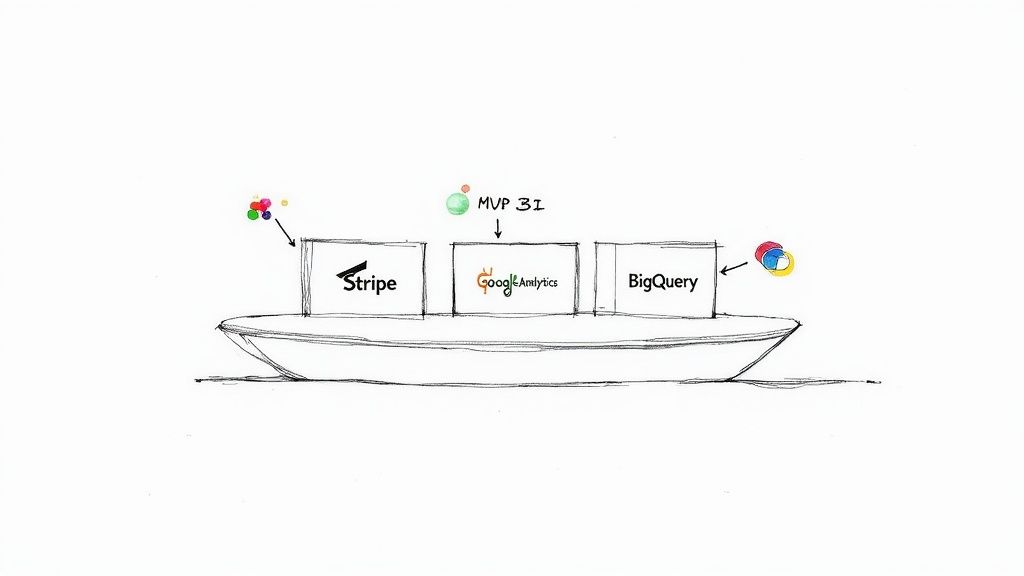
Your first business intelligence stack shouldn't be a battleship—it needs to be a speedboat. Think lean, fast, and able to turn on a dime. We're going to borrow the 'Minimum Viable Product' mindset and apply it directly to your data infrastructure. The goal is dead simple: get 80% of the value for 20% of the effort and cost. It’s the Pareto Principle in action.
Forget the monolithic, soul-crushing enterprise software peddled to Fortune 500s. As a founder, your most precious resources are cash and focus. Wasting either on an over-engineered BI system is a cardinal sin. Instead, we'll build something powerful and modern that costs less than a few team lunches.
The modern data stack is built on modular, pay-as-you-go parts. Let's think from first principles. What do we absolutely need to get from raw data to a real decision? We need to collect it, store it, and look at it. That's it. Everything else is a feature, not the foundation.
Step 1: Connect Your Core Data Sources
First things first, you need to tap into where your business actually happens. Don't try to boil the ocean. Just start with the two or three sources that hold your most critical operational data.
For most startups, this usually means:
Payment Processor (e.g., Stripe): This is your ground truth for revenue. It tells you who's paying you, how much, and how often.
Website Analytics (e.g., Google Analytics): This shows you how people find your site and what they do once they're there. It’s the very top of your funnel.
CRM (e.g., HubSpot): This is where your customer relationships live. It tracks the entire journey from a curious lead to a loyal advocate.
The key is to use tools with simple, well-documented APIs. Modern connectors can pull data from these sources with just a few clicks—no engineering degree required.
Step 2: Choose a Lean Data Warehouse
Your data needs a home. In the old days, this meant buying expensive servers and hiring someone to manage them. Today, it means spinning up a cloud data warehouse in minutes. Think of it as a central, infinitely scalable database built specifically for analysis.
For a startup, the choice is pretty obvious: go with a pay-as-you-go model. Services like Google BigQuery or Snowflake are perfect. They have generous free tiers and only charge for the data you store and the queries you run, which at an early stage is next to nothing. This approach dodges a massive fixed cost and scales right alongside you.
A data warehouse isn't just storage; it's the single source of truth. When marketing, sales, and product are all pulling from the same well, you eliminate the endless debates over whose numbers are 'right' and get straight to making decisions.
This centralized approach is fundamental to building an efficient, data-informed culture right from day one.
Step 3: Plug In a User-Friendly Visualization Tool
Finally, you need a way to actually see the patterns. Raw data sitting in a warehouse is useless to most of your team. A visualization tool is what turns all those rows of numbers into intuitive charts and dashboards that answer business questions at a glance.
You absolutely do not need to spend thousands. Google's Looker Studio is completely free and surprisingly powerful. It connects directly to BigQuery and other sources, letting you build clean, shareable dashboards with a simple drag-and-drop interface. For a deeper look at the landscape, check out our guide on business intelligence tools for a full breakdown of the options.
Here’s a quick look at the kind of clean, intuitive interface you can expect from a tool like Looker Studio.
A dashboard like this empowers anyone on your team, not just the data analysts, to explore information and find answers to their own questions.
The market for these tools is exploding for a reason. The global BI software market was valued at USD 41.74 billion and is projected to surpass USD 151.26 billion by 2034. The cloud segment, which includes these lean tools, dominates with a 53% market share, perfectly reflecting the startup world’s demand for affordable, scalable solutions. You can see more insights about BI software market growth at Precedence Research.
This Minimum Viable Stack—Stripe, Google Analytics, BigQuery, and Looker Studio—delivers actionable insights without you having to hire a dedicated data engineering team. It preserves your capital and lets you focus on what truly matters: building your product and serving your customers.
From Data to Decisions: Real-World Scenarios
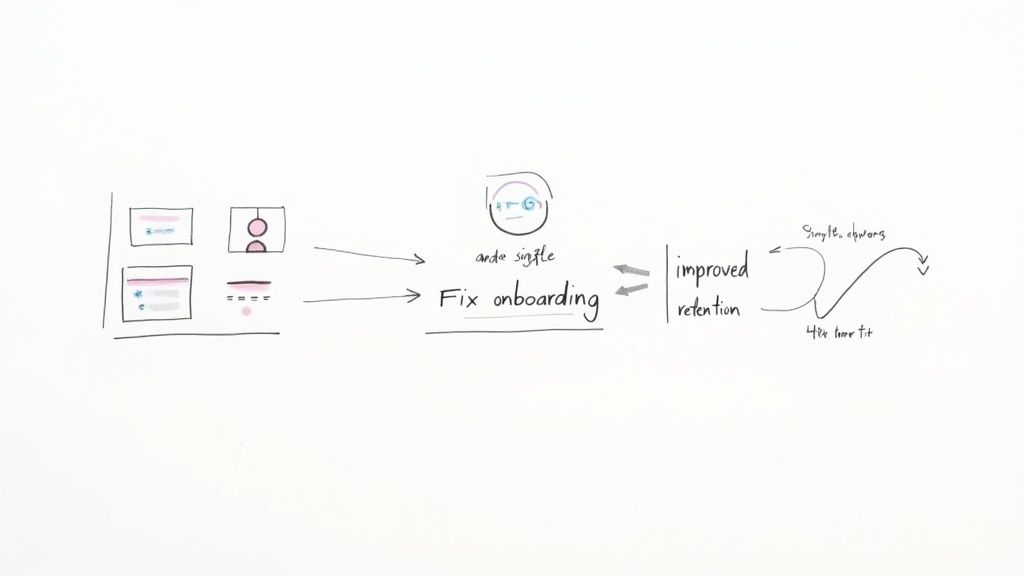
A startup's runway is measured in the speed and quality of its decisions. Theory is great, but let's talk about what actually works in the trenches.
Here are three real-world blueprints you can steal:
A SaaS team used cohort analysis to find a 40% churn cliff at the third onboarding step. They killed a "clever" UI change and saw trial retention jump.
An e-commerce brand A/B tested product bundles against customer segments, lifting average order value by 22% in under a month.
A paid ads squad audited cost per acquisition by channel, ruthlessly cut the losers, and slashed their overall CAC by 15% while boosting conversions.
Identifying Onboarding Churn
A SaaS founder saw trial users ghosting them before the second week. Instead of guessing, they used cohort analysis to track user actions against key milestones. The data screamed: a specific step in their onboarding was a conversion graveyard. They rebuilt that single step in Looker Studio—simplifying the language and flow.
Pinpointing the exact obstacle freed the team to rebuild only the flawed step.
The result? Trial retention shot up by 18% the very next week. Small change, massive leverage.
Boosting Average Order Value
An e-commerce founder wanted to increase basket size without burning more cash on ads. They broke down their purchase data in BigQuery by customer type and product category. This revealed hidden buying patterns. They prototyped three product bundles and ran simple A/B tests.
Data-driven bundles turned casual browsers into higher-value buyers overnight.
One bundle hit a 35% adoption rate, effectively printing money from existing traffic.
Refining Marketing Spend
A digital marketing team felt like their ad spend was hitting a wall. They mapped their cost per acquisition for every single channel. The results were brutal. They immediately paused the bottom-performers and reallocated that budget to their top two platforms.
Optimizing channel mix cut overall CAC by 15% and drove a 12% lift in conversion rate.
They now run this analysis every month. It’s a simple ritual that keeps their ad budget lean and lethal.
Scenario | Key Question | Action Taken | Outcome |
|---|---|---|---|
Onboarding Churn | Why are trials quitting early? | Simplified step in workflow | +18% retention |
Order Value | How to raise cart totals? | Launched bundles and A/B tests | +22% AOV |
Marketing Spend | Where to allocate ad budget? | Cut underperforming channels | -15% CAC |
Turning Insights Into Action
Notice the pattern? Each story follows the same simple loop:
Frame a precise business question tied directly to growth.
Isolate only the data needed to answer that question.
Visualize the data to make the root cause painfully obvious.
Run a small, fast experiment to test a fix.
Scale the winner.
This is how you build data-informed intuition. I know one founder who does this every Monday morning. They review a Looker Studio snapshot, delegate any data-pulling tasks, and spend their time on strategy—not lost in spreadsheets.
According to G2’s business intelligence statistics, 49% of companies have ramped up BI analytics since before the pandemic, and startups lead the way. The average salary for a BI analyst stands at $75,703, a sign of growing demand for data-savvy pros who turn numbers into action. Learn more in G2’s research.
Curious how market studies feed this decision cycle? Check out our guide on market research for startups to sharpen your data playbook with timely customer insights.
Data is just raw material. Your job is to forge it into a weapon.
How to Sidestep the Classic BI Traps
Charlie Munger, Warren Buffett’s legendary partner, had a brilliant way of thinking he called “inversion.” Instead of figuring out how to succeed, he'd ask, "What would guarantee failure?" Then, he’d just make sure to avoid those things. It's a surprisingly effective way to tackle complex problems, and it’s perfect for building your startup’s first data system.
From what I’ve seen, most founders don’t stumble with BI because the technology is too complicated. The real pitfalls are human. They get seduced by flashy numbers, build dashboards that gather digital dust, and end up making data a source of confusion, not clarity.
Let's flip the problem on its head and focus on what not to do.
Trap #1: Chasing Vanity Metrics
Want to guarantee your BI efforts go nowhere? Measure things that stroke your ego but have zero connection to the health of your business. Total sign-ups, raw website traffic, social media likes—this is the junk food of the data world. It feels good for a moment but provides no real substance and creates the illusion of progress.
Here’s how to invert that. Start with a critical business question, not with the data you have. Get your team together and ask, "What's the one thing we absolutely need to figure out this week to move the needle?" It might be understanding why trial users bail before converting, or pinpointing which type of customer sticks around the longest. Your BI work should be a direct response to that question. This forces you to focus on metrics that actually tie back to revenue and retention.
Trap #2: Building Ghost Town Dashboards
The second-fastest way to fail is to spend weeks building a beautiful, comprehensive dashboard that no one on your team ever looks at again. This is what happens when BI is treated like a side project owned by one person. The dashboard gets built, a link gets dropped in Slack, and it’s promptly forgotten.
The fix is surprisingly simple: make data a ritual, not just a report. Don't just send out a link and hope for the best. Weave your key metrics directly into how your team already operates.
Monday Morning Metrics: Kick off your weekly all-hands meeting with a quick, 5-minute look at the one or two KPIs that matter most for that week's goals.
Automated Slack Updates: Set up a simple bot to post the most important numbers in a public team channel every morning. It keeps the data top-of-mind.
Question of the Week: Instead of just presenting numbers, pose a single data-driven question for the team to chew on. This sparks genuine curiosity and conversation.
When you embed data into your company’s daily rhythm, dashboards stop being static artifacts and become living tools that drive real decisions.
Trap #3: Over-Engineering Your Tech Stack
Founders, especially those with a technical background, love to build things. It's in their DNA. So, the temptation to architect a flawless, enterprise-grade BI system from day one is strong. This is a classic trap. It burns through precious cash, diverts your best engineers from product work, and often delivers a complicated solution to what is, at this stage, a simple problem. You don't need a battleship when a speedboat will do the job.
The best BI systems for startups aren't the most complex ones. They're the ones that get a useful, directionally correct answer into the right hands as fast as possible. In the early days, speed and utility beat perfection every single time.
The inversion here is to embrace a Minimum Viable Product (MVP) mindset for your data. What’s the absolute simplest setup that could work? For many, it’s just a Google Sheet pulling data from Stripe. Resist the urge to add a new tool—whether it's a data warehouse or a fancy visualization platform—until the pain of your current, simple system becomes truly unbearable.
This ensures your BI stack grows because you need it to, not because you think you might need it someday. That's the heart of lean business intelligence for startups: build just enough to solve today's most urgent problem.
Delegating Data to Multiply Your Impact
As a founder, you are almost always the biggest bottleneck in your own company. Your highest value isn't in writing SQL queries or wrestling with spreadsheets; it's in making high-quality decisions and designing systems that run without you. Delegation isn't just about offloading tasks; it's about buying back your time to focus on the 20% of work that drives 80% of the results.
A well-designed BI setup should operate on autopilot, surfacing the critical numbers you need without your direct involvement. It requires a mental shift from doing the work to designing the machine. Billionaires don’t build their own financial models; they hire the best people and design a system to get the exact information they need. You should think the same way.
Your BI System As A Delegated Function
High-performing founders don’t wait 45 days for a static month-end summary. They expect live dashboards and instant answers—but they aren’t the ones clicking the refresh button. They treat business intelligence as a service they consume.
Think of it as BI-as-a-Service. Instead of hiring a full-time analyst—a massive cost for most startups—you leverage on-demand talent. This is exactly the model we built at Hyperon. Our executive assistants are trained to manage the setup, connect data sources, and build the dashboards, delivering ready-to-use insights directly to you.
This approach gives you the horsepower of a data team at a fraction of the cost, preserving both your runway and your most valuable asset: your focus.
Your effectiveness as a leader is measured by the quality of your decisions, not the quantity of your tasks. Delegating data analysis frees you from the mechanics and multiplies your decision-making power.
To make this work, you have to be ruthlessly clear in your instructions. For a detailed breakdown of crafting concise, outcome-oriented tasks, check out how to delegate effectively.
Taking The First Step To Reclaim Your Time
Delegation can feel risky, but like any skill, it gets easier with practice. Start small—with a single, well-defined task.
Here’s a simple, one-page brief you can adapt for your first data handoff:
Objective: Deliver a weekly snapshot of our customer acquisition cost (CAC) and customer lifetime value (LTV).
Key Question to Answer: Is our LTV/CAC ratio healthy (above 3:1) for our top three marketing channels?
Data Sources: Pull data from our Stripe account and Google Analytics.
Desired Output: A simple, one-page dashboard in Looker Studio displaying:
CAC per channel
LTV per channel
Combined LTV/CAC ratio
Deadline: Please deliver the first version by Friday EOD.
By stepping back and empowering someone else to build that dashboard, you reclaim your most precious resource—time. You’ll move from operator to strategist, and that’s where founders create the greatest impact.
Startup BI: Your Questions Answered
Let's cut through the noise. When I talk with other founders about getting their first data systems up and running, the same questions pop up over and over. Here are the straight-up, no-fluff answers I've learned from being in the trenches.
When Is It Too Early for a Startup to Implement BI?
It’s never too early to think like a data-informed company, but you can definitely be too early for a complex tech stack. The trick is to match the tool to the stage you're at.
Before you even have a product, your "BI" is probably a simple spreadsheet where you track notes from user interviews. That's perfectly fine. But the moment you have your first real users and money starts hitting the bank, it’s time to build a Minimum Viable BI Stack. The principle is simple: start measuring the second you have something worth measuring, but don't burn cash on fancy tools until your manual process becomes a genuine bottleneck.
How Much Should a Startup Budget for BI Tools?
A lot less than you might think. An early-stage startup can put together a powerful, scalable stack for under $150 a month. Seriously.
You can use free platforms like Looker Studio for all your visualization needs. Cloud data warehouses, such as Google BigQuery, offer generous free tiers and pay-as-you-go models that are incredibly cheap when you're just starting out. The real cost isn’t the software—it’s the time and focus you and your team have to pour into it. This is exactly why bringing in on-demand help to get it set up can offer such a massive ROI; it buys back your most valuable asset.
What Is the Biggest Mistake to Avoid with Startup BI?
The single biggest mistake is starting with the data instead of a question. It’s a classic trap. Founders get a glimpse of this mountain of data from Stripe, Google Analytics, and their CRM and immediately ask, "What interesting things can this tell me?"
That question is a direct path to analysis paralysis and dashboards cluttered with useless trivia.
The right way to do it—the first-principles approach—is to start with a critical business question. Ask something specific and urgent, like, "Why did 15% of our trial users from last week's cohort fail to activate?" Then, you can work backward to find the exact data needed to answer only that question.
This question-first process guarantees your BI efforts are always tied to a meaningful business outcome. It’s the difference between just being busy and actually being effective.
Your time is best spent on strategy, not wrestling with reports. At Hyperon, our on-demand executive assistants are trained to manage your BI stack, build the dashboards you need, and deliver insights that lead to faster, smarter decisions. Reclaim your focus and accelerate your growth with world-class support. Learn more about how Hyperon can help.