Executive Assistant vs Personal Assistant: A Founder's Guide to Delegation & Leverage
Discover when to hire an executive assistant vs personal assistant to maximize focus, efficiency, and life balance.
Dec 7, 2025

The real difference between an Executive Assistant and a Personal Assistant isn't the job title—it's the problem they solve. One is a business force multiplier; the other is a life optimizer. An Executive Assistant (EA) acts as your strategic partner to amplify professional output. A Personal Assistant (PA) handles the logistics of your personal life so you can show up with 100% focus. Choosing between them is a first-principles decision: where is your biggest bottleneck?
The Strategic Choice Every Founder Faces
Let's get straight to it. As a founder or executive, your most precious resources are time, attention, and energy. Every minute you spend on a task that isn't your unique and highest-value contribution is a direct tax on your company's growth. This isn't just a philosophy; it's the operating system of hyper-successful people. Think of entrepreneurs like Tim Ferriss or Naval Ravikant—their entire system is built on ruthless elimination and delegation to free up mental space for what truly matters.
So, the question isn't if you need leverage, but where you need to apply it first. The choice between an EA and a PA is your first strategic move in buying back time and building a system that removes friction, allowing you to operate at your peak.
This goes beyond just clearing a to-do list. It's about reclaiming the cognitive real estate required for deep, strategic work—the kind that actually moves the needle. An EA is your partner in the business, a co-pilot managing your calendar, driving projects, and prepping you for board meetings. A PA, in contrast, handles your personal logistics—managing your household, running errands, planning family travel. While you can find a deeper breakdown of these roles, the fundamental split is that simple.

Unpacking the Core Function from First Principles
From a first-principles perspective, an EA is an extension of your professional self. They are your operational right hand, your strategic partner embedded in the business, managing workflows and stakeholders to ensure your professional objectives are always advancing.
A PA is an extension of your personal life's operating system. They handle the logistics that create cognitive drag—booking family vacations, coordinating home repairs, dealing with personal finances. They work on your life so you can stay ruthlessly focused on the business.
The Bottom Line: Hiring an EA is a direct investment in your company’s operational horsepower. Hiring a PA is an investment in your personal focus and sanity—the fuel for your professional performance.
The right choice hinges on correctly diagnosing your biggest bottleneck. Are you drowning in investor reports and meeting prep? That's a business constraint. Or are you constantly distracted because your personal life feels like it’s held together with duct tape? That's a life constraint. Be honest about which fire is burning hottest.
EA vs PA At a Glance
To make it brutally simple, this table breaks down the core difference from a mental model perspective.
Attribute | Executive Assistant (EA) | Personal Assistant (PA) |
|---|---|---|
Primary Focus | The business & your professional output | Your personal & private life |
Core Function | Maximize professional productivity & impact | Minimize personal cognitive load & friction |
Main Goal | Acts as a business force multiplier | Functions as a life optimizer |
Ultimately, one helps you win in the boardroom, while the other ensures you have the clarity and peace of mind to show up ready to win in the first place.
Deconstructing the Roles: Professional Leverage vs. Personal Bandwidth
To really get to the heart of the EA vs. PA debate, we have to strip away the job titles and think from the ground up. The question you should be asking isn't "Do I need an assistant?" but rather, "What problem am I actually trying to solve?" When you boil it all down, the answer is almost always about reclaiming one of two critical resources: professional leverage or personal bandwidth.
An Executive Assistant (EA) is your source of professional leverage. Think of them as your strategic partner or co-pilot, woven directly into the fabric of your business operations. Their job isn't just to manage your calendar; it's to amplify your professional impact. They’re the gatekeeper, the project manager, and often, your trusted stand-in when you're pulled in a dozen different directions.
A Personal Assistant (PA), on the other hand, is your bandwidth creator. Their entire focus is on your life outside of work. They tackle the endless logistics of your personal world—from managing your household to planning family vacations—so the mental drain of daily life doesn't chip away at the focus you need to excel professionally. In short, they manage your life so you can manage your business.
The EA: Your Business Operating System
A great EA functions as a central processing unit for your professional world. They don't just put meetings on your calendar; they ensure you walk in prepared with briefing docs, pre-read summaries, and a clear agenda. They act as a firewall, protecting your deep work blocks from the constant barrage of low-value requests.
Take a founder in the midst of a Series A fundraise. A mediocre assistant schedules investor meetings. A world-class EA manages the entire fundraising operation:
Investor Pipeline Management: They're in the CRM, tracking every interaction with VCs, managing follow-ups, and ensuring the data room is pristine and instantly accessible.
Stakeholder Communication: They handle non-urgent inbound from current investors, freeing the founder from the context-switching that kills fundraising momentum.
Operational Continuity: While the founder is laser-focused on the pitch deck, the EA is the one ensuring the rest of the business doesn't skip a beat, coordinating with department heads and keeping internal projects on track.
This is the force multiplier effect. They aren't just checking off a to-do list; they are managing entire systems to make you more effective. A top-tier EA thinks three steps ahead, anticipating needs and solving problems before they hit your radar. You can learn more about this deep, strategic partnership by exploring the modern role of an executive assistant.
The PA: Your Life Operating System
Now, let's talk about the Personal Assistant. Their domain is the beautiful chaos of your personal life. Many founders and executives, especially those with families, find their focus shattered by a death-by-a-thousand-cuts: scheduling the plumber, researching summer camps, planning a surprise party for a spouse.
Individually, these tasks are trivial. Collectively, they create a massive cognitive load. A PA’s entire purpose is to absorb this load for you. Their success isn't measured in business KPIs, but in how seamlessly your personal life operates.
A world-class PA creates a bubble of focus around you. Inside that bubble, the only thing that exists is your highest-leverage work. Everything else is simply handled.
A billionaire investor I know relies on his PA not for simple errands, but as a strategic life manager. This PA oversees multiple properties, coordinates with private chefs and personal trainers, and plans incredibly complex international family trips. This single hire frees up hundreds of hours and thousands of decision-making cycles every year—time and energy the investor plows directly back into his portfolio. That’s the real ROI of an incredible PA: reclaimed focus.
Detailed Role Breakdown: Executive vs. Personal Assistant
To make the distinction crystal clear, it helps to put the core components of each role side-by-side. This table breaks down where they operate, the skills they need, and how their success is ultimately measured.
Criteria | Executive Assistant (EA) | Personal Assistant (PA) |
|---|---|---|
Primary Domain | The business and professional operations | The executive’s personal and family life |
Core Objective | To maximize the executive's professional output and strategic impact | To minimize the executive's cognitive load from personal logistics |
Key Skillset | Business acumen, project management, discretion with corporate data, stakeholder management | Resourcefulness, event planning, household management, extreme attention to personal preferences |
Common Tools | Asana, Slack, G Suite, CRM software (e.g., Salesforce), Expensify | Personal banking apps, travel booking platforms, home service apps, luxury concierge contacts |
Measure of Success | Increased executive productivity, smoother business operations, successful project completion | A seamless personal life for the executive, reduced personal stress, reclaimed personal time |
Looking at it this way, the line becomes incredibly sharp. An EA is your business force multiplier, directly fueling operational excellence. A PA is your life optimizer, creating the mental clarity you need to perform at your absolute peak.
Calculating the Economics of Delegation
Hiring an assistant isn't an expense; it’s an investment in your most valuable, non-renewable asset—time. But when you’re weighing an executive assistant vs a personal assistant, the ROI model is fundamentally different. This isn't about finding the cheaper option. It's about applying capital to the area of your life that will yield the highest return.
The most effective founders don't think in terms of hourly rates. They think in terms of opportunity cost. Every minute they spend on a $20/hour task is a minute they aren't spending on a $1,000/hour task. The math is simple: you buy back your time at a wholesale rate and reinvest it into work that generates value at a massive premium.
The EA as a Revenue-Generating Asset
Think of a great Executive Assistant as a direct investment in your company's top-line revenue. Their salary isn't a cost center; it’s directly tied to their ability to unlock your productivity, manage complex projects, and amplify your effectiveness across the entire organization. Viewing their compensation as simple overhead is a first-principle error.
Frame it as acquiring a strategic asset. If an EA saves you 15 hours a week of your time, and you use that reclaimed time to close one extra enterprise deal per quarter or ship a product feature a month sooner, the ROI is exponential. Their value isn't measured by the tasks they complete, but by the high-value opportunities you now have the bandwidth to pursue.
A world-class EA doesn’t cost you money; they make you money by manufacturing the time you need to focus on revenue-generating activities. Their salary isn't overhead; it's a direct investment in executive-level output.
The market reflects this strategic value. It's not uncommon for EAs supporting C-suite leaders in major tech hubs to command salaries well over $104,000 annually. And here’s a fascinating trend: remote EAs often earn 15-20% more than their in-office counterparts. That premium is a nod to their advanced skills in managing complex digital workflows and often supporting multiple executives seamlessly. You can find more EA compensation trends on Boldly.com.
The PA as a Cognitive Load Reducer
The ROI of a Personal Assistant is measured differently. You won't see their impact on a P&L statement. Instead, their value is measured in reclaimed mental energy and focus. You're not hiring a PA to help you close the next big deal; you're hiring them to eliminate the thousand tiny personal tasks that drain your cognitive battery before you even get to work.
Their pay structure often reflects this personal optimization focus, typically an hourly rate or a monthly retainer. For a better sense of these models, you can find a detailed breakdown of what a virtual assistant costs. The economic justification here is about burnout prevention and sustained peak performance.
To get the most out of either role, you have to master effective delegation strategies; otherwise, you're just creating an expensive management layer. The true value of a PA is the quiet, uninterrupted weekend you get before a massive product launch, or the international business trip where every personal detail is handled so you can stay in a state of flow. It’s about killing decision fatigue at the source.
The Founder's Decision Matrix for Hiring
The biggest mistake I see founders make isn't failing to hire help; it's hiring the wrong kind of help at the wrong time. This isn’t a decision you make on gut feel. It’s a calculated move based on a ruthless audit of your biggest bottleneck. Get it right, and you unlock growth. Get it wrong, and you’ve just given yourself a new, expensive task: managing the wrong person.
Think about this from first principles. What is the one thing that, if solved, would create the biggest positive ripple effect on your output? Is it chaos in your business operations or chaos in your personal life? Be brutally honest with yourself. Your ego has no place in this conversation.
The Bottleneck Audit: Your First Step
Before you even dream of writing a job description, you need data. For one full week, track every single thing you do. And I mean everything. A simple spreadsheet or a tool like Toggl works perfectly. At the end of the week, categorize every task into the Eisenhower Matrix.
This isn't just another productivity hack; it’s a diagnostic tool for your life. The matrix forces you to sort tasks based on two simple variables: urgency and importance.
Urgent & Important (Do): These are the fires you have to put out yourself. Think crises, pressing deadlines, and investor calls.
Not Urgent & Important (Decide): This is where founders actually create value—strategic planning, building key relationships, R&D.
Urgent & Not Important (Delegate): Scheduling meetings, booking travel, answering routine emails, managing your inbox. This is prime territory for an assistant.
Not Urgent & Not Important (Delete): Time-wasting activities and distractions. Get rid of them.
Once your audit is done, take a hard look at that "Delegate" quadrant. Is it filled with business logistics like "prep for board meeting," "coordinate with department heads," and "filter inbound sales leads"? If so, your bottleneck is in business operations. An Executive Assistant is your answer.
Or is that quadrant packed with personal logistics like "schedule doctor's appointment," "research summer camps," "plan anniversary dinner," and "deal with the leaky faucet"? Then your bottleneck is in your personal life. A Personal Assistant is what you need.
Inflection Points: When to Hire Which Role
Your company's stage of growth adds another critical layer to this decision. The right hire at the seed stage is often the completely wrong one when you're scaling to Series B.
The Seed Stage Founder (Wearing All the Hats) At this point, your biggest bottleneck is almost always business-related. You're drowning in back-to-back meetings, trying to build a product while wooing your first investors. Your personal life might be a mess, but operational drag is what will actually kill the company.
Primary Pain: Operational chaos, calendar mismanagement, and missed follow-ups.
The Hire: Executive Assistant. Their mission is to create structure and process where none exists, freeing you to focus on product and sales. Our guide on how to hire an executive assistant is built specifically for founders at this critical juncture.
The Growth Stage CEO (Scaling the Machine) Your company now has teams and processes, but your time is fractured between internal leadership and external stakeholders. The bottleneck isn't doing the work anymore; it's managing the machine.
Primary Pain: Constant context switching, inefficient communication flows, and a stark lack of time for strategic thinking.
The Hire: Executive Assistant. A top-tier EA at this stage becomes a true strategic partner, acting as your proxy and the information hub for the entire organization.
The Established Executive (Optimizing for Peak Performance) The business runs like a well-oiled machine, but your personal life is paying the price. The cognitive load from managing your household, family schedules, and personal finances is bleeding into your work, causing burnout and a loss of focus. There's a reason billionaires don't check their own bank statements or book their own vacations.
Primary Pain: Decision fatigue, distractions from your personal life, and the inability to truly disconnect.
The Hire: Personal Assistant. Their ROI is measured in reclaimed mental clarity and the ability to be fully present and energized for your highest-level work.
The 80/20 rule of delegation is simple: Your assistant should handle the 80% of tasks that generate 20% of the value, freeing you to focus exclusively on the 20% of activities that drive 80% of the results. Your time audit will tell you exactly where that 80% lies.
Finally, as you refine your decision, don't forget the importance of hiring for culture fit. This person, whether an EA or PA, will be operating in your innermost circle. A mismatch in values or work ethic will create more friction than it removes, defeating the entire purpose of the hire.
Finding Your Force Multiplier
Here's a hard truth: you can't land A-player talent with a C-player hiring process. The world is full of people who can manage a calendar. But a true force multiplier—the kind of person who genuinely gives you back 10-15 hours of high-value time every week—is a rare find. To get them on your team, you need a hiring funnel designed to aggressively filter for the exact competencies you need.
When you're weighing an executive assistant vs a personal assistant, you’re looking for completely different skill sets. For an EA, you have to test for strategic thinking and business acumen. For a PA, the non-negotiables are extreme resourcefulness, discretion, and logistical mastery. One manages the chaos of business; the other manages the chaos of life.
This simple decision tree helps cut through the noise and figure out where your real bottleneck is—in the office or at home.
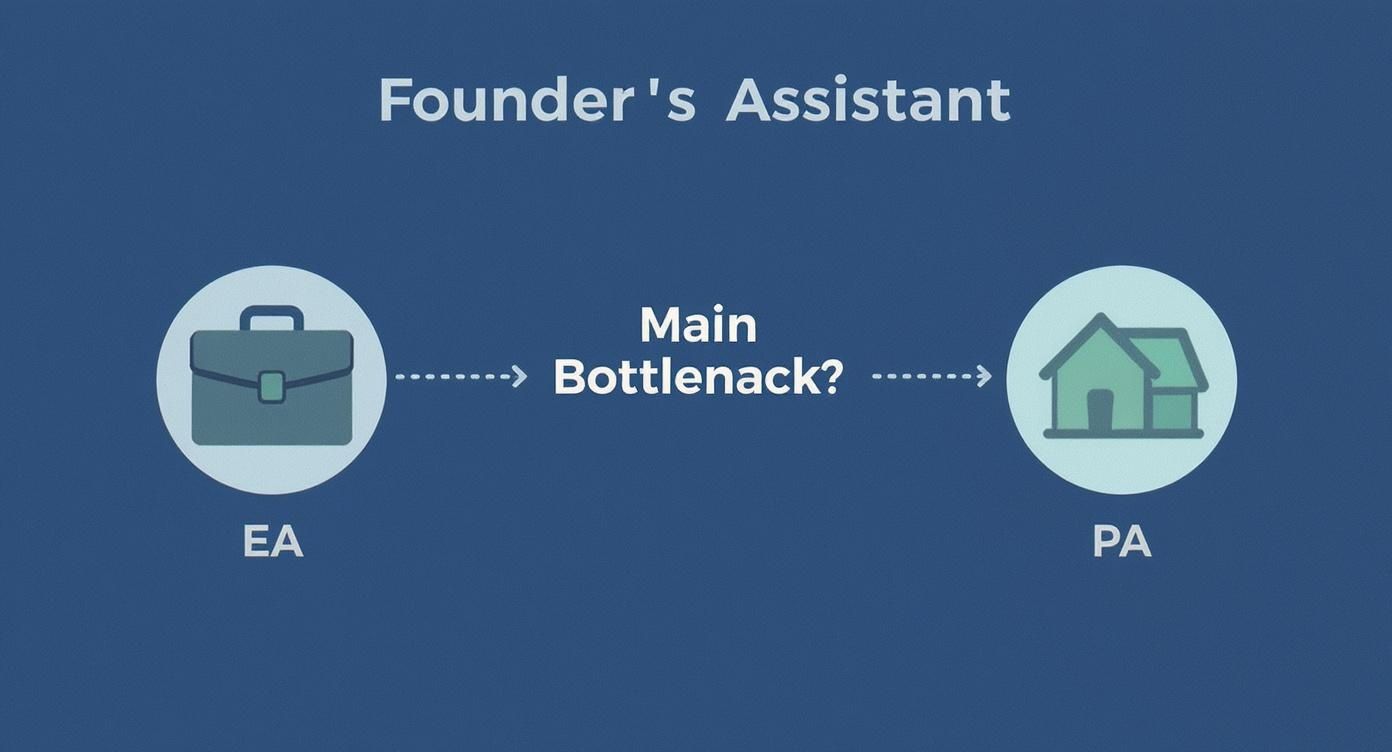
As you can see, the core question is simple: what’s causing the most friction? Answering that honestly points you directly to the right kind of support.
Designing the Hiring Funnel
Forget the generic interview questions. If you want to find a world-class operator, you need to simulate the job itself. Throw them real-world scenarios designed to show you how they think under pressure. This is how you separate the checklist-followers from the genuine problem-solvers.
For a Potential Executive Assistant: The goal here is to see if they can think three steps ahead and wrangle complex projects with multiple stakeholders. Their value isn't just in doing tasks; it's in their ability to anticipate needs and operate as a true strategic partner.
The Scenario Question: "Walk me through how you would prepare me for a critical board meeting, starting one week out. What information do you need, who do you need to coordinate with, and what does the final briefing packet you hand me look like?"
This question digs into their project management skills, communication planning, and whether they understand what matters at an executive level. A great answer isn't just "I'd schedule the meeting." It involves a detailed timeline, coordinating with department heads for pre-reads, and summarizing key data points into a digestible brief.
For a Potential Personal Assistant: With a PA, you're testing for poise, creativity, and an almost obsessive attention to personal detail and privacy.
The Scenario Question: "The private chef for an important dinner party you’ve organized at my home cancels two hours before guests arrive. What is your exact process for handling this?"
A top candidate won’t just say, "I'd find another chef." They’ll have a pre-vetted list of emergency contacts. They'll talk about having a high-end restaurant on standby for catering. They’ll describe how they would communicate seamlessly to ensure the guest experience remains flawless. They solve the problem without adding to your stress.
A-players want to be tested. A tough, scenario-based interview doesn't scare them away—it attracts them. It signals that you're a high-performer who values competence and strategic thinking.
Job Description Templates That Attract the Best
Your job description is your first filter. It needs to speak directly to the kind of operator you want. Ditch the corporate jargon. Be direct, be clear, and focus on the outcomes they'll be responsible for.
Executive Assistant Job Description Snippet (Focus on Impact): "You will be the operational backbone of the CEO's office, responsible for maximizing their efficiency and strategic output. We will measure your success by your ability to create seamless workflows, manage key projects independently, and anticipate the needs of a fast-scaling tech company. This is a strategic partnership, not an administrative role."
Personal Assistant Job Description Snippet (Focus on Lifestyle Management): "You will be the central nervous system for a busy executive's personal life, tasked with creating a frictionless and optimized living environment. Your mission is to eliminate cognitive load by flawlessly managing household operations, complex travel, and personal events with absolute discretion. Success means building a foundation of calm and order that allows for peak professional performance."
At the highest level, the line between these roles can blur into a hybrid "Executive Personal Assistant." This is common for ultra-high-net-worth individuals, and these roles are incredibly demanding, often requiring 24/7 availability and deep integration into a person's life. As a result, compensation for these elite positions can skyrocket, with top-tier salaries reaching as high as $250,000 per year. You can get more insights on compensation for these roles from household management experts. This premium reflects the immense trust and responsibility needed to manage both the business and personal worlds of an executive.
Frequently Asked Questions
Let's cut through the noise. When you're thinking about hiring an assistant, the same questions and mental roadblocks always pop up. It's easy to get stuck second-guessing yourself, so let's tackle these head-on.
Can I Just Hire One Person for Both Roles?
This is easily the most common question I get. It usually comes from a desire to find that perfect "unicorn" who can seamlessly manage a board meeting one minute and book a family vacation the next. My advice is blunt: avoid it.
While it's tempting to blend the Executive Assistant and Personal Assistant roles, you're setting yourself—and your hire—up for failure. Think of it this way: context switching is the enemy of high-quality work. An EA needs to be completely immersed in your business—your strategy, your key stakeholders, your project timelines. A PA, on the other hand, is focused on the logistics of your personal life—household vendors, school schedules, and travel preferences.
Asking one person to toggle between prepping a pitch deck and arranging for dry cleaning creates a huge amount of mental friction. Something has to give, and it’s almost always the strategic business work that requires deep, uninterrupted focus.
The only exception is for a brand-new founder whose personal and professional lives are naturally a tangled mess. Even then, you should hire for your biggest bottleneck (which is almost always the business) and treat personal tasks as a secondary, temporary part of the job.
What's the Best Way to Onboard a New Assistant?
The biggest mistake I see executives make is what I call "delegation by abdication." They just dump a mountain of tasks on their new assistant with zero structure and then act surprised when things fall through the cracks. That isn't delegation; it's a setup for failure.
A-players don't just want tasks; they want a system. I always recommend a structured, 30-day offloading process designed to build trust and autonomy from the ground up.
Week 1: Shadowing. Give them view-only access to your inbox and calendar. Their only job is to observe your rhythm, your communication style, and who your key contacts are. They’re basically downloading your professional operating system.
Week 2: Low-Risk Tasks. Start handing off simple, repeatable tasks. Use a shared document or a project management tool with crystal-clear instructions. A huge time-saver here is to record short Loom videos of you doing the task once.
Week 3: Process Ownership. Now, give them complete ownership over a single, crucial process, like managing your calendar. They run it, but you review and approve their decisions. This is where they build confidence and you build trust.
Week 4: Management by Exception. Finally, you transition them to full autonomy within their defined role. At this point, they should only be coming to you with issues or questions that truly require your specific input.
This methodical approach isn't just about training. It's about forging a reliable, high-trust partnership that turns them from a simple task-doer into a true operational partner.
How Do I Measure the ROI of My Assistant?
If you're trying to measure your assistant's ROI by counting how many tasks they complete, you're looking at the wrong metric. That’s like judging a world-class chef by the number of vegetables they chop.
The real ROI of an assistant isn't their output; it's the increase in your own high-value output.
The value of an assistant is not measured in the cost of their time, but in the value of the time they buy back for you.
Before you even think about hiring, do a brutal audit of your own time for one full week. Categorize every single activity into one of four buckets:
High-Leverage Work (Only you can do): Closing major deals, setting company vision, nurturing strategic partnerships.
Important, Delegable Work: Preparing reports, managing projects, initial client outreach.
Low-Skill, Necessary Tasks: Scheduling meetings, booking travel, filing expense reports.
Distractions: Anything else that doesn't actually move the needle.
Your new assistant's mission is to completely eliminate categories 3 and 4 from your life and eventually take over 80% of category 2. The ROI is the value you create by reinvesting all of those reclaimed hours back into category 1.
If your EA frees up just 10 hours a week and you use that time to secure one more major client, the ROI isn't just positive—it's exponential.
Ready to stop managing tasks and start multiplying your impact? At Hyperon, we connect founders and executives with the top 1% of global Executive Assistants who are pre-vetted and trained to be the strategic partner you need. Reclaim your time and accelerate your growth by visiting https://www.hyperon.com to learn more.