The 8 Mission-Critical Skills of an Executive Assistant for 2025
Uncover the 8 mission-critical skills of an executive assistant that founders and CEOs demand. Go beyond admin tasks to strategic partnership.
Dec 6, 2025
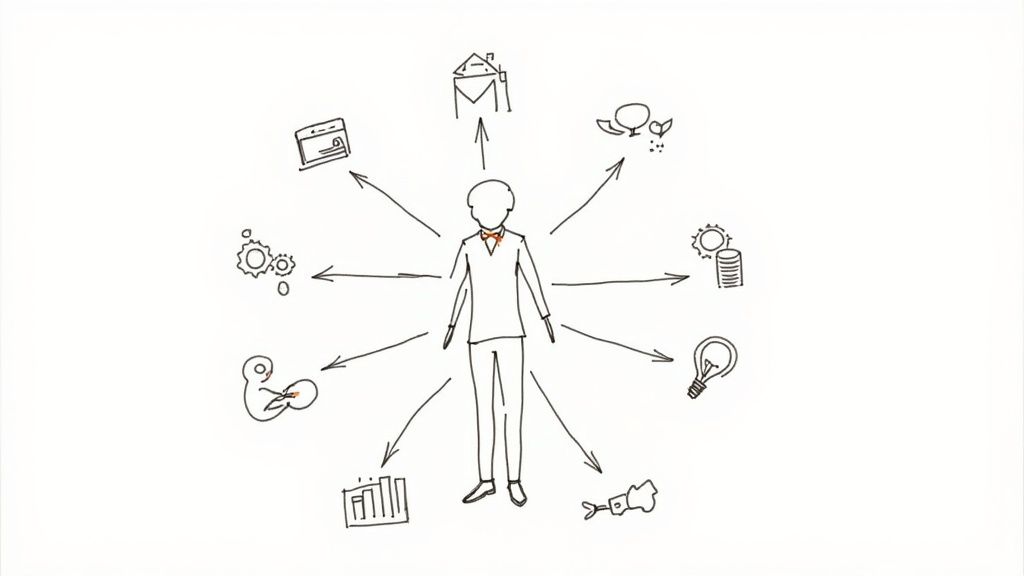
I've seen hundreds of founders burn out trying to do it all. They treat their Executive Assistant like a simple admin, a human task-doer. This is a catastrophic, first-principles mistake. The defining difference between a founder who scales and one who stagnates is leverage. Ask Tim Ferriss, ask any billionaire who has built something massive, they are all obsessed with it.
An elite EA isn't just an extra pair of hands; they are a strategic partner who multiplies your output, an extension of your own executive function. They don't just follow checklists. They operate from a place of deep understanding, deconstructing your chaotic workflow to rebuild it for maximum efficiency and impact. This isn't about simply outsourcing your calendar management; it's about systematically reclaiming your time and mental energy to focus on the one or two things that truly move the needle.
We’re not talking about basic administrative abilities here. This guide is a deep dive, designed for founders and executives who want to hire a true operator. We're breaking down the eight core competencies that separate a good EA from a genuine force multiplier. Understanding these fundamental skills of an executive assistant is the first step in finding someone who won’t just manage your inbox, but will help you architect a more effective professional life. This is your playbook for identifying, assessing, and hiring a partner who will fundamentally change the way you work. Let's deconstruct what excellence looks like.
1. Advanced Calendar and Schedule Management
Mastering an executive's calendar isn't about filling empty slots; it's about architecting their time to maximize output and strategic thinking. This core skill of an executive assistant transcends simple scheduling. It's the practice of becoming the COO of your executive's time, treating their 24 hours as the company's most valuable, finite asset. An elite EA doesn’t just manage a calendar; they protect it, optimize it, and align it with the highest-leverage organizational goals.
This skill is about moving from a reactive "appointment setter" to a proactive "time strategist." It involves understanding the true hierarchy of priorities, even the unspoken ones, and ruthlessly defending blocks of time for deep work, creative thinking, and personal recovery. This is the difference between an executive who is constantly busy and one who is consistently effective.
Assessing Proficiency Levels
When hiring, you need to gauge where a candidate falls on the spectrum of calendar management. This is one of the most crucial skills of an executive assistant, and proficiency varies widely.
Level 1 (Basic): Can schedule meetings, find availability across multiple attendees, and handle basic rescheduling requests using tools like Outlook or Google Calendar.
Level 2 (Intermediate): Proactively color-codes calendar entries, builds in buffer time between meetings, and uses scheduling automation tools like Calendly to reduce back-and-forth.
Level 3 (Advanced): Strategically blocks time for deep work, anticipates and resolves conflicts before they arise, and regularly audits the calendar to align it with quarterly priorities. They can confidently decline or delegate meetings that don't serve the executive's primary objectives. For a deeper dive into these concepts, discover more about how we view executive time management strategies.
Interview Questions to Test This Skill
"My calendar is booked solid for three weeks with back-to-back meetings. A critical, urgent two-hour investor prep session needs to happen this week. Walk me through your exact process for handling this."
What to listen for: A first-principles approach. Do they first question the urgency? Do they ask about the attendees? Do they audit the existing calendar for low-priority meetings to reschedule or delegate? A great answer involves problem-solving, not just shifting blocks around.
"How would you balance my need for long, uninterrupted 'deep work' blocks with the team's need for access to me?"
What to listen for: The ability to create systems. A top-tier EA might suggest implementing themed days (e.g., "Maker Mondays," "Meeting Fridays"), establishing office hours, or creating a clear decision-making framework for when it's acceptable to interrupt a deep work session.
2. Executive Communication and Correspondence
An executive assistant isn't just a gatekeeper for time; they are the proxy for the executive's voice. This skill goes far beyond grammar and spell-checking. It's about deeply internalizing your executive's unique communication style, priorities, and mental models to the point where you can draft emails, memos, and reports that are indistinguishable from their own. This is one of the highest-leverage skills of an executive assistant, turning communication from a bottleneck into a force multiplier.
The goal is to move from being a "proofreader" to a "ghostwriter" and, ultimately, a "communications strategist." An elite EA understands that every email sent and every presentation drafted is an extension of the executive's brand and authority. They master the art of conveying complex ideas with clarity and brevity, adapting the tone flawlessly whether addressing the board, an investor, or the entire company.

Assessing Proficiency Levels
When hiring, evaluating a candidate's ability to represent you in writing is non-negotiable. This is where many assistants fall short, remaining in a purely administrative capacity.
Level 1 (Basic): Can proofread for spelling and grammar, format documents, and manage a basic email inbox using folders and filters. They can respond to simple inquiries with a template.
Level 2 (Intermediate): Can draft routine correspondence, summarize meeting notes into action items, and triage an inbox by priority. They are comfortable using frameworks for clear communication but may still require heavy editing for tone.
Level 3 (Advanced): Can autonomously draft sensitive investor updates, company-wide announcements, and board meeting prep materials in the executive's voice. They proactively manage the flow of information, ensuring clarity and consistency across all channels, and can coach others on effective communication. To explore the foundational aspects of this, learn more about our views on email management best practices.
Interview Questions to Test This Skill
"I've just finished a complex, data-heavy quarterly business review. I need you to draft a one-paragraph summary for the all-hands meeting and a three-bullet-point summary for the board. How do you approach this?"
What to listen for: The ability to distill and adapt. A great candidate will ask about the key takeaway for each audience. They should recognize that the all-hands summary needs to be motivational and clear, while the board summary needs to be concise and focused on strategic outcomes and metrics.
"You see an email from me to a key client that has a slightly aggressive or ambiguous tone. It's already been sent. What do you do?"
What to listen for: A proactive, problem-solving mindset and high emotional intelligence. The best answer isn't just about damage control. It involves flagging the potential misinterpretation to the executive, suggesting a clear follow-up to provide clarification, and then proposing a system (like a "send-delay" rule or a quick final review on sensitive emails) to prevent it from happening again. They own the process, not just the task.
3. Strategic Thinking and Business Acumen
A world-class executive assistant operates not just as an administrator, but as a strategic partner and a proxy for the executive. This skill is the dividing line between an EA who simply executes tasks and one who multiplies their executive's impact. It's about developing the business acumen to understand the why behind the what, allowing them to anticipate needs, prioritize with precision, and make decisions that align with the company's core strategy.
This is where an EA moves from managing logistics to influencing outcomes. They become a crucial intelligence node, connecting dots between departments, understanding the competitive landscape, and filtering information so the executive only sees what truly matters. This isn't just a "nice-to-have"; it's one of the most critical skills of an executive assistant in a fast-paced environment where context is king. An EA with business acumen can prepare a pre-meeting brief on a potential partner that goes beyond their LinkedIn profile, including recent market shifts and competitor movements.
Assessing Proficiency Levels
Gauging this skill is about assessing a candidate's ability to think beyond their immediate to-do list and connect their work to the bigger picture.
Level 1 (Basic): Understands the company’s mission and can articulate what the business does. They can follow instructions related to business activities without needing a deep explanation of the context.
Level 2 (Intermediate): Actively follows company news, reads internal strategy updates, and asks clarifying questions about business priorities. They might suggest a better way to schedule a sales trip based on their understanding of key accounts in a specific region.
Level 3 (Advanced): Proactively consumes industry news, analyst reports, and even competitor earnings calls. They can independently draft communications on behalf of the executive, flag potential business risks or opportunities, and contribute to meeting preparation by adding strategic context, not just logistical details.
Interview Questions to Test This Skill
"Our company is entering a new market segment this year. How would you, in your role as my EA, support this major strategic initiative?"
What to listen for: Answers that demonstrate proactive, high-level thinking. A top candidate won't just say they'll schedule meetings. They'll talk about conducting preliminary research on key players in that market, tracking competitor announcements, building relationships with the project leads internally, and creating a dashboard to monitor key milestones for you.
"If you noticed that I was consistently spending time on activities that don't seem to align with our stated quarterly objectives, how would you address it?"
What to listen for: A combination of tact, data, and courage. A great EA would mention scheduling a "calendar audit" meeting, presenting a clear, data-driven overview of time allocation versus priorities, and asking thoughtful questions to understand the discrepancy, rather than making assumptions or accusations. This shows they can manage up effectively.
4. Relationship Building and Stakeholder Management
An executive doesn't operate in a vacuum; their success is a function of the quality of their relationships. An elite EA understands this from first principles and becomes the central node in the executive’s human network. This skill of an executive assistant is about more than just being polite; it’s about architecting a durable network of advocates, allies, and information sources. The EA acts as a diplomat, intelligence officer, and social proxy, ensuring every interaction strengthens the executive’s position and the company’s mission.
This is about moving from a reactive "gatekeeper" to a proactive "relationship architect." It involves mapping the entire ecosystem of stakeholders, from board members and investors to key clients and the executive’s own direct reports. A top-tier EA doesn't just manage contacts; they manage rapport. They know who needs a quick, informal text versus a formal email, and they understand the underlying motivations of each key player, using that insight to facilitate smoother, more effective communication for their executive.
Assessing Proficiency Levels
When hiring, you need to understand if a candidate is merely a contact manager or a true network builder. This is one of the most leveraged skills of an executive assistant, and it’s often what separates good from great.
Level 1 (Basic): Can professionally handle incoming calls and emails, maintain an updated contact list, and schedule meetings with key stakeholders.
Level 2 (Intermediate): Proactively maintains a stakeholder CRM, tracks personal details (like birthdays or recent achievements), and follows up after important meetings to ensure action items are clear.
Level 3 (Advanced): Actively maps the stakeholder ecosystem, anticipates relationship needs, and facilitates strategic introductions. They can confidently represent the executive’s office to board members, investors, and VIPs, handling sensitive communications with precision and grace. They become a trusted confidant for the entire network.
Interview Questions to Test This Skill
"A key board member has sent a terse email expressing frustration about the lack of communication on Project X. I'm in all-day strategic planning sessions and can't be reached. How do you handle this situation from start to finish?"
What to listen for: An understanding of de-escalation, information gathering, and expectation management. A great answer involves acknowledging the board member's concern immediately, assuring them the message will be relayed, gathering internal context on Project X, and teeing up a concise summary for the executive to review at their first break. They act as a shock absorber, not just a message forwarder.
"Describe your system for managing and nurturing my professional network. What tools and processes would you use?"
What to listen for: The ability to think systematically about relationships. Look for mentions of creating a stakeholder map, using a lightweight CRM (even a sophisticated spreadsheet), and establishing routines for proactive outreach. A top candidate might suggest sending relevant articles to key contacts or scheduling periodic, informal check-ins to maintain connections, turning relationship management into a reliable, repeatable process.
5. Project and Priority Management
An executive's agenda is a portfolio of projects, from high-stakes M&A deals to internal culture initiatives. An EA's role evolves from task-doer to project-driver, acting as the executive's proxy to ensure critical workstreams move forward. This skill transforms an assistant from a support function into a strategic execution partner, responsible for orchestrating outcomes, not just managing tasks.
This is about applying a CEO mindset to project oversight. It requires seeing the entire chessboard of competing initiatives and understanding their interdependencies. A top-tier EA doesn’t just track progress; they anticipate bottlenecks, manage stakeholder communication, and ensure every project aligns with the executive's strategic intent. This is one of the most leveraged skills of an executive assistant, as it directly frees up the executive's mind to focus on the next big bet.
Assessing Proficiency Levels
Understanding a candidate's ability to manage projects and priorities is crucial. It’s the difference between someone who needs constant direction and someone who can take a goal and run with it.
Level 1 (Basic): Can track action items from a meeting in a spreadsheet or task manager. Follows up with stakeholders when prompted by the executive.
Level 2 (Intermediate): Uses project management tools (like Asana or Monday.com) to build simple project plans. Proactively sends status updates and flags when deadlines are at risk.
Level 3 (Advanced): Manages a master project dashboard for all of the executive's key initiatives. They can independently coordinate multi-departmental projects, identify critical path dependencies, and run efficient status meetings. They understand how to manage multiple projects simultaneously without letting quality drop.
Interview Questions to Test This Skill
"We have three major projects all due in the same quarter: a product launch, an office relocation, and preparations for our annual board retreat. How do you build a system to ensure nothing falls through the cracks?"
What to listen for: Systems thinking. They should talk about creating a centralized dashboard, establishing a clear communication cadence (e.g., weekly syncs, written updates), and identifying key milestones for each project. A great answer will focus on creating a single source of truth that you, the executive, can glance at for a 60-second update.
"A key project is falling behind schedule because a department head is unresponsive. Walk me through how you would handle this without escalating to me immediately."
What to listen for: Diplomatic problem-solving and ownership. The best EAs will first try to understand the 'why' behind the delay. They might offer to help the department head by gathering data, scheduling a working session, or clarifying the project's priority. They demonstrate resourcefulness before using executive authority. For more on this, check out our guide on how to prioritize work tasks.
6. Information Management and Research
An executive's decision-making is only as good as the information they have access to. A great EA doesn't just find information; they act as a strategic filter, transforming raw data into actionable intelligence. This skill involves moving beyond simple Google searches to become the executive’s personal intelligence officer, responsible for gathering, synthesizing, and presenting critical information that shapes strategy.
This is about building a system for knowledge acquisition and delivery. The goal is to eliminate noise and deliver a high-signal briefing, whether it's for a high-stakes negotiation or a new market entry. This is a core skill of an executive assistant because it directly leverages the executive's time and cognitive resources, allowing them to focus on judgment, not on sifting through dense reports or fragmented data.
Assessing Proficiency Levels
You need to understand if a candidate can merely retrieve data or if they can synthesize it into strategic insights. The difference is massive and directly impacts an executive's effectiveness.
Level 1 (Basic): Can perform targeted web searches to find specific pieces of information, such as contact details, company histories, or flight options. They can compile this data into a simple document.
Level 2 (Intermediate): Organizes research into structured formats like briefing documents or spreadsheets. They can pull key metrics from different sources to create a simple dashboard and proactively prepare background information for upcoming meetings.
Level 3 (Advanced): Synthesizes complex information from multiple, varied sources (e.g., market reports, financial statements, industry news) into a concise, one-page executive summary. They can identify key trends, flag potential risks, and maintain an organized knowledge base for the entire leadership team.
Interview Questions to Test This Skill
"I'm meeting with a potential strategic partner, a Series B tech company, in three days. I know nothing about them. What information would you prepare for me, what would the final deliverable look like, and what sources would you use?"
What to listen for: A systematic approach. Do they mention looking up key executives on LinkedIn, checking their funding history on Crunchbase, reading recent press releases, and looking for competitor analysis? A top-tier answer will focus on the final output: a scannable, one-page brief with headshots, key talking points, potential risks, and strategic questions to ask.
"We are considering a new software tool for the team. How would you go about researching the top three options to help me make a final decision?"
What to listen for: The ability to create a decision-making framework. A great candidate won't just list features. They'll suggest creating a comparison matrix based on key criteria (e.g., pricing, integrations, security, user reviews from sites like G2), and they may even suggest reaching out to their network for off-the-record feedback. This demonstrates a first-principles approach to problem-solving.
7. Discretion and Confidentiality
Discretion is not a soft skill; it's a foundational pillar of trust upon which the entire executive-assistant relationship is built. An EA is privy to the company's most sensitive data, from M&A discussions and fundraising term sheets to personnel issues and the executive's personal life. The ability to act as a vault, treating all information with absolute confidentiality, is a non-negotiable trait. This skill of an executive assistant is the ultimate gatekeeper function, protecting the leader and the organization from catastrophic leaks and breaches of trust.
This goes far beyond simply not gossiping. It's about exercising impeccable judgment on what to share, when, and with whom, operating on a strict "need-to-know" basis. A world-class EA understands that even the perception of a leak can damage credibility. They become a trusted confidant, enabling the executive to think and speak freely, knowing that the information goes no further. This creates a zone of psychological safety that is critical for high-stakes decision-making.
Assessing Proficiency Levels
Trust is hard to test, but you can probe for the principles and systems a candidate uses to manage sensitive information. This is one of the most vital skills of an executive assistant to get right during the hiring process.
Level 1 (Basic): Understands the concept of confidentiality and has signed NDAs before. Avoids obvious indiscretions like discussing work in public places.
Level 2 (Intermediate): Proactively uses secure communication channels (like Signal or encrypted email) for sensitive topics. Understands the "need-to-know" principle and applies it when sharing information with the broader team. Can give examples of securing physical and digital documents.
Level 3 (Advanced): Demonstrates situational awareness at an elite level. They can navigate complex social and political dynamics, knowing what not to say and what nuances to convey. They have a pre-built mental model for handling information and can be trusted implicitly with board-level, personal, and strategic data without constant reminders.
Interview Questions to Test This Skill
"You're in the office kitchen and overhear two senior leaders discussing a potential, unannounced company-wide layoff. Later that day, a trusted colleague who is also a friend asks you if you've heard any rumors, as they are worried about their job. How do you respond?"
What to listen for: An unwavering commitment to confidentiality. The correct answer involves a polite, firm, and vague deflection. They should not confirm, deny, or engage with the rumor. Look for phrases like, "I'm not privy to those kinds of discussions," or "I don't have any information on that." This tests their ability to maintain a boundary even under social pressure.
"Walk me through the systems you would use to handle and store highly sensitive digital and physical documents, such as board meeting minutes or a list of potential acquisition targets."
What to listen for: Specificity and a process-oriented mindset. A top-tier candidate will mention password managers, encrypted drives, secure cloud storage with specific access permissions, and protocols for physical documents like locked filing cabinets and shredding policies. They should think like a security professional, demonstrating a proactive approach to protecting information.
8. Adaptability and Resilience
The startup ecosystem is defined by chaos and constant change. For an executive, this is the operating environment; for their EA, it's the terrain they must navigate with absolute composure. Adaptability and resilience are not soft skills; they are the fundamental survival skills of an executive assistant in a high-growth environment. This is the ability to absorb shocks, pivot without friction, and maintain peak performance when the plan inevitably goes sideways.
An EA who possesses this skill acts as a stability anchor for their executive. When a key hire quits, a funding round gets complicated, or a product launch hits a snag, the executive needs an operator who remains calm and effective, not another source of stress. This is about moving from being easily flustered to being antifragile, growing stronger and more capable with each unexpected challenge. It's the difference between an assistant who needs hand-holding during a crisis and one who creates the plan to navigate it.
Assessing Proficiency Levels
When evaluating the skills of an executive assistant, their response to pressure is a critical data point. You are looking for someone who can thrive in dynamic conditions, not just tolerate them.
Level 1 (Basic): Can handle last-minute changes to the schedule or travel plans without major disruption. Remains calm when faced with minor, expected challenges like a technical issue on a video call.
Level 2 (Intermediate): Proactively adjusts priorities when a significant business change occurs (e.g., a sudden M&A discussion). Can quickly learn a new software or internal process with minimal guidance and applies past learnings to new problems.
Level 3 (Advanced): Thrives in high-stakes, ambiguous situations. They can independently manage the operational pivot during a crisis, such as a sudden shift to remote work, and can handle a complete change in executive leadership by quickly building new relationships and adapting to new workflows. They see change as an opportunity, not a threat.
Interview Questions to Test This Skill
"Describe a time when a project you were managing completely failed or had its core assumptions proven wrong. What was your specific role, and what did you do next?"
What to listen for: Ownership and a bias for action. A weak answer blames others or external factors. A strong answer details how they diagnosed the failure, documented the lessons (creating a "failure resume"), and immediately applied those learnings to the next action or project. Look for evidence of a growth mindset.
"Imagine we've just decided to pivot our company's core strategy. This invalidates about 50% of my planned priorities for the next quarter. Your job is to manage the operational fallout. What are your first five steps?"
What to listen for: A systematic, first-principles approach to chaos. A top-tier EA will talk about immediate communication triage, auditing the calendar and project lists to pause non-essential work, seeking clarity on the new "North Star" priority, and creating a new short-term operational playbook to support the executive through the transition. They manage the chaos, not just react to it.
8 Core Executive Assistant Skills Comparison
Capability | 🔄 Implementation Complexity | ⚡ Speed / Efficiency | ⭐ Expected Outcomes | 📊 Ideal Use Cases | 💡 Key Advantages / Resources |
|---|---|---|---|---|---|
Advanced Calendar and Schedule Management | High — multi‑timezone coordination, proactive blocking | ⚡ High — optimizes executive time use | ⭐ Fewer conflicts; more focused strategic time | Packed executive schedules; cross‑timezone teams | 💡 Uses Outlook/Google/Calendly; requires deep priority knowledge and clear stakeholder rules |
Executive Communication and Correspondence | Medium — mastering tone, formats, and approvals | ⚡ Medium — saves exec time but requires careful drafting | ⭐ Consistent, high‑quality external and internal messaging | Board communications, investor relations, public statements | 💡 Maintain templates/style guide; invest time learning exec voice; proofread rigorously |
Strategic Thinking and Business Acumen | High — ongoing learning and access to strategic info | ⚡ Medium — upfront investment, strong long‑term payoff | ⭐ Proactive support; better decision readiness | Strategy meetings, QBRs, competitive positioning | 💡 Leverage HBR, earnings calls, cross‑dept relationships; continuous study |
Relationship Building and Stakeholder Management | Medium — continuous effort and soft skills | ⚡ Variable — time‑intensive initially, yields leverage later | ⭐ Strong network; improved information flow and trust | Board/investor relations, cross‑functional projects, networking events | 💡 Use stakeholder maps/CRM; follow up consistently; remember personal details |
Project and Priority Management | High — systems, dependency mapping, discipline required | ⚡ High — prevents delays and speeds delivery when structured | ⭐ Projects stay on track; reduced exec tracking burden | Product launches, integrations, multi‑stakeholder initiatives | 💡 Use Asana/Jira/Notion; master dashboard, weekly reviews, buffer time |
Information Management and Research | Medium — requires research skills and curation | ⚡ High — saves executive research time with concise briefs | ⭐ Accurate, actionable briefings; improved decisions | Meeting prep, competitive analysis, executive dashboards | 💡 Use Notion/OneNote/SharePoint; one‑page briefs, verify multiple sources |
Discretion and Confidentiality | Medium — consistent judgment and compliance awareness | ⚡ Neutral — not about speed but essential for trust | ⭐ Strong executive trust; protected sensitive information | M&A, personnel matters, board deliberations | 💡 Default to confidential; use secure channels; follow legal agreements |
Adaptability and Resilience | Medium — practice and mindset work required | ⚡ High under pressure — maintains continuity during change | ⭐ Reliable performance in crises; quick pivots | Leadership changes, crises, rapid operational shifts | 💡 Build playbooks, practice stress management, cultivate growth mindset |
Your Next Move: Stop Managing, Start Multiplying
We've deconstructed the eight foundational pillars that separate a good assistant from a true operational partner. From the strategic foresight of a chess master in calendar management to the diplomatic finesse required for stakeholder relations, the essential skills of an executive assistant are not merely about task execution. They are about creating leverage.
Think about it from first principles. What is the fundamental goal of hiring an EA? It’s not to delegate your to-do list; it's to buy back your most finite resource: time. It's to reclaim the mental bandwidth you currently spend on low-leverage activities so you can redirect it toward the $10,000-per-hour work that only you can do.
The problem is that most founders approach this critical hire with a flawed mental model. They look for someone to manage tasks, when they should be looking for someone to multiply their output. A task manager requires constant input and oversight. A force multiplier, on the other hand, anticipates needs, streamlines systems, and creates a protective buffer around your focus, allowing you to operate at your peak.
The Asymmetry of a 10x EA
The difference between an average EA and a top 1% EA isn't linear; it's exponential. A mediocre assistant might save you five hours a week but cost you three in management and corrections, yielding a net gain of two hours. A world-class EA, proficient in the skills we've detailed, can save you 15-20 hours a week while requiring minimal oversight. They don't just clear your plate; they help you redesign the entire kitchen for maximum efficiency.
This is the asymmetry that founders like Jeff Bezos or Elon Musk understand intuitively. They don't just delegate; they build systems and empower operators who can run those systems autonomously. Your EA should be the first and most critical operator in your personal system.
Consider the skills we covered not as a checklist, but as an interconnected system:
Strategic Thinking and Business Acumen are useless without the Project Management skills to execute on insights.
Executive Communication is ineffective without the Relationship Building prowess to ensure the message lands with the right stakeholders.
Adaptability and Discretion are the foundational bedrock upon which all other skills are built, providing the psychological safety needed for you to delegate high-stakes responsibilities.
From Theory to Execution
Recognizing these skills is the easy part. The real bottleneck is implementation. You can spend the next three months painstakingly crafting the perfect job description, sifting through hundreds of applicants, and conducting multi-stage interviews, only to find your top candidate lacks the specific startup DNA to thrive in a high-growth, ambiguous environment. The opportunity cost of a bad hire, or even a slow one, is immense.
This is where you must decide: Do you want to become an expert in recruiting executive assistants, or do you want to get back to building your company? The most successful leaders don’t try to do everything themselves. They find partners who have already achieved mastery in a specific domain and leverage their expertise.
The ultimate takeaway is this: Stop thinking about hiring an assistant and start thinking about installing an operating system. Find a partner who embodies these eight core competencies, who has been pressure-tested in chaotic environments, and who can plug directly into your workflow to create immediate lift. Your goal isn't just to get more done; it's to multiply your very capacity to achieve.
At Hyperon, we've built our entire vetting and training process around identifying these eight core competencies to find the top 1% of operational partners. We find EAs who are proactive force multipliers, ready to optimize your workflows and multiply your impact from day one. If you're ready to stop managing tasks, let's have a conversation about what true leverage looks like: Hyperon.