How to Find a Virtual Assistant: A Founder's Playbook for Leverage
Stop wasting time on $20/hour tasks. Our first-principles guide on how to find virtual assistant will help you source, vet, and hire top-tier talent fast.
Dec 10, 2025

Before we even talk about where to look for a virtual assistant, let's deconstruct the problem. This isn't about clawing back a few hours. It’s an act of aggressive leverage—a strategic reallocation of your focus to the high-value, needle-moving activities that only you can do. The game is about auditing your time like a ruthless investor, getting real about the opportunity cost of low-leverage tasks, and then finding an operator to execute the rest.
The Unsexy Math of Leverage: Why a VA Is Your Highest ROI Hire

Most founders are trapped. They mistake being busy for being productive, spending their days putting out fires and reacting to notifications instead of architecting their company's future. You’re answering emails, scheduling meetings, and filing expenses—these are $20/hour tasks. Let's call them what they are.
As a founder, your time should be poured into $1,000/hour work: closing a key investor, negotiating a game-changing partnership, or refining product strategy. Every minute you spend on administrative drag is a minute stolen from the handful of activities that actually create enterprise value.
This isn't about time management. It's about manufacturing focus.
The True Cost of Doing It Yourself
Let’s get down to first principles. The problem isn't a lack of time; it's a misallocation of your personal leverage. Billionaires and top-tier founders don’t have more hours in the day. They just have better systems for amplifying their impact. Thinkers like Naval Ravikant talk about leverage through capital and code, but the most accessible form for any founder is through people.
Before we dive into the how-to, it’s worth understanding the fundamental benefits of outsourcing for your business. It's a core concept for scaling.
“The goal is to spend your time on things that you are uniquely capable of doing, and to delegate or automate everything else.” - Tim Ferriss
Hiring a virtual assistant is not an expense; it's an investment in your own output. It’s the highest ROI hire you can make because it directly buys back your most finite resource—your attention.
A Simple Audit to Reveal Your Leverage Gaps
Try this for the next three days. It's a brutally simple time-audit exercise. Log every single thing you do and drop it into one of two buckets:
$1,000/Hour Work: High-level strategy, fundraising, key hires, product vision, major sales deals.
$20/Hour Work: Email filtering, calendar scheduling, travel booking, data entry, social media updates, expense reports.
Be honest with yourself. I'd bet you'll discover that a shocking 20-40% of your week is getting eaten up by low-leverage activities. If you spend just 15 hours a week on $20/hour work, that's 60 hours a month you're basically lighting on fire—time that could have been spent building your empire.
This mindset shift is everything. You're not just offloading tasks; you're buying back the cognitive bandwidth required for the deep, strategic work that moves the needle. Exploring the many benefits of a virtual assistant can make this value proposition crystal clear.
The global virtual assistant market is exploding for a reason. Founders are finally waking up to this reality. The market is projected to hit as high as $19.5 billion by 2025, with small and medium-sized businesses driving almost half of that demand. This isn't a trend; it's a fundamental shift in how smart businesses operate.
Stop asking, "Can I afford a VA?" The real question is, "How much longer can I afford not to have one?"
Building Your System to Source the Top 1%

Finding the right virtual assistant isn’t a matter of luck. It comes down to building a solid system designed to attract and filter for that top 1% of talent. The goal isn't just to find any VA; it's to find your VA—an operator who functions like an extension of your own brain and multiplies your output.
This is where most founders get it wrong. They toss a generic job description onto a huge marketplace and immediately get swamped with hundreds of low-quality applications. This isn't a numbers game; it's a precision game. A small, smart investment of time upfront in a rigorous filtering process pays off massively in quality, reliability, and your own peace of mind.
Think of this as your playbook for finding the needle in the haystack.
Sourcing Channel Comparison for Founders
So, where do you actually find these people? Not all talent pools are created equal. Let's break down the main channels and what you can expect from each.
Sourcing Channel | Best For | Typical Cost | Vetting Effort | Key Advantage |
|---|---|---|---|---|
Massive Marketplaces (Upwork, Fiverr) | Founders on a tight budget who have time to manage the entire hiring process. | $$ | High | Massive talent pool and competitive pricing. |
Boutique Agencies | Time-strapped founders who need a pre-vetted, high-caliber assistant without the hiring headache. | $$$$ | Low | Quality is guaranteed, saving you dozens of hours. |
Niche Job Boards | Sourcing candidates with a specific skillset (e.g., marketing, design, tech). | $$$ | Medium | Highly targeted audience relevant to your needs. |
Referrals & Networks | Finding trusted candidates through your existing professional circle. | $ | Low | High level of trust from the very beginning. |
Each path has its place. If you have more time than money, a marketplace might work. If you value your time above all else and can't afford a bad hire, an agency is the smarter bet.
From Job Description to Mission Brief
Now, let’s talk about your most important tool: the job post itself. The first thing you need to do is stop calling it a "job description." That sounds passive and transactional.
From now on, you're creating a “Mission Brief.”
This simple shift in framing changes everything. A job description lists boring duties. A mission brief outlines a compelling objective and empowers an operator to help you achieve it. You’re not hiring a task-doer; you’re recruiting a partner for your mission.
Your Mission Brief should be so specific and compelling that the right candidate feels like it was written just for them. It should repel the 90% who are just looking for a gig and magnetize the 10% who are looking for a real challenge.
To make this work, you have to build "filter questions" directly into your brief. These are small, subtle tests designed to immediately screen for attention to detail and resourcefulness.
For instance, instead of asking, "Are you organized?" (everyone will say yes), give them a mini-scenario. Ask them to suggest three tools that could improve a hypothetical workflow you describe.
Here's another one I've used with great success: bury a specific instruction deep in the brief, like, "When you apply, use the word 'Catalyst' in your subject line." It’s incredible how many people will miss this. They just filtered themselves out, saving you time.
For founders who are already drowning in work, the agency route is often the highest-leverage choice. You can learn more about this specialized process in our deep-dive on executive assistant recruitment, which explains how a managed approach prevents costly hiring mistakes.
And if you're looking to tap into global talent pools, understanding the nuances of different regions is key. For example, there's a fantastic guide on how to hire remote assistants from Latam that offers some great regional insights.
This systematic approach turns hiring from a game of chance into a predictable machine. It takes a bit more thought upfront, but it will save you countless hours and headaches later.
The Trial Task: The Only Way to Know for Sure
Let's be brutally honest. Resumes are marketing documents, and interviews are a performance. When you’re hiring a virtual assistant, the only thing that actually matters is how they perform on the job.
You wouldn't hire a chef without tasting their food, right? So why would you hire a key operational partner based on how well they talk about organizing your life?
This is where so many founders and executives mess up. They get a good "vibe" from a candidate and make a gut decision, which is often a recipe for frustration down the line. We aren't hiring for vibes; we're hiring for competence under pressure. The only way to truly gauge that is with a paid trial task.
This isn’t about assigning busywork. It’s a real-world simulation designed to test the core skills you need in a great VA. The goal is simple: de-risk your hiring decision by seeing exactly how a candidate thinks and executes before they ever touch your actual business.
How to Design the Perfect Competence Test
A powerful trial task isn't just one simple request. It should be a multi-layered project that mirrors the kind of chaotic, multi-step problems you face every day. It needs to test for problem-solving, communication, resourcefulness, and attention to detail—all at once.
After years of hiring assistants for myself and others, I've found that a well-designed test can tell you more in 3 hours than three weeks of interviews ever could.
Here’s a structure I've used to hire absolute rockstars. It’s complex enough to reveal their thought process but straightforward enough to be completed in 2-4 hours.
Sample Trial Task Scenario:
"I'm flying to San Francisco for a one-day investor meeting next Tuesday. I land at SFO at 9 AM and need to be at a VC firm in SoMa at 11 AM. My return flight is at 7 PM. Please create a full itinerary for the day. Do not book anything. Just provide me with a clear plan I can approve and execute myself."
This simple prompt looks like a basic travel request, but it's a Trojan horse packed with hidden tests.
Logistics & Planning: Do they account for peak morning traffic from SFO to SoMa? Do they suggest a ride-share service and give a realistic cost estimate?
Proactivity & Foresight: Did they think about what I'll do between my meeting and my flight? Do they suggest a well-rated coffee shop with Wi-Fi or a co-working space with a day pass near the airport?
Research & Detail-Orientation: Do they find a good spot for a quick, healthy lunch near the VC firm? More importantly, did they check the restaurant's hours to make sure it's open?
Clarity of Communication: How is the final plan presented? Is it a long, rambling email, or a clean, easy-to-scan document or Google Sheet with links, times, and estimated costs laid out?
The deliverable you get back is pure signal. A decent candidate will list some times and addresses. A great candidate will anticipate your needs before you do.
They'll say something like, "Traffic from SFO to SoMa can be unpredictable between 9-10 AM, so I've budgeted 75 minutes for your ride. I've also found two coffee shops within a 5-minute walk of your meeting so you have a place to prep beforehand."
That's the difference between a task-doer and a true partner.
Reading Between the Lines: What to Actually Look For
The final itinerary is only half the story. The process is where the real insights are hiding. You're not just evaluating the final plan; you're evaluating their entire approach to solving the problem.
Here’s my mental checklist when I review a trial task submission:
Communication Style: Was their summary email concise and professional? Did they ask smart clarifying questions upfront, or did they just barrel ahead with assumptions?
Problem-Solving Instincts: Did they spot potential roadblocks (like traffic or a short layover) and proactively present solutions?
Meticulous Attention to Detail: Are there typos? Do all the links work? Did they follow every single instruction, no matter how small?
Resourcefulness: Did they just do a quick Google search, or did they use better tools to find flight options, check reviews, or map out routes?
The "Wow" Factor: Did they do anything that went above and beyond? For example, did they include a weather forecast for the day in San Francisco or provide a backup restaurant option in case your first choice was too crowded?
This isn't about finding someone who does things exactly "your way." It's about finding someone who has a thoughtful, robust system of their own.
The Post-Task Debrief Interview
The final, crucial step is the interview you hold after they've submitted the task. Forget about their resume—this conversation is a debrief of the work they just did. Having a tangible work product to discuss cuts through all the usual interview fluff.
Your questions should be laser-focused on their process.
"Walk me through how you approached this project, starting from the moment you first read the instructions."
"What was the very first thing you did? What was the last thing you double-checked?"
"What information did you feel was missing from my request, and how did you decide to handle that?"
"If you had another hour to work on this, what would you have done differently or added to your plan?"
Their answers will show you exactly how they think, prioritize, and deal with ambiguity. You’re looking for someone who can clearly articulate a logical process, not just someone who stumbled into a good result. This final conversation connects their demonstrated performance with their operational mindset, giving you the complete picture you need to make a confident hire.
The Onboarding Sprint: Your First 5 Days to a High-Performing VA
You’ve found your perfect VA. The contract is signed. So, you’re done, right? Not even close.
This is where most founders completely drop the ball. They treat onboarding like an afterthought—a quick email with a few logins and a vague "let me know if you have questions." That's a recipe for a chaotic, unproductive start that poisons the well for the entire relationship.
A sloppy handoff guarantees a sloppy partnership. Your VA’s first week is the most critical period. It sets the tone, the expectations, and the communication patterns for everything that follows. We're not just "onboarding"; we're executing a deliberate, five-day onboarding sprint designed for immediate integration and trust.
Think in Reverse: How to Guarantee Failure
Before we build the perfect first week, let's borrow a mental model from investors like Charlie Munger: Inversion. Instead of asking, "What makes onboarding successful?" we'll ask, "What would make this an absolute train wreck?"
Here’s what a disastrous first week looks like:
Login Limbo: The VA wastes three days chasing passwords and permissions, feeling useless before they’ve even started.
The Silent Treatment: They don't know how or when to reach you, so they either sit in silence, afraid to interrupt, or ping you constantly, driving you nuts.
Unspoken Rules: They have no clue what your priorities are, what your pet peeves are, or what a "win" actually looks like in your world.
The Context Vacuum: You give them a task but none of the background, forcing them to execute blindly.
By mapping out these failure points, we can build a system that actively prevents them. This is how you engineer a resilient working relationship instead of just hoping for the best. Remember, the trial task process was designed to test for core skills; the onboarding sprint is where you integrate those skills into your world.
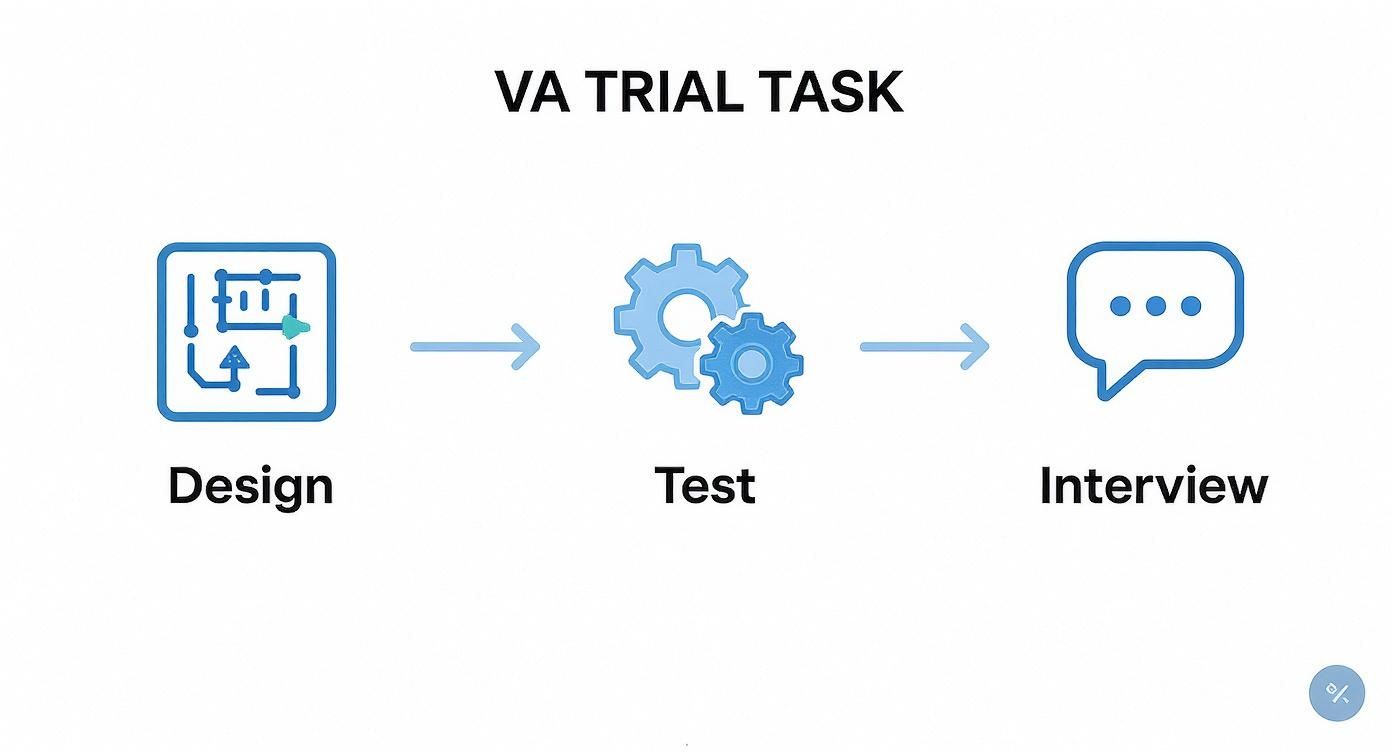
This structured flow ensures that by the time you start onboarding, you’re building on a proven foundation.
The 5-Day Onboarding Sprint Checklist
This sprint isn’t about burying your new VA in busy work. It’s a focused immersion into your systems, communication style, and priorities. Each day has a theme designed to build clarity and momentum.
Day 1: Systems and Security
The first day is all about giving them the keys to the kingdom—smoothly and securely. Stop emailing passwords. It’s a massive security risk. Use a password manager like 1Password or LastPass to share credentials safely.
Grant access to all the essentials: email, calendar, project management tool (Asana, Trello, etc.), and your main communication channel (Slack/Teams).
Jump on a 30-minute kickoff call. Walk them through the tech stack and answer any immediate questions.
Give them their first task: a simple tech audit to confirm they can log in to every single tool. This confirms access and gives them an easy first win.
Day 2: Communication and Cadence
This is all about setting the rhythm for how you'll work together. Getting this right prevents 90% of future misunderstandings.
Define your communication rules. When is Slack appropriate versus email? Is it ever okay to call? Be explicit.
Establish a daily check-in. This is non-negotiable for the first few weeks. It can be a 10-minute huddle in the morning or a quick end-of-day summary on Slack.
Clarify your expectations for response times. For example, "For Slack DMs, I expect a reply within an hour. For emails, within 24 hours."
The single most important part of onboarding is codifying communication. Assumptions are the enemy of remote work. Write down the rules of engagement so there is zero ambiguity.
Day 3: The "User Manual for Me"
Today, you give them the cheat codes. Your personal user manual is a simple document that radically shortens the learning curve for understanding how you think and work. It's the fastest way to get them operating as an extension of your brain.
Include things like:
How I Communicate Best: "I prefer a single, consolidated EOD summary over a dozen pings throughout the day."
My Core Priorities: "Investor relations is always my top priority. Anything related to our board or funding moves to the top of the list, no matter what."
How I Like to See Options: "When you research something, give me 2-3 vetted options with a clear recommendation. Don't just send me a list of 10 raw links."
My Pet Peeves: "I absolutely can't stand calendar invites that are missing a clear agenda or location details."
This document eliminates the frustrating guesswork and empowers them to align with your preferences from day one.
Day 4: Putting It All into Practice
Time to shift from setup to execution. Assign 2-3 low-risk but real tasks that touch on the systems and preferences you've discussed.
Task 1 (Organization): Have them organize a messy folder in your Google Drive or Dropbox according to a specific structure.
Task 2 (Research): Ask them to find three potential venues for an upcoming team offsite, complete with pricing and availability.
Task 3 (Communication): Have them draft a polite "no, thank you" response to a non-urgent sales email.
You're not just looking for completion here. You're observing their process. How did they communicate when they had a question? How did they present the final work?
Day 5: The Week 1 Retro
End the sprint with a dedicated 30-minute review session. This closes the loop and sets the stage for week two.
Go over the tasks from Day 4. Offer specific, kind, and constructive feedback.
Ask for their feedback. What was confusing? What tool was a pain to use? What would make their job easier?
Clearly outline the key goals and priorities for next week. Give them a clean runway so they can hit the ground running on Monday.
This sprint turns onboarding from a passive, check-the-box exercise into a dynamic, strategic integration. You’re not just handing over logins; you’re hardwiring a new, high-value member into your personal operating system.
The Real Endgame: Turning Your VA Into an Automation Engine
Hiring a top-tier virtual assistant is just the starting line, not the finish. The real power move isn't just about offloading tasks; it's about building a self-improving system where your VA evolves from a task-doer into an outcome-owner.
This is the leap from simple delegation to a true operational partnership. The goal is to create a flywheel: your VA executes a task, documents the process, refines it, and then actively looks for ways to automate it completely. This is how your initial investment in finding the right person pays compounding dividends.
A Better Way to Delegate: The Compounding Loop
Most founders get trapped in a frustrating cycle: assign, execute, repeat. It saves a little time upfront, but they remain the bottleneck. Every single task, every single time, requires their input.
A much smarter approach, and the one we drill into our best operators, is the Delegation Loop. It's a simple, four-stage mental model:
Assign: Hand off a task with clear context and the desired outcome.
Execute: Your VA gets the job done right.
Document: They create a simple, clear Standard Operating Procedure (SOP) explaining exactly how they did it.
Improve: The next time the task comes up, they follow the SOP and actively hunt for ways to make it faster, cheaper, or better.
This simple shift turns every task into a company asset. Instead of a one-off result, you get a documented, repeatable process that anyone on your team could follow. You are no longer the single point of failure.
Empowering Your VA to Build Systems
For this to actually work, you have to empower your VA to own processes, not just check off tasks. This is a crucial psychological shift. You must give them explicit permission—and set the expectation—that they should question how things are done.
Start by tracking metrics that focus on system improvement, not just busywork. Micromanaging hours is a waste of everyone's time. Instead, measure things that create leverage.
Processes Documented: How many new SOPs did they create this week?
Inbox Zero Time: How quickly are they getting your inbox to zero each day?
Tasks Automated: How many recurring tasks did they move into an automation tool this month?
This reframes their entire role. They aren't just managing your calendar; they're building the perfect calendar management system. When your VA sees themselves as an architect of efficiency, they'll start spotting opportunities you're too busy to see.
This trend toward specialized, system-building support is growing fast. For instance, the health intelligent virtual assistant market is projected to skyrocket from USD 513.91 million to USD 4.68 billion by 2034, as experts see the value in assistants who can manage complex, industry-specific systems. You can read more about this trend on Precedence Research.
The moment your VA stops asking, "How do you want this done?" and starts suggesting, "Here's a better way to do this," you've won. You've unlocked a whole new level of leverage.
From SOPs to Zapier: The Automation Flywheel
Once a process is documented and refined, the final, most powerful step is to ask: "Can a robot do this?"
This is where you introduce your VA to tools like Zapier or Make. Encourage them to become an automation hunter, constantly on the lookout for those repetitive, mind-numbing tasks that software can handle. This doesn't make their role obsolete; it frees them up to tackle more valuable, strategic work.
Think about a common task like saving email attachments to a specific folder in Google Drive.
Before: You forward an email to your VA. They download the file, then upload it to the right place.
With the Loop: They create a quick SOP documenting these steps.
With Automation: They build a Zap that automatically watches for emails with certain keywords, saves the attachments to the correct folder, and pings them in Slack when it's done.
Just like that, a manual task that took five minutes several times a day is gone forever. Your VA’s role evolved from doing the task to designing the system that eliminated it.
This is the ultimate expression of leverage. For a deeper dive, our guide on how to automate repetitive tasks is a great place for both you and your assistant to start. This is how you build a personal operating system that truly scales.
Answering Your Lingering Questions
Alright, we've walked through the entire playbook, from finding candidates to getting them started. But I've been through this process enough times to know there are always a few nagging questions that pop up right when you’re about to pull the trigger.
Let's get those sorted out so you can move forward with confidence.
What Should I Hand Off First?
This is where most founders get stuck. They try to find the "perfect" task. Don't.
Instead, aim for momentum. For the next three days, just jot down every single thing you do. Look for the tasks that are high-volume, low-strategy, and just plain draining. Anything repetitive that doesn't absolutely need your brain on it is your starting point.
Good first things to delegate usually look like this:
Taming your calendar: All the back-and-forth of scheduling, confirming, and moving meetings.
Inbox triage: Getting junk out of sight, flagging what’s urgent, and maybe even drafting simple replies.
Travel logistics: Booking flights, hotels, and cars based on your known preferences.
Simple research projects: Think "pull together a list of 20 podcasts in our niche" or "find three potential venues for our offsite."
Getting these things off your plate builds trust quickly and gives you an immediate return on your time with very little risk.
What’s a Realistic Budget for a Good VA?
You'll see rates everywhere from $10/hour to over $50/hour. Honestly, thinking about the hourly rate is the wrong way to look at it. You need to think in terms of value and return on your own time.
The cheapest VA is rarely the best deal. A $15/hour assistant who constantly needs you to check their work and provide step-by-step instructions is costing you more in management time than a $35/hour pro who just gets it done.
For a truly great VA—someone who can think ahead and operate as a real partner—you should plan to invest in the $25-$45 per hour range. See this as buying back your time and focus, not just another business expense.
How Do I Give Them Access to My Accounts Securely?
Simple rule: Never, ever email or message a password. Ever. It's a massive security blindspot you just can't afford.
The only professional way to handle this is with a password manager. Tools like LastPass or 1Password are designed for exactly this.
They let you share access to specific logins without revealing the actual password. Best of all, if you ever part ways, you can revoke all their access with a single click. It's non-negotiable for securely delegating work.
Does Their Location Really Matter?
Focus on skill and time-zone overlap, not geography. A rockstar VA in your time zone is a thousand times better than a mediocre one halfway around the world, regardless of the cost savings.
The talent pool is global, which is fantastic. But your main filters should always be:
Fluent English: Communication breakdowns will kill productivity. It needs to be effortless.
Sufficient Time Zone Overlap: You need at least four hours of crossover with your workday for things to run smoothly.
The Right Experience: Look for someone who has worked in a similar fast-paced environment and understands the hustle.
Ready to stop searching and start scaling? Hyperon connects you with the top 1% of global Executive Assistants—vetted for speed, resourcefulness, and the startup DNA you need to win. Find your operator today.