Executive Assistant vs Secretary: A Founder's Guide to Strategic Delegation
Executive Assistant vs Secretary an analysis of the two roles from first principles. Find out which strategic partner is right for your startup.
Dec 11, 2025

Let’s get right to the first principles. The difference between an executive assistant vs secretary is the difference between reactive execution and proactive partnership. A secretary executes tasks within a system. An Executive Assistant helps you architect that system. One manages a to-do list; the other manages outcomes.
As a founder, every hire is either a force multiplier or a source of friction. The EA vs. secretary question isn’t about titles—it's a diagnostic tool for your own operational bottlenecks. Are you simply looking to offload tasks to buy back a few hours, or are you ready to invest in a system that multiplies your output exponentially?
This is the fundamental distinction that high-performers like Tim Ferriss or any a16z-backed founder intuitively grasp. They don't delegate tasks; they delegate entire functions.
The term 'executive assistant' gained traction in the late 20th century precisely because the old model was breaking. The shift signaled a move from traditional, reactive secretarial duties toward an advanced support function—one focused on architecting an executive's entire operational world.
A secretary is a brilliant operator within a system you've designed. An Executive Assistant is a co-designer of that system, constantly iterating and optimizing it.
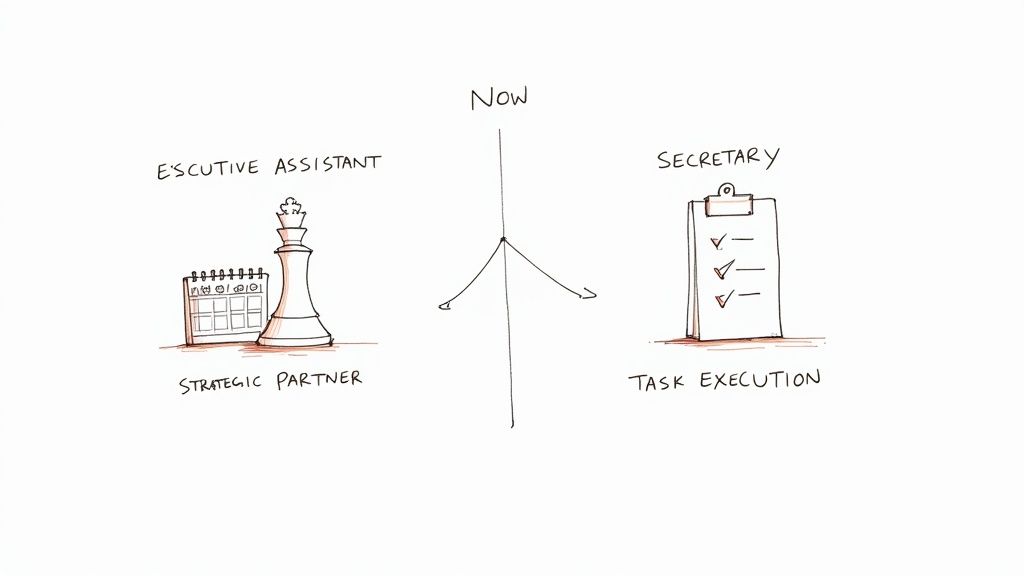
Quick Glance: The DNA of Each Role
This table cuts through the noise. Use it to diagnose your immediate need: are you plugging a leak, or are you building a new engine?
Attribute | Secretary (Task-Oriented) | Executive Assistant (Outcome-Oriented) |
|---|---|---|
Core Function | Executes defined administrative and clerical tasks. | Manages and optimizes the executive's time, focus, and priorities. |
Primary Value | Reliability, organization, and efficient task completion. | Proactive problem-solving, strategic leverage, and system optimization. |
Typical Scope | Handles scheduling, data entry, phone calls, and office logistics. | Oversees project coordination, stakeholder management, and workflow automation. |
Mindset | Reactive: "What do you need me to do?" | Proactive: "Here's what I've handled, and here's what's next." |
While this guide focuses on the nuances between an executive assistant and a secretary, it helps to start with the basics. Getting a solid grasp on foundational support positions, like by defining the roles and responsibilities of an Administrative Assistant, can provide crucial context.
Ultimately, choosing the right person comes down to identifying your biggest bottleneck. As we’ll explore, understanding the strategic leverage a world-class EA provides is essential before you make a hire that will define your capacity to scale.
Deconstructing Roles Through a First Principles Lens
Forget the generic job descriptions you find online—they're mostly noise. To really understand the executive assistant vs. secretary distinction, you have to strip the roles down to their foundational elements. Let's apply some first principles thinking.
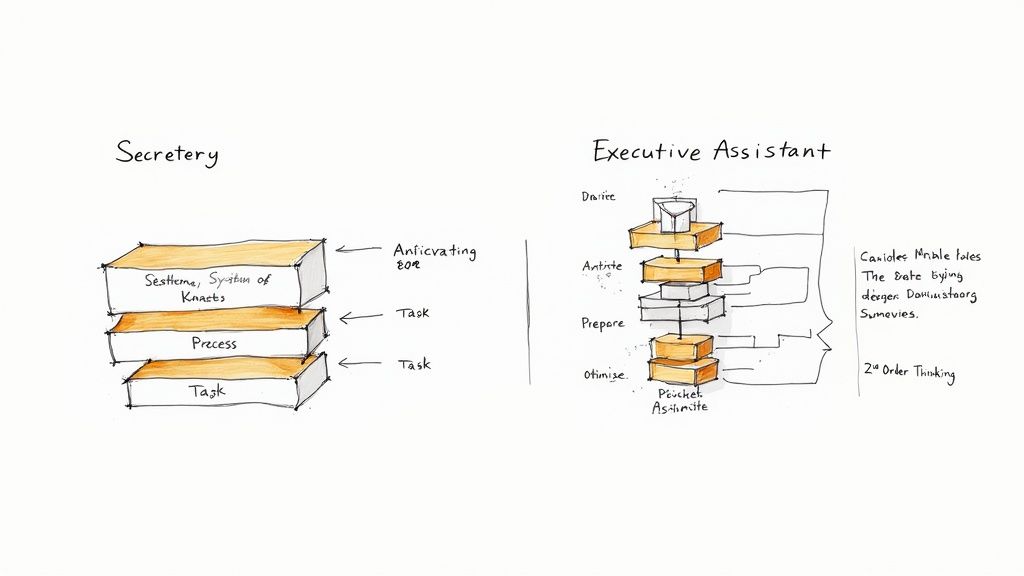
When you boil it down, a secretary operates within a defined system. Their primary function is to execute tasks reliably and efficiently inside that system. Think managing calls, keeping records straight, scheduling appointments as they roll in. Their value is consistency and execution. This is critical, but it's fundamentally reactive.
A world-class Executive Assistant (EA), on the other hand, is a system architect. They don’t just work in your system; they actively design, build, and optimize it. They aren't just scheduling your meeting; they're owning the entire outcome. That means pulling together briefing docs, anticipating follow-up actions, and ensuring you walk into that room with maximum strategic leverage.
Applying the 80/20 Rule to Delegation
Let's run this through a powerful mental model: the Pareto Principle, or the 80/20 rule. Roughly 80% of your results come from 20% of your efforts. As a founder, your entire job is to live in that high-impact 20%—the work that only you can do.
A secretary helps you manage the 80% of tasks that are necessary but low-leverage. They take the administrative weight off your shoulders, freeing you up to focus.
An EA helps you identify and dominate your critical 20%. They proactively find ways to automate, delegate, or eliminate the other 80%, manufacturing bandwidth for your highest-value work.
This isn’t just about clearing your calendar. It’s about re-architecting your entire operating system so your default state becomes strategic focus. This is how founders like Tim Ferriss build empires while seemingly working less. They aren't just working harder; they're working with exponential leverage, often provided by a world-class EA.
Key Differentiator: Gatekeeper vs. Gateway A secretary often acts as a gatekeeper, filtering incoming requests based on a set of rules you provide. An EA, in contrast, functions as a gateway, strategically managing relationships and information flow to create opportunities and fiercely protect your focus.
The Power of Second-Order Thinking
Another mental model that nails the difference is second-order thinking. First-order thinking is simple and immediate: "I need to book a flight." Second-order thinking goes deeper: "What are the downstream consequences of this trip? What prep is needed? Who needs to be briefed? What could go wrong, and how do we pre-solve it?"
A secretary excels at first-order tasks. You ask for a flight, they find the most efficient option. Job done.
An EA lives in the realm of second-order consequences. You tell them you have a key investor meeting in San Francisco. They don't just book a flight. They anticipate you'll need quiet time to prep, so they book a hotel with a reliable business center. They know you'll be jet-lagged, so they buffer your schedule for the following day. They pull together a full briefing packet on the investors, including recent news and even social media activity.
This level of foresight moves beyond task completion into the realm of outcome ownership.
Task Manager vs. Strategic Partner
This deconstruction reveals the core philosophical difference:
A Secretary is a task manager. You provide inputs, they produce the desired outputs. The system is linear and directed by you.
An Executive Assistant is a strategic partner. They are your operational co-pilot, deeply integrated into your goals, constantly looking for ways to improve the entire system.
Their job isn't to check off boxes but to make you more effective. This requires a unique blend of operational excellence and strategic foresight. For anyone serious about scaling their impact, understanding the core skills of a world-class executive assistant is the first step toward finding a true force multiplier. The choice isn't about hiring for a list of tasks; it’s about deciding what level of leverage you're ready to unlock.
The Economics of Support: Analyzing Your Return on Delegation
When you see someone like Jeff Bezos or Elon Musk, you can bet they don't view their Executive Assistant as an expense on the P&L. They see them as a force multiplier—a high-ROI investment in their own productivity. It’s a first-principles way of looking at impact: invest in leverage to multiply output.
Too often, the EA vs. secretary conversation gets stuck on salary. That's a rookie mistake. The real analysis is about the true cost of a hire, the massive opportunity cost of your own time, and what I call your "Return on Delegation."
Beyond Salary: The True Cost of a Hire
Salary is just the price of admission. The full investment includes recruiting, onboarding, tools, and training. To get a real grip on the financials, you absolutely have to understand how to calculate cost per hire correctly.
But even those costs are small potatoes compared to the most critical variable: the opportunity cost of your time spent on low-value work. Every hour you burn on logistics or formatting a deck is an hour you're not spending closing a deal, designing a product, or raising capital.
The Founder's Fallacy: "I'll save money by doing it myself." This is one of the most destructive mental models for any entrepreneur. You aren't saving money. You're trading your most valuable, non-renewable asset—time—for a task someone else could do better and faster for a fraction of your time's worth.
Calculating Your Return on Delegation
Let's do some quick, back-of-the-napkin math. As a founder, your time is easily worth a minimum of $500/hour. We'll be conservative and stick with that.
Now, let's look at the value a top-tier EA creates by freeing you up to focus only on that high-value work.
Time Reclaimed: 15 hours/week
Your Hourly Value: $500
Weekly Value Generated: 15 x $500 = $7,500
Annual Value Generated: $7,500 x 52 weeks = $390,000
Suddenly, an EA's salary doesn't look like a cost anymore, does it? It looks like one of the smartest investments you could possibly make. This is the financial calculus that separates operators who scale from those who burn out. A secretary saves you time on tasks; a great EA generates enterprise value by manufacturing focus for you.
Framing the Salary Discussion Around Value
Of course, salary is a real-world factor. Executive assistants command higher salaries than secretaries, and that difference is directly tied to their strategic responsibility and organizational impact. Based on 2023-2025 data, the average annual salary for an EA in the U.S. lands between $65,000 to $83,000, with senior EAs at top companies earning significantly more. For deeper insights, you can explore EA compensation trends on Indeed.com.
But thinking of this number as a pure "cost" is the wrong mental model. It's the price of admission to unlock hundreds of thousands of dollars in value. The right EA doesn’t cost you money—they make you money by ensuring your time is spent only on things that truly move the needle. This is the core economic principle of strategic delegation.
A Founder’s Framework for Choosing the Right Support
Hiring the wrong support role at the wrong time is a classic unforced error that can kill momentum. Making the right call isn't about filling a seat—it's about getting brutally honest about the single biggest bottleneck holding you back. This isn’t a decision for HR; it requires a first-principles look at your own operational chokepoints.
Are you drowning in administrative quicksand? Your inbox is a disaster zone, your calendar is a mess, and you're bleeding hours on low-value tasks that drain your will to live. If so, the 80/20 solution might be a virtual secretary or an administrative assistant. Their job is to pull you out of the weeds so you can breathe.
But what if you're leading a growing team, juggling investor calls, and your schedule looks like Tetris on the highest difficulty? Your bottleneck isn't just task management; it's a complete lack of strategic bandwidth. You're deep in Executive Assistant (EA) territory.
I've put together a decision tree to help you pinpoint your primary bottleneck and map it to the right role.
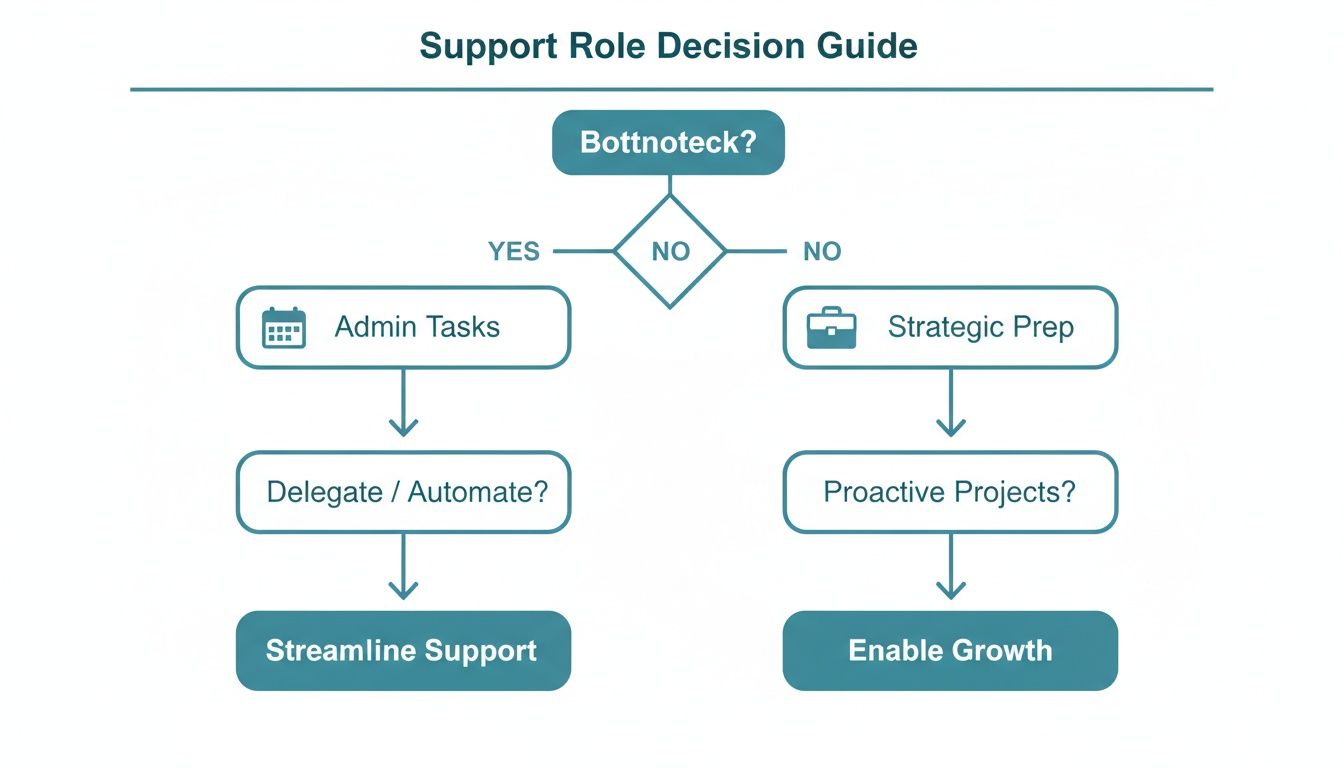
This flowchart gets to the core question: are you trying to streamline existing tasks (a secretary's world) or unlock entirely new strategic capacity (an EA's domain)?
Identifying Your Core Bottleneck
Let's break this down. Forget job titles and focus on the problem you need to solve. What is the one thing holding back your effectiveness right now?
If your main bottleneck is task overload... you need a secretary. This is about clawing back hours. The pain is tangible: a chaotic schedule, disorganized files, missed follow-ups. You need someone to reliably execute a defined set of tasks and get things off your plate now.
If your main bottleneck is a lack of leverage... you need an EA. This is about multiplying your impact. The pain is strategic—you’re showing up unprepared for key meetings, dropping the ball on important relationships, and constantly firefighting instead of driving the business forward. You need a partner to anticipate what's next, manage complex projects, and act as your operational co-pilot.
A helpful mental model: The Painkiller vs. The Vitamin A secretary is a painkiller. They offer immediate relief from the acute pain of administrative overload. An EA is a vitamin—a long-term investment in your strategic health that makes you more effective, resilient, and capable of sustained high performance.
An 'If-Then' Framework for Your Next Hire
To make this even more concrete, use these "if-then" scenarios to diagnose your need over the next 12-18 months. Be honest.
IF your inbox and scheduling eat up more than five hours of your week, THEN a secretary or administrative assistant is your immediate priority.
IF you constantly find yourself prepping your own briefing documents and chasing project updates, THEN you need an EA to own those outcomes.
IF your primary goal is simply to stop doing low-value administrative work, THEN a secretary will solve that problem cleanly.
IF your primary goal is to create more time for deep work, strategic planning, and building key relationships, THEN only a strategic EA will get you there.
Think of it like a high-performance engine. A secretary keeps it clean and running smoothly. An EA is like adding a turbocharger—they fundamentally increase the engine's power and output. Deciding between an executive assistant vs secretary is choosing whether you need maintenance or a major performance upgrade.
The Playbook for Hiring a Force Multiplier
Finding a top-tier Executive Assistant isn't something you can delegate to HR. That's a huge mistake. As a founder, you have to own this process. Hiring a great EA is like finding a co-founder for your operations. You’re not filling a role; you’re installing a strategic asset who will directly amplify your effectiveness.
The goal isn't finding someone who can tick off tasks. You need a partner who thinks ahead, anticipates corners, and takes ownership of outcomes. This calls for a different hiring playbook—you're looking for someone with the strategic mind of a Chief of Staff and the execution skills of a master operator.

Crafting a Job Description That Attracts Strategic Thinkers
Your job description is your first filter. If it sounds generic, you'll get generic candidates. It needs to be a magnet for high-agency people and a repellent for passive task-doers.
Stop listing duties like "manage calendar." Start framing the work around its impact. This simple language shift changes everything.
Don't say: Manage executive's calendar.
Instead, say: Architect and defend the CEO’s time to ensure maximum focus on high-leverage activities.
Don't say: Handle travel arrangements.
Instead, say: Own all travel and logistical outcomes, designing seamless experiences that minimize friction and optimize productivity on the road.
Don't say: Prepare reports.
Instead, say: Synthesize complex information into clear, concise briefing documents that enable rapid, high-quality decision-making.
This framing speaks to people who want to be strategic partners. It sets the expectation from day one that this role is about ownership.
The Interview Questions That Reveal True Proactivity
Typical interview questions are useless. You need to simulate real pressure to test for resourcefulness, discretion, and second-order thinking. The idea is to see how they think.
Here are a few of my go-to questions:
The Preparation Scenario: "Walk me through, in detail, how you would prepare me for a critical investor meeting, starting 72 hours out. What information would you gather, what problems would you anticipate, and what would my briefing packet look like the morning of?"
The Proactive Problem-Solving Test: "Describe a time you identified a potential problem in your executive's workflow and solved it before they were even aware. What was the situation, your thought process, and the outcome?"
The Ambiguity Gauntlet: "I need to be in London next month for meetings. That's all the information I'm giving you. What are the first ten questions you would ask to turn this ambiguous request into a successful outcome?"
The Prioritization Challenge: "It’s Monday morning. I've sent you five urgent emails, your Slack is blowing up, and a board member just called your phone directly. Walk me through how you triage this in the first 15 minutes."
These questions don't have right answers. They reveal a candidate's mental models for solving real problems.
Key Insight: Test for Agency, Not Just Skill A candidate can learn a new software tool in an afternoon. You can't teach someone to have a high sense of agency or an obsession with ownership. Your hiring process must be ruthless in filtering for these innate traits above all else.
The Founder's Hiring Checklist
A rigorous, structured process helps you decide based on evidence, not just gut feel. My team and I have fine-tuned this over hundreds of hires. For a deeper dive, you can read our complete guide on how to hire an executive assistant.
Treat this checklist as non-negotiable:
Skills Assessment: A practical test is a must. Give them real tasks. Have them draft an email to an investor, proofread a document with seeded errors, and solve a complex scheduling puzzle with conflicting priorities.
Reference Checks Reimagined: Don't ask, "Were they a good employee?" Dig deeper. Ask, "Give me an example of a time they saved their executive from a major mistake," or "How did they handle highly confidential information?"
The "One-Week Trial" Project: For final candidates, consider a paid, short-term project. Give them a real, low-stakes task to manage. It's the ultimate test of their communication style, resourcefulness, and ability to deliver.
Hiring a genuine force multiplier is one of the highest-leverage moves a founder can make. It deserves that level of seriousness.
Frequently Asked Questions
Even with a clear roadmap, there are always lingering questions. Let’s tackle some of the most common ones I hear from founders wrestling with the executive assistant vs. secretary decision.
Can a Secretary Grow into an Executive Assistant Role?
Absolutely, but it’s a bigger leap than most people think. The key is a fundamental mindset shift. Growth isn't about doing more tasks; it’s graduating from executing instructions to owning outcomes. They have to move from asking, "What do you need me to do?" to proactively stating, "Here's what I think we should do, and here’s why."
As a founder, you can guide this. Start by delegating projects with ambiguity. Give them ownership over a small outcome, not just a series of steps. You'll know they're ready when they start anticipating your needs and solving problems before they hit your desk.
What Is the Difference Between a Virtual Assistant and an Executive Assistant?
This is a critical distinction many founders get wrong. A Virtual Assistant (VA) is usually a remote, transactional contractor hired for a narrow set of tasks. VAs often work for multiple clients on things like social media scheduling or basic data entry. You hire a VA to perform a specific function.
An Executive Assistant (EA) is a dedicated strategic partner embedded in your workflow and business goals, whether remote or in-office. They handle confidential information, manage complex projects, and build relationships with your key stakeholders.
Mental Model: A VA is like renting a specific tool for a job. An EA is like adding a master mechanic to your crew who not only knows how to use every tool but also helps you tune the entire engine for peak performance.
How Do I Effectively Delegate to a New Executive Assistant?
Proper delegation isn't offloading your to-do list; it’s transferring responsibility for outcomes. The goal is to get out of micromanagement and into what Tim Ferriss calls "liberation management." You have to empower them to think for you.
Start by creating a comprehensive "delegation document." This is a living guide to how you work: communication preferences, key contacts, recurring processes, personal preferences. It’s the operating manual for working with you.
In the beginning, assign small, well-defined projects with clear success metrics to build trust. As they deliver, shift from process-driven requests to outcome-driven ones.
Bad Delegation: "Please book me a flight to NYC on Tuesday."
Good Delegation: "I have a 10 AM meeting in NYC on Tuesday. Please handle all logistics. The goal is to minimize travel time and ensure I have at least two hours of focused work time before the meeting."
The second approach gives them autonomy to think critically and add value far beyond booking a ticket.
What Are the Key KPIs to Measure the Success of an EA?
Measuring an EA's impact requires looking past a task checklist. Their real value is the leverage they create. The best KPIs are tied directly to your productivity and the company's efficiency.
Here are the metrics that actually matter:
Hours of Your Time Reclaimed per Week: The ultimate KPI. Track how many hours you get back from administrative and operational work that you can now reinvest into high-value activities.
Reduction in Your "Reactive" Time: A great EA smooths out the road ahead. You should see a noticeable decrease in the time you spend putting out fires.
Inbox and Communication Metrics: If a chaotic inbox is a primary pain point, track metrics like the percentage of emails handled without your direct input or the average response time to critical messages.
Qualitative Feedback from Key Stakeholders: How seamlessly is your EA managing relationships with your board, investors, and leadership team? Their ability to act as a frictionless extension of you is a powerful, though less quantitative, measure of success.
At Hyperon, we specialize in connecting founders with that top 1% of Executive Assistants who are genuine force multipliers. We find the strategic partners trained in the art of delegation and operational excellence, so you can reclaim your focus and scale your impact. Learn how a Hyperon EA can transform your productivity.