The Mental Model for Leverage: Rethinking the Role of an Executive Assistant
Discover the role of executive assistant and how they act as a strategic partner to drive efficiency, delegation, and growth.
Dec 3, 2025
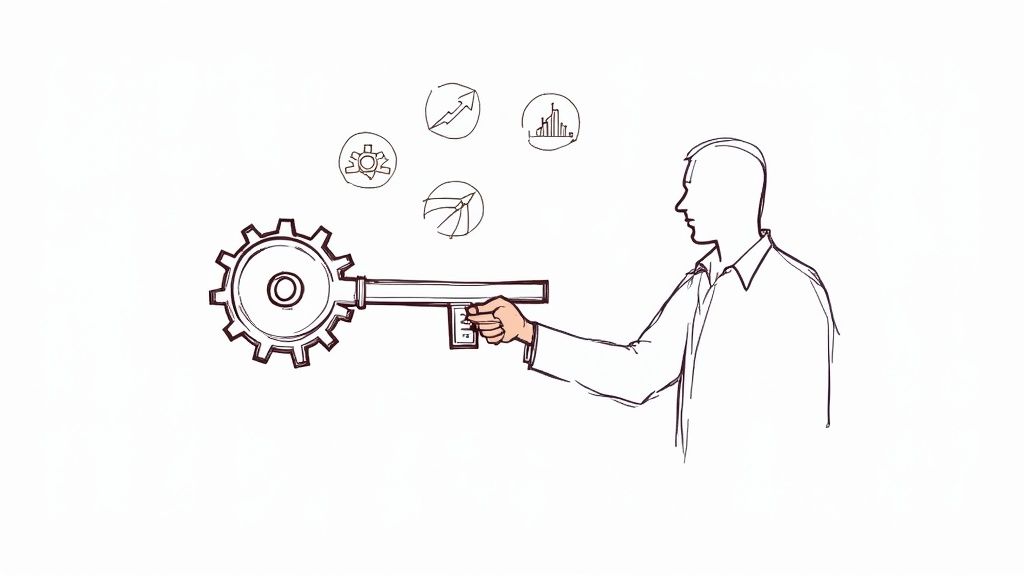
Most founders get the role of an executive assistant completely wrong. They see it as a line item expense for managing a calendar and fetching coffee. That mental model is a self-imposed ceiling on your company’s potential.
The real role of an executive assistant, from first principles, is to be your operational co-founder—a true force multiplier who buys back the only asset you can't make more of: time.
Rethinking The Executive Assistant's Role: A First Principles Approach
Let's break it down. Why do high-potential founders burn out? It's rarely a lack of vision. It's a failure to scale themselves. The founder—you—becomes the bottleneck for every decision, every email, every meeting.
Every minute you spend on a task that someone else could do is a minute stolen from fundraising, product strategy, or closing a key hire. This is where the antiquated idea of an "assistant" completely self-destructs.
The most effective operators I know—think Musk, Bezos, or someone like Tim Ferriss who obsesses over this stuff—don’t have “assistants.” They have operational partners who function as extensions of their own brains. They don't just delegate tasks; they delegate entire outcomes and areas of responsibility. This distinction is the entire game.
From Task Manager to Force Multiplier
You need to reframe your thinking. Your EA isn't an admin; they're a Chief of Staff in training. This isn't just semantics; it's a fundamental shift in your personal operating system. A world-class EA doesn’t just check your inbox; they build a system to triage it, responding on your behalf so that only the 1% of messages that truly require your unique input ever reach your screen.
They don’t just book travel. They optimize the entire trip for peak performance—pre-planning meals, scheduling decompression time, and ensuring you hit the ground ready for battle.
The goal isn't to offload work. The goal is to create leverage. A great EA gives you the freedom to operate at a level you simply cannot reach alone, creating the bandwidth for the deep, focused work that actually moves the needle.
This isn’t just a nice-to-have; it's a structural necessity for high-performance organizations. The demand is obvious, with over 304,678 Executive Assistants currently employed in the U.S. alone. The average age of 49 points to a workforce with deep, seasoned operational expertise, not entry-level task-checkers.

Building a Scalable Operating System
Your partnership with an EA is the first, most critical step in building a scalable company. It’s where you begin to document, systematize, and eventually automate the processes that run your life and your business.
This isn’t about finding someone to handle your personal errands, though that might be a small part of the scope. To get this right, you need to understand the fundamental differences between a personal assistant vs an executive assistant. A true EA is focused on building and running the systems that enable business growth.
This strategic partnership is the key that unlocks the next level of output. When you stop viewing the role of an executive assistant as a cost and start seeing it as an investment in your own focus, you’re finally on the path to building something that can scale beyond your personal limitations.
The Four Functions of a Modern Executive Assistant
To really understand the impact of a world-class EA, you have to abandon the laundry list of tasks. The modern role of an executive assistant isn't about what they do; it's about the function they serve and the outcomes they own.
After building this system for hundreds of top founders, I’ve distilled the role into four distinct functions. Each one builds on the last, creating a compounding effect that moves from tactical execution to a true strategic partnership. It’s a powerful progression.
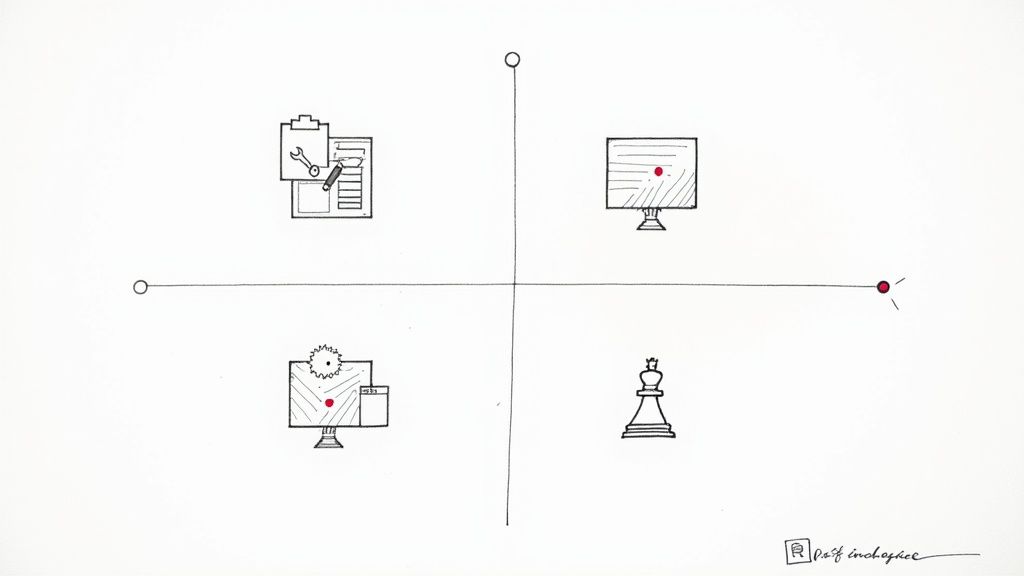
This framework isn't just theory; it’s a mental model for understanding how a great EA delivers compounding value over time.
| The Four Core Functions of a Strategic EA |
| :--- | :--- | :--- |
| Core Function | Primary Objective | Example Activities | | Operator | Flawless execution of core logistics. | Protecting your calendar, managing your inbox, booking all travel. | | Optimizer | Systematically improve workflows and efficiency. | Building project templates, automating follow-ups, refining processes. | | Proxy | Act and communicate on the executive's behalf. | Drafting emails, leading initial screening calls, representing you internally. | | Strategist | Provide high-level insight and thought partnership. | Prepping for board meetings, anticipating risks, managing strategic projects. |
Let's break down what each of these functions looks like in the trenches.
The Operator
This is the foundation, the bedrock. An Operator masters the logistics of your life and work, creating a frictionless environment for you to do your highest-leverage thinking. They are tactical masters who ensure the trains run on time, every time.
This function is about flawless execution of the fundamentals:
Calendar Management: This isn't just scheduling. It's aggressively defending your time like a fortress. They are the gatekeepers who ensure your calendar reflects your priorities, not the inbound chaos of everyone else’s agenda.
Inbox Management: They build a system to triage your email, answering what they can, archiving the noise, and surfacing only the 1-2% of messages that absolutely require your cognitive energy.
Travel and Logistics: Every trip is planned with military precision. From flights and hotels to ground transport and dinner reservations, all details are handled. You just focus on the mission.
The Optimizer
Once the Operator function is locked down, the EA evolves into an Optimizer. They shift from just doing tasks to actively improving the systems behind those tasks.
An Optimizer is obsessed with efficiency, constantly applying the mental model of "How can we do this better, faster, or with less energy?" They are your personal process improvement engine. They don't just schedule board meetings; they create a reusable template in Asana, automate follow-ups, and refine the agenda based on post-mortem analysis.
The Optimizer’s goal is to obsolete their own manual tasks. They don't just manage chaos; they systematically destroy it by building robust, repeatable systems that reduce your cognitive load.
The Proxy
The third evolution is the Proxy. This level is built on deep trust and calibration. A Proxy can act on your behalf, communicating with your voice and intent. They become an extension of you, freeing up a massive amount of your time and mental bandwidth.
They draft emails to investors that sound like you wrote them.
They represent you in initial screening calls with potential hires or partners, filtering for signal.
They provide context to your leadership team when you're heads-down, ensuring momentum is never lost.
A massive part of this is information capture and distribution. To ensure nothing is ever lost in translation, it’s critical they know how to take effective meeting notes that drive action.
The Strategist
Finally, the EA reaches the level of Strategist. At this stage, they are a true thought partner. Because they’ve mastered the operational details (Operator), streamlined the systems (Optimizer), and earned your complete trust (Proxy), they possess a unique, ground-level view of the entire business.
They anticipate problems before they become fires, contribute to high-level planning, and even own strategic projects. A Strategist might help you prep for a board meeting by not just gathering data, but by proactively identifying the tough questions and potential objections from board members. They become a critical sounding board—someone who deeply understands both your personal operating system and the company's strategic goals.
These four functions—Operator, Optimizer, Proxy, and Strategist—create a powerful compounding effect. Each level builds on the last, transforming the role of an executive assistant from a support position into one of the biggest strategic advantages a leader can have.
Why a Great Executive Assistant Is a Profitable Investment
Most founders make a critical accounting error when they think about the role of an executive assistant. They file it away as a cost, just another line item under SG&A expenses. This mental model is completely broken. A world-class EA isn't an expense; they're an investment vehicle with a massive, immediate, and measurable return.
If you're skeptical, let's break it down from first principles. Your single most valuable, non-renewable asset is your time. Every minute of your day has an implicit value. Billionaire investor Naval Ravikant famously set an aspirational personal hourly rate for himself, and he simply refused to do any task he could delegate for less. It’s a simple but profound way to optimize your life.
This isn’t about ego. It’s about pure financial leverage.
Calculating Your Leverage Ratio
Let's run the numbers. Start by calculating the real value of your time. Take your company's total valuation and divide it by the number of productive hours you work in a year. If you're the founder of a $10M company working 2,500 hours a year, your time is literally worth $4,000 per hour.
Now, audit your calendar and to-do list from last week. How many hours did you burn on tasks that were not worth $4,000/hour? Things like scheduling meetings, booking travel, chasing down follow-ups, or formatting a presentation. These are all necessary tasks, but they are absolutely not $4,000/hour work.
Every task you handle that falls below your calculated hourly rate is not just a poor use of your time—it's a direct financial loss to your company. You are actively choosing to perform a $50/hour task when you could be generating $4,000/hour in value.
This is the entire financial case for an EA in a nutshell. The salary you pay isn't a cost; it's a direct investment in buying back your highest-value hours.
The ROI of Reclaimed Time
Let's make this real. A great EA can easily reclaim 15-20 hours of your work week. Even if we're conservative and say they save you just 15 hours, the math is staggering:
15 Hours/Week x $4,000/Hour = $60,000/Week in reclaimed value.
That’s an astronomical return. Even if you think your time is only worth $500/hour, you're still looking at a reclaimed value of $7,500 per week. Suddenly, the conversation about salary looks completely different, doesn't it?
Executive Assistant compensation has climbed significantly, reflecting this strategic importance. The median annual wage is around $65,980, but top-tier EAs supporting C-suite leaders often earn well over $104,000. Even at the highest end of the market, the payback period on this investment is measured in days, not years. You can find detailed salary benchmarks that show just how much leverage you can get.
Beyond the Tangible Returns
The numbers alone are compelling, but the hidden returns are where the real magic happens. An EA’s greatest contribution is reducing your cognitive load and decision fatigue. Think about it: every tiny decision—what time to meet, which flight to book, how to word a reply to a low-priority email—drains your finite mental energy.
By handing off these decisions to a trusted operator, you save your best brainpower for the only things that truly move the needle: product, strategy, and people. For EAs who want to demonstrate this incredible ROI, understanding how to improve operational efficiency with AI is a game-changer for maximizing their impact.
This strategic offloading of mental clutter creates the space you need for clarity and deep work. That's the space where breakthrough ideas are born and game-changing deals get closed. You can't put a price tag on that, but it's the ultimate return on your investment.
Building Your Digital Command Center
A modern Executive Assistant isn't just great with people; they’re an architect of digital systems. That’s the ultimate form of leverage. The best founders I know don’t just delegate tasks—they delegate the construction of entire systems. And today, those systems are all built on technology.
The most effective EAs I’ve ever worked with operate like what I call "centaurs"—a powerful blend of human intuition and machine-like efficiency. They don't just react to your needs; they build a digital command center that actually anticipates them. This isn't about simply using a few apps. It's about creating a seamless operational nervous system for you and your company.

From Manual Tasks to Automated Workflows
Let's get down to brass tacks. An amateur assistant schedules your meetings. A world-class EA, on the other hand, builds you an automated scheduling machine with tools like Calendly or Motion that intelligently protects your deep work time.
An amateur triages your inbox. An elite EA designs AI-powered filters and uses a tool like Superhuman to ensure you only see what's absolutely critical, handling the rest on their own. This leap from manual labor to system architect is the very core of the modern role of an executive assistant. They aren't just a user of tools; they are the integrator that makes your entire tech stack sing.
Your EA's job is to make technology your servant, not your master. They should be the one experimenting with the latest tools so you don't have to, implementing what works and ditching what doesn't. Their real goal is to build a system so seamless you barely even notice it's there.
The Essential Tech Stack
While the specific apps will always change, the core functions don't. A top-performing EA builds your command center around a few key pillars, creating a single source of truth for your entire operation.
Project Management: This is the backbone. Tools like Asana, Trello, or Notion become the hub for tracking every single initiative, from planning a board meeting to shipping a new product feature. The EA owns this system, guaranteeing nothing ever slips through the cracks.
AI Assistants: The rise of AI has been a genuine game-changer. In fact, Executive Assistants are 42% more likely to use AI than other administrative professionals, with 26% already using it daily. This integration frees them from routine work to focus on what really matters. You can see more data on this trend in this comprehensive report.
Communication Hubs: Sure, everyone uses tools like Slack, but an EA’s true value is in taming the chaos. They structure channels, build automations, and make sure communication is efficient, not just constant noise.
Business Intelligence Dashboards: The best EAs think beyond logistics. They help you keep a pulse on the business by building and managing dashboards that pull data from different sources. This bird's-eye view is crucial for making fast, well-informed decisions. For anyone looking to get started, checking out a comparison of business intelligence tools is a great first step.
The Symbiotic Relationship
This tech-forward approach creates an incredibly powerful feedback loop. The EA uses technology to save you time. That reclaimed time lets you focus on high-level strategy. The clarity you gain is then fed back to your EA, who uses it to refine and optimize your digital systems even further.
It's a compounding cycle of efficiency. This symbiotic relationship between you, your EA, and your tech stack is how you achieve exponential output. It turns the role of an executive assistant from a simple support function into the very engine of your personal and professional productivity.
The 90-Day Onboarding Blueprint
Finding a top-tier EA is like finding a co-founder for your productivity. It's a massive win. But here’s a hard truth most founders learn too late: the hire is only the beginning. The real test is the integration.
A haphazard, “figure it out as you go” onboarding is a surefire way to watch the partnership fail. You can't expect someone to become an extension of your mind without a deliberate process for transferring knowledge. This isn't about handing over a laptop and a list of passwords. It’s about forging an unbreakable operational alliance.
This 90-day playbook is the exact system I’ve used and refined with countless founders. It’s designed to take an EA from supervised task-doer to a proactive, autonomous operator. This is how you build a partnership that actually scales.
Phase 1: The First Week of Mind-Melding
The first five days are a full-immersion sprint. The goal is simple but intense: download your brain. Your new EA's only job is to shadow you, observe, and document everything. Think of them as a biographer of your work life, creating a "User Manual" for you as an executive.
This manual becomes the foundational document for your entire partnership. It should capture:
Your Mental Models: How do you make decisions? What are your first principles for business, communication, and life? What frameworks do you lean on?
Your Preferences: How do you like your calendar structured? What's your automatic "yes" or "no" for meeting requests? How do you prefer information—brief summaries or detailed reports?
Your Processes: Document every recurring task, from how you review metrics to how you prep for board meetings. No detail is too small.
The goal this week isn't high output from the EA. The goal is deep learning and documentation. Believe me, this initial investment pays dividends for years to come.
Phase 2: Days 8-30 – Supervised Execution
With the User Manual as their guide, the first month is all about building trust through supervised execution. Your EA now moves from shadowing to doing, but with a very tight feedback loop. This is the calibration phase.
During this period, you establish your core communication rhythms. These are the non-negotiable touchpoints that keep you both aligned and build momentum.
Daily Stand-Up (15 minutes): A quick morning sync to review the day's priorities, flag any potential roadblocks, and confirm objectives. This isn't a status report; it's a tactical huddle.
End-of-Day Summary: A brief email from your EA outlining what was completed, what’s still open, and any key takeaways or questions from the day. This creates clarity and closure.
Weekly Review (30 minutes): A dedicated session to look at the week ahead, discuss what worked and what didn't in your partnership, and refine processes from the User Manual.
The objective of the first 30 days is to build confidence—both yours in their ability and theirs in their understanding of your needs. You should be delegating tasks, reviewing the output, and providing immediate, direct feedback. Micromanagement here isn't a bug; it's a feature, but only for a short time.
Phase 3: Days 31-90 – The Path to Autonomy
By the second month, your EA should be operating with more and more independence. The training wheels come off. Your role shifts from direct supervisor to strategic guide. They are no longer just executing tasks you assign; they are starting to anticipate needs and manage entire outcomes on their own.
This is where you define crystal-clear Key Performance Indicators (KPIs) to measure their impact. These can't be task-based (e.g., "answered 100 emails"). They have to be outcome-oriented.
Reclaimed Hours: The number of hours you get back on your calendar each week. This is the ultimate metric of their success.
Inbox Zero Rate: The percentage of days your inbox is fully triaged and organized by the end of the day.
Project Completion Rate: The percentage of delegated projects completed on time without you needing to step in.
By day 90, the transformation should be complete. Your EA is no longer just an assistant; they are an operator who owns their domain. They're proactively managing your time, protecting your focus, and running the systems that allow you to do your absolute best work. This is the true role of an executive assistant in a high-growth environment.
If you're just starting this journey and need to articulate these expectations clearly, our executive assistant job description template can provide a solid foundation for defining these responsibilities from day one. This blueprint ensures you don’t just hire help; you build a genuine strategic advantage.
Frequently Asked Questions About the EA Role
Even after laying out all the numbers and operational benefits, I see a lot of founders get stuck. They hit a few common mental roadblocks—old ways of thinking that stop them from making what could be the single most important hire of their career.
Let's cut through the noise and tackle these questions head-on. No vague promises here, just a straightforward breakdown to help you get past the analysis paralysis and take action.
How Can I Justify the Cost When We’re Still Lean?
This is the big one, and it comes from looking at the problem all wrong. You’re seeing an EA as a line item expense, not as a direct investment in your own output. Stop thinking about their salary as money out the door and start thinking of it as buying back your own time.
Let's run the numbers again. If you value your time at a conservative $500/hour, and a great EA saves you just 15 hours a week, you're creating $7,500 of value. Every single week. A top-tier remote EA might cost around $2,000 a week. That isn't a cost; it’s a 3.75x weekly return on your investment.
The real question isn’t, "Can I afford an EA?" It’s, "Can I afford to keep doing $50/hour tasks when I should be generating $500/hour in value?" Every day you wait, you’re choosing to burn your most valuable asset: your own focus.
What If I Don’t Have Enough Work to Give Them?
This is a classic failure of imagination. If you truly believe you don’t have enough to delegate, it just means you haven't done a serious audit of your time. Try this: for one week, log every single thing you do. Every email you answer, every meeting you schedule, every report you format, every flight you book.
I guarantee you'll find 10-20 hours of work that is not the highest and best use of your time as a founder. At first, delegating feels like more work because you have to explain and document things. But that’s a small, one-time investment for a massive long-term payoff.
Start with the basics:
Inbox Triage: Give them clear rules for what to archive, what to flag for you, and what they can answer on your behalf.
Calendar Gatekeeping: Block out your "deep work" time and empower your EA to protect it like a fortress.
Meeting Prep: Have them build pre-read docs, pull relevant data, and draft agendas for all your key meetings.
Once these simple systems are humming along, you'll wonder how you ever got by without them. The work is there. You just have to be willing to see it and let it go.
Can a Remote EA Really Be as Effective?
The whole remote versus in-person debate is usually a stand-in for a much deeper question: "Can I build enough trust and communication to make this work from a distance?" The location is almost irrelevant; it's the system that matters.
A world-class remote EA partnership is built on two things: a solid digital command center and a crystal-clear communication rhythm. With tools like Slack, Asana, or Notion, a remote EA often has more insight into your workflow than someone sitting in the next office.
The secret is in the onboarding. A deliberate, structured 90-day plan is what creates that deep mind-meld, no matter the geography.
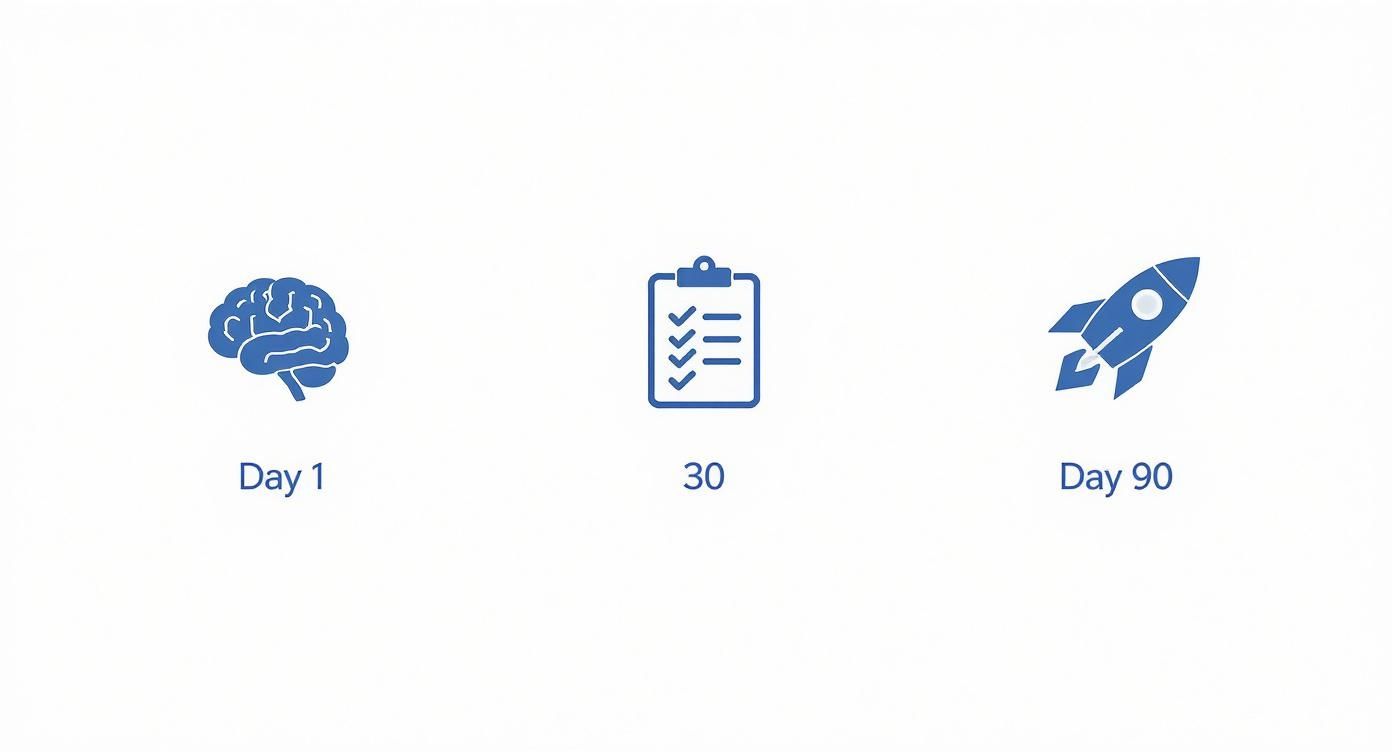
This journey—from the initial brain-dump to full, proactive ownership—is all about process, not proximity.
Think about it: people like Peter Thiel have been running global companies with distributed teams for decades. The limiting factor isn't physical distance; it's your willingness to build and trust a system. A great remote EA isn't a compromise. It's an upgrade that gives you access to a global talent pool with major cost efficiencies.
How Do I Find Someone I Can Truly Trust?
Trust isn't something you find; it's something you build, piece by piece. It's a process, not a switch you flip on day one. You don't hand over the keys to the kingdom right away. Instead, you build confidence through a series of small, intentional tests.
Start with Low-Risk Tasks: Begin with things like scheduling and research. The blast radius is small if something goes wrong.
Review and Calibrate Constantly: In the first 30 days, be all over their work. Give immediate, direct feedback to help them calibrate their judgment to match yours.
Delegate Outcomes, Not Tasks: As they prove themselves, shift your language. Instead of "book my flight to NYC," say "handle the entire NYC trip." This signals that you trust them to own the entire outcome.
Trust is really just a function of reliability over time. A rigorous hiring process is your first line of defense, but the real work happens during onboarding. By systematically testing and verifying their judgment, you forge the kind of partnership that allows for true, high-level delegation. The role of an executive assistant is ultimately defined by this foundation of earned trust.
Success with an EA isn't an accident. It's the result of focusing on specific, critical factors that create a strong foundation.
Table: EA Partnership Success Factors
Factor | Importance Level (1-5) | Why It Matters |
|---|---|---|
Clear Communication Cadence | 5 | Regular check-ins prevent misalignment and build rapport. Daily stand-ups and weekly reviews are non-negotiable. |
Defined Delegation Scope | 5 | Knowing exactly what to hand off (and what not to) from day one prevents confusion and frustration for both parties. |
Mutual Trust & Respect | 5 | This is the bedrock. Without it, you'll micromanage, and they'll never take true ownership. |
Systematized Onboarding | 4 | A structured 90-day plan accelerates the "mind-meld" process, turning a new hire into a true partner faster. |
Shared Tech Stack | 4 | Using the same tools (e.g., Asana, Slack, Notion) creates a shared "brain" and ensures nothing falls through the cracks. |
Feedback Loop | 4 | A culture of open, honest, and immediate feedback allows for rapid course correction and growth. |
Getting these elements right from the start dramatically increases the odds of building a partnership that doesn't just save you time, but actively multiplies your impact.
Ready to stop being the bottleneck in your own company? Hyperon connects you with the top 1% of global Executive Assistants who are vetted and trained to multiply your impact from day one. Ditch the low-leverage work and get back to building your empire. Find your force multiplier at Hyperon.