A Founder's Guide to Leverage: Why a Virtual Assistant is Your Startup's Ultimate Multiplier
Discover how a virtual assistant for startup can streamline operations, free founders' time, and scale growth—practical tips, tools, and real-world use cases.
Dec 2, 2025

Hiring a virtual assistant for your startup isn't just another line item on the P&L; it's a first-principles decision about your most finite resource: your time. This isn't about offloading tasks you dislike. It's about systematically buying back your hours to reinvest them in activities with asymmetric upside—product, fundraising, and high-stakes deals. Moving from "founder-as-doer" to "founder-as-architect" is the first real step in building a scalable enterprise instead of a high-paying job for yourself.
The Unscalable Founder And The Mental Model of Leverage
Let's be brutally honest. Every founder starts as the bottleneck. It's a rite of passage born from necessity. You have the vision, the drive, and the context, so you handle everything from debugging the checkout flow to scheduling investor calls. But that "I'll just do it myself" mindset, the very thing that got you off the ground, quickly becomes the anchor holding you down. It doesn't scale.
This is where you must think from first principles. What is the real job of a founder? It's not inbox management or formatting a slide deck. Your job is to apply your unique abilities to the highest-leverage activities—the 20% of actions that generate 80% of the results. This is the Pareto Principle in action.
Think about operators like Tim Ferriss or billionaires like Naval Ravikant. They don't have more hours in the day. They are just world-class at applying leverage. They relentlessly audit their time and then eliminate, automate, or delegate anything that isn't in their "zone of genius." The game isn't about working harder; it's about increasing your output-per-hour.
Shifting From Doing To Directing
A virtual assistant is your first and most powerful Leverage Multiplier. They aren't just a calendar admin; they are a strategic partner whose entire mandate is to dismantle the low-value work clogging your schedule.
The default for any founder is doing. Hiring a VA is a conscious, deliberate choice to break that habit. It's the moment you start designing an operational system, not just hacking together a product that relies on your brute force.
Making that mental shift from "doer" to "director" is one of the most pivotal transitions in a founder's journey. It forces you to document processes, define clear outcomes, and create repeatable systems—the very architecture of a company built to last. For founders truly pushing the envelope on efficiency, combining a top-tier VA with tools like AI in accounting creates a nearly unbeatable operational advantage.
To see what this looks like in practice, let's deconstruct a typical founder's 60-hour work week.
A Founder's Time Audit Before And After A VA
Task Category | Hours Per Week Without A VA | Hours Per Week With A VA | Impact On Business Growth |
|---|---|---|---|
Low-Leverage Tasks (Admin, Scheduling, Data Entry, Research) | 25 hours | 5 hours (Oversight only) | Massive time recovery. |
High-Leverage Tasks (Strategy, Fundraising, Sales, Product) | 35 hours | 55 hours | Dramatically accelerates progress on core goals. |
The math is stark. By offloading 20+ hours of administrative drag, you inject that time directly back into the activities that actually create enterprise value.
The chart below visualizes this transformation.
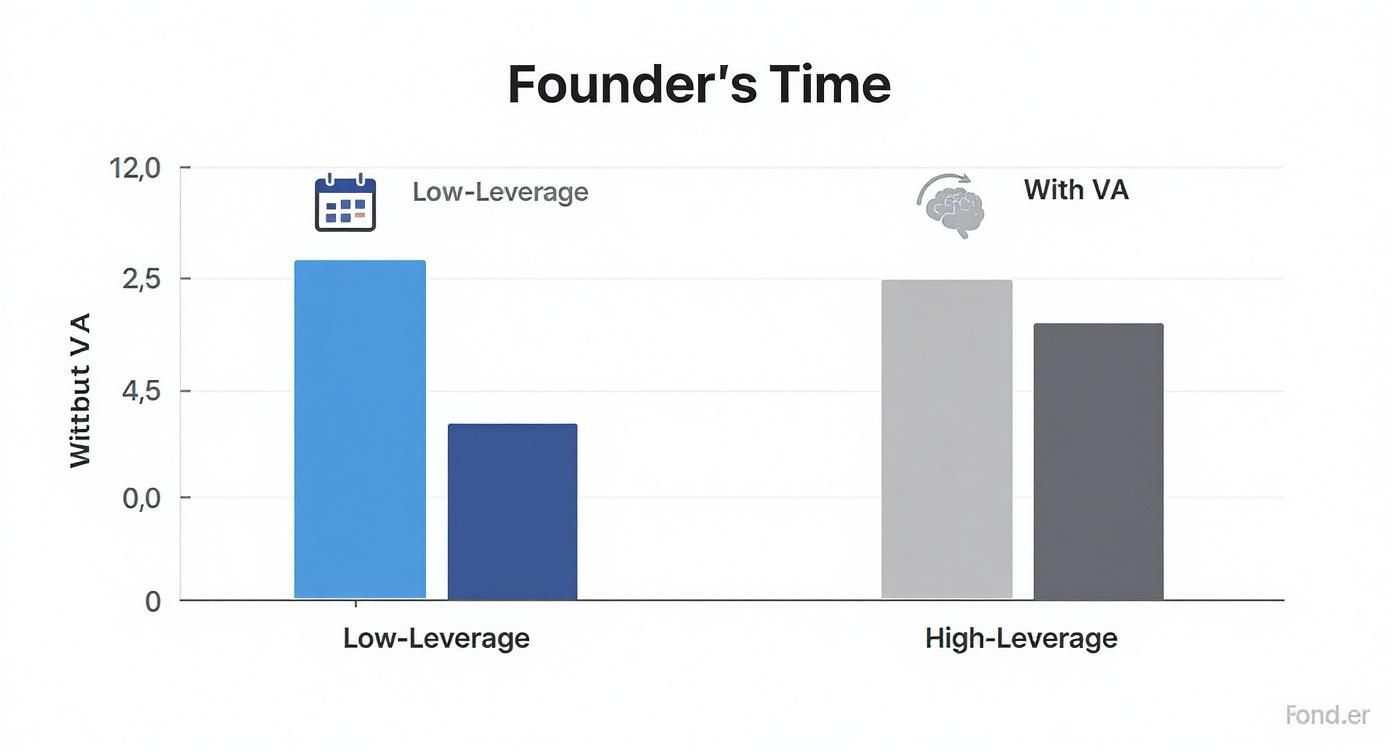
As you can see, a VA completely flips the script. Your time is reallocated from low-impact administrative debt to high-leverage strategic work. This isn't a luxury—it's about using capital efficiently to maximize your velocity and get to the next milestone, faster.
What a Startup Virtual Assistant Really Does
Let's get one thing straight: if you're picturing a simple task-ticker, you're thinking too small. For a founder, a virtual assistant for your startup isn't just an admin. They're a force multiplier. Viewing them as someone to just handle your to-do list is the fastest path to mediocre results.
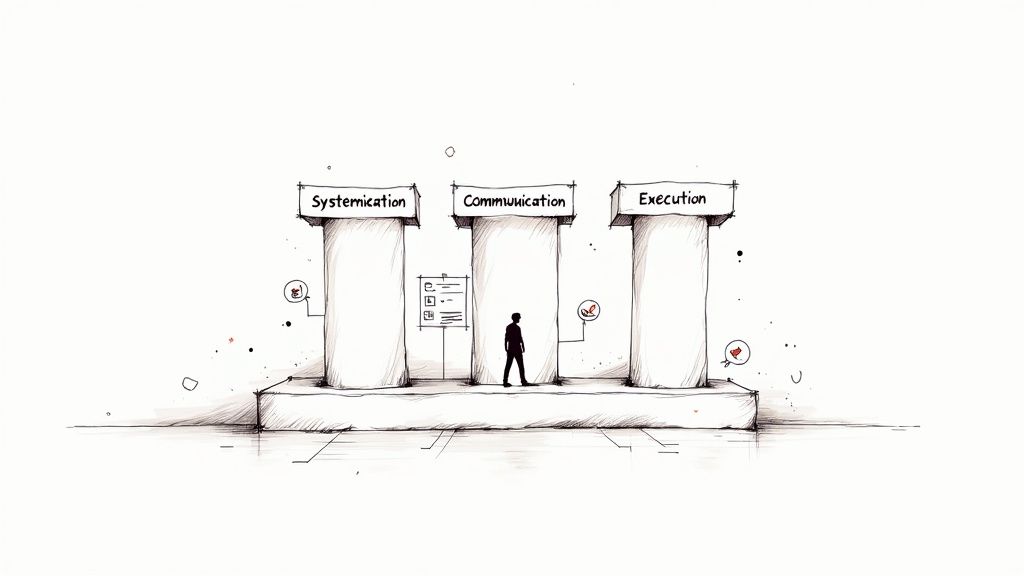
The best VAs don’t just do tasks; they own outcomes. Their real job is to be a strategic partner who manufactures leverage for you. When I place an executive assistant with a founder, I frame their responsibilities around three core pillars. This mental model is what separates a basic support role from an integral part of your growth engine.

Pillar 1: Systemization
A great VA doesn't just do something once. They turn it into a repeatable, documented system that anyone can follow. Founders are brilliant at creating one-off hacks to solve immediate problems. This creates organizational chaos. A world-class VA is the architect of order.
Their job is to observe how you work and relentlessly ask, "How can we productize this process to make it faster, better, and less dependent on you?"
Process Documentation: They build the Standard Operating Procedures (SOPs) for everything—from onboarding a new contractor to publishing a blog post. This becomes your company's operational playbook.
Workflow Optimization: They hunt for bottlenecks. If you burn 30 minutes every week pulling metrics for an investor update, they’ll build a template and a process to automate 90% of that work.
Tool Management: They become the power user of your tech stack—your Asana, Slack, or HubSpot—ensuring information flows smoothly without you becoming the human router.
This first pillar is about building the infrastructure that allows your company to scale beyond your personal bandwidth.
Pillar 2: Communication
As a founder, your focus is your most valuable asset. There's a reason billionaires like Warren Buffett have famously empty calendars—they are ruthless about protecting their time for deep work. Your VA is the gatekeeper who makes this possible.
They manage the constant influx of information, acting as a filter between you and the noise of the outside world.
The VA’s primary communication role isn’t just to respond to emails. It's to build a fortress around your focus time, ensuring only the most critical information gets through. This is non-negotiable for high-output founders.
This goes far beyond basic inbox management. A skilled VA learns to triage requests, draft replies in your voice, and handle routine inquiries so you never see them. They prep you for key meetings with concise briefings and ensure every follow-up is executed flawlessly. This is the core of what an executive assistant does; they manage communication to maximize your impact.
Pillar 3: Execution
The final pillar is about precise, reliable execution. Once a system is defined and communication is clear, your VA takes on well-defined projects with total ownership. This is where you begin to reclaim huge blocks of your time.
And I'm not just talking about scheduling. This is about them owning entire operational verticals.
Project Coordination: Preparing all materials for a board meeting, from chasing down departmental updates to formatting the final presentation deck.
Market Research: Compiling detailed reports on new competitors, potential integration partners, or emerging customer feedback trends.
Personal Logistics: Managing complex travel itineraries, booking personal appointments, and handling the personal admin that would otherwise fragment your focus.
When you entrust these three pillars—Systemization, Communication, and Execution—to a dedicated virtual assistant for your startup, you finally stop being the chief "doer" of everything. You get to step into the role you were meant to have: the chief strategist and visionary for the business.
Calculating The Real ROI Of Delegation
Founders are obsessed with metrics. We track CAC, MRR, and burn rate with religious fervor. But what about the single most critical metric of all—the ROI on your own time? This is where most founders, even the brilliant ones, stop thinking from first principles.
We A/B test ad spend down to the last cent but treat our own 60-hour workweeks as an infinite, free resource. It's not. Every hour you spend on a low-leverage task is a direct withdrawal from the bank account of your startup's potential.
This isn't about comparing a VA's hourly rate to your own. That’s a rookie mistake. The real calculation is about opportunity cost and enterprise value. You have to think like an investor in your own time.
Introducing The Founder Leverage Score
Let's make this tangible. I want you to calculate your Founder Leverage Score. It’s a simple but brutally honest audit of how you spend your days. For one week, track every single task and drop it into one of two buckets:
$100/Hour Work: Inbox management, scheduling, data entry, booking travel, basic research, formatting presentations. These are necessary tasks that don’t require your unique, founder-level genius.
$1,000/Hour Work: Closing a major sales deal, negotiating with investors, defining product strategy, recruiting a key engineer, building a strategic partnership. These are the needle-moving activities only you can do.
Your Founder Leverage Score is the percentage of your time spent on that $1,000/hour work. If you spend 15 hours on high-leverage activities in a 60-hour week, your score is a dismal 25%. That means 75% of your company’s most valuable asset—your time—is being squandered.
Hiring a virtual assistant for your startup is the fastest way to manipulate this score in your favor.
The goal isn't just to buy back time. It's to reinvest that time into activities that create a step-function increase in your company's valuation. Offloading 15 hours of admin doesn't just save you 15 hours; it unlocks 15 hours of enterprise-building work.
The Financial Model For Your Time
Let's run the numbers. Say you hire a world-class virtual assistant for $3,000 a month who takes 20 hours of $100/hour work off your plate each week. That's 80 hours a month you just bought back.
Cost: $3,000 per month.
Time Reclaimed: 80 hours per month.
Value of Reclaimed Time (at a minimum): 80 hours x $100/hour = $8,000.
Immediate ROI: ($8,000 - $3,000) / $3,000 = 167%.
But this is thinking way too small. This is where you see the real benefits of a virtual assistant on a larger scale. What if you reinvest those 80 hours into your $1,000/hour work? Suddenly, you've injected $80,000 of high-value founder activity back into the business for a cost of just $3,000. The ROI becomes astronomical.
This isn't just theory; it’s a capital-efficient growth strategy. Virtual assistants provide significant economic advantages—some studies show they can reduce a company's operational costs by as much as 78%. For a startup, where every dollar is scrutinized, this kind of efficiency is a non-negotiable competitive edge.
A VA Is A High-Yield Investment, Not An Expense
Thinking of a VA as an expense is a fundamentally flawed mental model. It's a high-yield investment in your own output.
When Jeff Bezos was building Amazon, do you think he was spending his time booking his own flights or managing his calendar? Of course not. Elite founders understand that their primary job is to create leverage.
Hiring a VA is your first, most accessible form of leverage. It's the mechanism that allows you to stop being the company's chief bottleneck and start being its chief visionary. Stop analyzing it as a cost center and start modeling it as the highest-return investment you can make in your startup’s future.
The Hiring Playbook For Finding Your Force Multiplier

Hiring a developer is a science. You test for code quality, architectural thinking, and problem-solving with a fair degree of precision. But hiring a virtual assistant for a startup? That’s different. It's less about testing for rote skills and much more about screening for a specific mindset.
You’re not just hiring someone to check boxes. You're looking for trust, radical proactivity, and the ability to think in systems.
Most founders get this wrong. They post a generic job description on a freelance site and wonder why they end up with a task-doer who needs constant hand-holding. That’s a first-principles mistake. You aren’t looking for an extra pair of hands; you're searching for a co-pilot, a genuine force multiplier who frees you up to do your best work.
This playbook is designed to help you find that exact person by filtering for the traits that actually matter.
Freelancer Platforms vs. Dedicated Agencies
Your first decision is where to fish. Both ponds have their merits, but they’re stocked for different needs.
Freelance Platforms (Upwork, Fiverr): These sites offer a massive talent pool and cost flexibility. The upside is choice. The downside? You are entirely responsible for vetting, onboarding, and quality control. It’s a high-effort, high-risk approach that can pay off if you're willing to sift through hundreds of candidates to find a diamond.
Dedicated VA Agencies (like Hyperon): Agencies are a filtration system. They handle the intense vetting for you, screening for essential soft skills, testing for reliability, and providing an extra layer of management and support. You pay a premium, but you're buying back dozens of hours you would’ve spent sourcing and de-risking the hire. For a time-crunched founder, this is almost always the higher-leverage move.
The right model depends on your most constrained resource. If it’s cash, platforms are your starting point. If it’s your time and you need proven quality from day one, an agency is the smarter capital allocation.
Vetting for Traits, Not Just Skills
Once you have a pool of candidates, your interview process must uncover how they think, not just what they can do. Forget questions like, "Are you proficient in Asana?" Anyone can learn a tool in a weekend. What you really need to know is how they approach an ambiguous problem.
My single most important interview question is this: "Imagine I’ve asked you to book a flight for me to a conference in San Francisco next month. You have my calendar and my credit card on file. Walk me through every single step you would take, starting right now."
A mediocre candidate will say, "I'll find the cheapest flight and book it." A world-class EA will immediately start asking second-order questions that demonstrate systems thinking. They'll consider your preferred airline, seating preferences, travel time to the airport, and even check if your hotel is near the conference venue to minimize transit. They see the entire system, not just the isolated task.
If you’re looking for more guidance on this critical step, our detailed article on how to hire a virtual assistant provides a full checklist and more powerful interview questions.
The Paid Test Project
The final step is the most critical: a small, paid test project. A resume is a story someone tells about themselves; a test project is ground truth. Never ask for free work—always pay for their time.
The project should be designed to test three specific things:
Communication: How clearly do they ask questions? Do they provide updates proactively, or do you have to pull information from them?
Resourcefulness: When they hit a wall, do they give up and wait, or do they come to you with proposed solutions?
Attention to Detail: Is the final deliverable polished and error-free? Did they follow all instructions, down to the letter?
A great test project could be: "Please research the top 5 podcasts for startup founders and present your findings in a simple Google Sheet. Include columns for their main topics and guest submission guidelines." This task is simple enough to complete in a few hours but reveals everything about their true capabilities.
This isn’t just about hiring a VA; it’s about finding a strategic partner who elevates your execution from day one.
The First 90 Days: Onboarding for Maximum Impact
The delta between success and failure with a new hire is often decided in the first three months. This is especially true when bringing a virtual assistant into a startup.
Why? Most founders fall into one of two traps. They either micromanage every task, becoming the bottleneck themselves, or they completely abdicate, throwing tasks over a digital wall and hoping for the best. Both are recipes for disaster.
A better mental model for this period is the gradual release of responsibility. You aren't just assigning tasks; you're building a system of trust and autonomy. The goal is to carefully hand over ownership, turning your VA from someone who follows orders into a true extension of yourself. This is less about setting up software and more about calibrating a human partnership.
To get this right, you need a plan. A solid ultimate remote employee onboarding checklist can provide the structure you need to build a strong foundation from day one.
Week 1: Observation and Documentation
Forget about productivity in week one. This week is for immersion. Your new VA should be your shadow, learning the rhythm of how you operate.
Grant them read-only access to your calendar, inbox, and key project management tools. Their primary job is to watch, listen, and start building a "Founder's Manual"—a living document capturing your preferences, processes, and priorities. This manual becomes the bedrock of all future delegation.
It should cover things like:
Communication Style: How do you prefer updates? A quick Slack message? A daily email summary?
Key Contacts: Who are the most important people in your orbit (investors, advisors, top clients)?
Travel Preferences: Aisle or window? Specific hotel chains? Uber or Lyft?
Standard Processes: What's the protocol for submitting an expense report or scheduling a non-urgent meeting?
This upfront investment pays dividends. You explain it once, they document it, and you never have to repeat yourself.
Weeks 2-4: Executing Clearly Defined Tasks
Now it's time to start handing things off. Begin with highly structured, low-risk tasks where "done" is unambiguous. This is not the time for creative interpretation. You're testing for reliability and attention to detail.
The objective here is to build muscle memory and confidence—for both of you. You learn to trust their execution, and they learn your standards. This is where you establish a baseline of operational excellence.
Perfect tasks for this phase include scheduling internal meetings with a strict set of rules, transcribing meeting notes into a standard template, or handling basic data entry. Use tools like Slack or Asana to assign these tasks, always with crystal-clear instructions. This builds the operational rhythm that everything else depends on.
Months 2-3: Proactive System Building
If the first month was about your VA executing your systems, the next two are about them improving those systems. This is the leap from reactive task-doing to proactive problem-solving.
Empower your VA to spot bottlenecks and suggest better ways of doing things. Instead of just booking your travel, they should create a repeatable travel-booking checklist. Instead of just triaging your inbox, they should propose new email filters or canned responses.
Their role shifts from "doing the work" to "improving the work." This is how you find real leverage and build an operational engine that can actually scale with your startup. It's no wonder the demand for this kind of support is booming; the global virtual assistant market is expected to reach nearly $19.66 billion by 2029.
Common Questions From Startup Founders
I’ve had this conversation with hundreds of founders. They’re drowning in work, they know they need help, but the thought of bringing someone new into their controlled chaos feels… exhausting. It feels like one more thing to manage.
If that sounds familiar, you’re not alone. This is a totally normal friction point. The trick is to reframe it. Hiring a virtual assistant for a startup isn’t about adding another direct report; it’s about installing an operating system upgrade for yourself.
Let's deconstruct the most common questions and mental hurdles I see all the time.
How Do I Know If My Startup Is Ready For A Virtual Assistant?
Most founders wait too long. They wait until they are completely submerged. Don't do that.
The key mental model here is opportunity cost. Every minute you spend on a $20/hour task is a minute you're not spending on a $1,000/hour task, like closing a keystone customer or pitching a crucial investor.
The trigger point is simple: if you’re consistently spending more than 5-10 hours a week on repetitive, low-impact work, you’re ready. Just track your time for one week. If you’re the one booking travel, chasing down routine emails, or wrestling with spreadsheets, the decision has already been made for you.
A founder's time is the ultimate finite resource. Wasting it on administrative drag isn't just inefficient; it's a direct act of self-sabotage against your company's growth. If you are post-seed or have any meaningful revenue, you are past the point where you should be doing this yourself.
What Are The Most Common Mistakes Founders Make When Delegating?
The biggest mistake, by a mile, is unclear delegation. A founder drops a vague, one-line Slack message and then gets frustrated when the result is nothing like what they pictured. I call it "drive-by delegation," and it fails because it’s missing two things: context and a clear definition of 'done'.
The second killer is abdicating instead of delegating. Delegation is an active process—it involves training, providing resources, and checking in. Abdication is throwing a task over the wall and hoping for the best. It never works.
To fix this, use a simple framework every single time you delegate:
Desired Outcome: What is the ultimate goal here?
Definition of Done: What does a perfect final result look like, specifically?
Deadline: When is this needed?
Context & Resources: What information or tools are required to succeed?
That small upfront investment in clarity pays back tenfold in execution quality and saves countless hours of painful rework.
Should I Hire A Specialized VA Or A Generalist?
For your first VA? A smart generalist. Without question.
The needs of an early-stage founder are fluid. One day you need someone to research competitors, the next you need them to clean up your CRM, and the day after that you need them to plan a team offsite. You don't need a specialist who only does "social media management"; you need a Swiss Army knife.
You should be hiring for traits, not a laundry list of software skills. You want:
Proactivity: Do they anticipate what you'll need next, or do they just sit and wait for instructions?
Extreme Ownership: When something goes wrong, do they make excuses or do they own the solution?
A Bias for Action: Is their default setting to solve problems and get things moving?
A sharp generalist can learn any tool you throw at them over a weekend. A narrow specialist often freezes when asked to step outside their comfort zone. Your first virtual assistant for a startup needs to be an adaptable force multiplier. You can always bring in specialists for specific, short-term projects later.
How Much Should I Expect To Pay For A Quality Virtual Assistant?
This is where you have to fight the startup instinct to over-optimize for the lowest possible cost. A virtual assistant is not a commodity. While pricing varies by location and experience, you must actively avoid the race to the bottom.
Here are some realistic benchmarks:
Philippines or Latin America: A top-tier, properly vetted VA will typically run you $10-$25 per hour.
US-Based: An assistant based in the US will usually fall in the $30-$75+ per hour range.
Think in terms of value, not cost. A $20/hour VA who saves you 15 hours a week and prevents you from dropping a critical ball provides an infinitely higher ROI than a $7/hour assistant who needs constant hand-holding and actually creates more work for you.
Budget for a part-time role to start (maybe 20 hours a week) and focus on finding someone in the mid-to-high end of the market for their region. This is a direct investment in your own productivity, and honestly, it’s one of the highest-return investments you can make in your business.
At Hyperon, we've built the playbook for this. We connect founders with the top 1% of global Executive Assistants who are pre-vetted for the exact traits that drive startup success. If you're ready to stop being the bottleneck and start multiplying your impact, let's talk. Learn more at https://www.hyperon.com.