Tasks of an executive assistant: 7 essentials for founders
Discover tasks of an executive assistant and learn 7 practical tips to boost founder productivity and smooth operations.
Nov 22, 2025

I've spent years obsessed with a single question: what is the highest-leverage use of a founder's time? It's not fundraising, product development, or sales. It's thinking. Yet, most founders are trapped in a reactive loop of administrivia, answering emails and managing calendars instead of architecting the future.
We idolize figures like Elon Musk for their relentless focus, but we often miss the first principle behind their productivity: they ruthlessly delegate everything that doesn't require their unique genius. The secret isn't just 'hiring an assistant'; it's understanding the fundamental system of delegation. This isn't about offloading your to-do list. It's about surgically removing low-value, high-drag tasks to reclaim your most precious resource: cognitive bandwidth.
Before founding my company, I spent years reverse-engineering the workflows of the world's most effective leaders, from Tim Ferriss's 'muse' experiments to the operational cadence of Fortune 500 CEOs. The common thread was a world-class Executive Assistant (EA) acting as a strategic partner, not just a scheduler. They were the force multiplier, the COO of the executive's time.
This guide breaks down the core tasks of an executive assistant not as a simple checklist, but as a framework for building your personal operating system for scale. We won't just list what an EA does; we will deconstruct how these functions create leverage, save time, and amplify your output. Each task is a lever. Your job is to learn which ones to pull and when. Let's begin.
1. Calendar and Schedule Management: Architecting Your Time
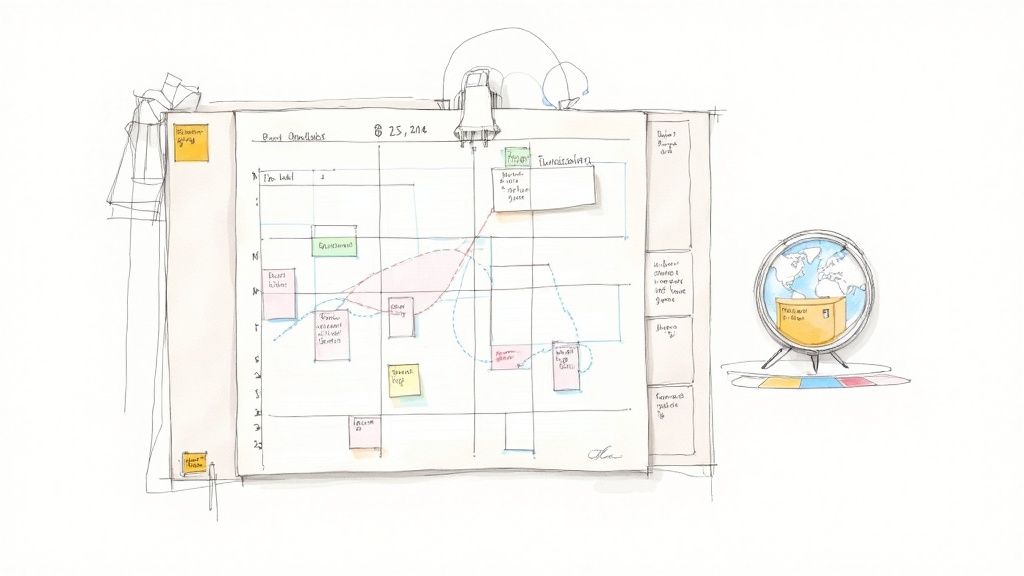
An executive's most finite resource is time. Therefore, one of the most critical tasks of an executive assistant isn't just managing a calendar; it's architecting the executive’s time from first principles. This goes beyond simply accepting meeting invites. It involves proactively designing the perfect week, every week, ensuring that the highest-leverage activities receive the lion's share of attention. This is about shifting from a reactive "inbox zero" mindset to a proactive "schedule zero" approach, where every block of time has a purpose aligned with core objectives.
Why It's a Core EA Task
Effective calendar management is the foundation of executive productivity. A poorly managed schedule leads to decision fatigue, reactive firefighting, and a lack of strategic progress. A world-class EA acts as a gatekeeper and a strategist, creating the space for deep work and high-value interactions. They protect their executive's focus as if it were the company's most valuable asset-because it is. This is a primary reason founders delegate this task; it has an immediate and massive ROI on their output.
Actionable Implementation
To master this domain, an EA must implement a clear system. Here are the core components:
Time Blocking: Proactively schedule non-negotiable blocks for "deep work," strategic planning, and personal time. A Fortune 500 CEO's assistant might block every Friday morning for "No-Meeting Strategy Review."
Buffer Zones: Always schedule 15-minute buffers between meetings. This allows for travel, mental resets, and prevents a domino effect of lateness.
Color-Coding System: Use a simple, visual system to categorize events. For instance: Green for internal team meetings, Blue for external client/investor calls, Red for deep work, and Yellow for personal appointments.
Scheduling Automation: Utilize tools like Calendly or SavvyCal to eliminate the back-and-forth of scheduling, but only for pre-approved meeting types. This frees up the EA for more strategic coordination, like organizing a multi-day board meeting across five time zones.
"Your calendar is a weapon. It should be used for offense, to attack your most important priorities-not as a defensive shield to block incoming requests."
This systematic approach to time is a cornerstone of high-level performance. For a deeper dive into structuring an executive's day for maximum impact, explore these advanced strategies for executive time management.
2. Email and Communication Management: Forging an Information Shield
An executive's inbox is not a to-do list; it's a battlefield of competing priorities, where signal is constantly at risk of being drowned out by noise. Effective email and communication management is one of the most vital tasks of an executive assistant. It involves transforming a chaotic firehose of incoming messages into a filtered, prioritized stream of actionable information. This isn't about clearing messages; it's about curating attention and defending the executive's cognitive energy from low-value distractions.

Why It's a Core EA Task
The sheer volume of communication directed at a founder or CEO is unsustainable for one person to handle. A CEO receiving 500+ emails daily simply cannot give each one the attention it might deserve while also running the company. An EA acts as a human firewall, a trusted proxy who can sort, filter, and often act on correspondence. This delegation frees up hours of mental RAM each day, allowing the executive to focus on the 1-3 critical decisions that will actually move the needle, rather than reacting to dozens of minor requests.
Actionable Implementation
A robust communication management system is built on clear rules and proactive tools. Here’s how a top-tier EA implements this:
Triage and Categorization: Create a simple folder system like "Action Required (Exec)," "FYI," and "Handled (by EA)." The goal is for the executive to only ever need to open the first folder.
Drafting and Templatizing: For the 80% of emails that are recurring requests (e.g., introductions, scheduling), create pre-approved templates. The EA can then draft responses for the executive to review and send with a single click.
Clear Escalation Protocols: Define what constitutes an "urgent" message. For an investment firm partner, this might be a time-sensitive deal update from a portfolio company, while everything else can wait for a designated daily email batch.
AI-Powered Summaries: Leverage tools like Superhuman or SaneBox to automatically summarize long email threads and filter out newsletters, allowing the EA to quickly grasp the context of a conversation.
"Your inbox is a convenient organizing system for other people's priorities. A great EA reclaims it and makes it a tool for your priorities."
By systematizing communication, an EA doesn't just manage an inbox; they protect their executive's most valuable asset: their undivided attention. For a deeper analysis, review these expert email management best practices.
3. Meeting Preparation and Coordination: Engineering Serendipity
An unprepared meeting is a colossal waste of everyone’s most valuable asset: cognitive bandwidth. The role of an EA extends far beyond sending a calendar invite; it's about engineering the conditions for a successful outcome before anyone even joins the call. This means transforming a simple meeting into a high-stakes, high-leverage event where decisions are made and progress happens. It’s about building the entire scaffolding-the agenda, the pre-read, the stakeholder context-so the executive can simply show up and execute.

Why It's a Core EA Task
Walking into a meeting cold is a rookie move that high-performing executives cannot afford. A top-tier EA ensures their executive enters every engagement armed with the necessary context, objectives, and background information to steer the conversation effectively. This strategic preparation minimizes surprises, maximizes influence, and turns potential time sinks into productive sessions. Delegating this allows a founder to preserve their mental energy for the strategic conversation itself, rather than spending it on logistical prep.
Actionable Implementation
To flawlessly execute meeting coordination, an EA should operate from a standardized playbook. Here are the essential components:
Briefing Document Template: Create a one-page template for every significant meeting. It should include: objective (the one thing that must happen), key attendees with one-sentence bios, relevant background links, and 3-5 key talking points or questions.
Pre-Read Discipline: Establish a rule that all pre-read materials for major meetings, like a board meeting, are compiled and distributed at least 72 hours in advance. This sets a standard of professionalism and ensures everyone arrives prepared.
Action Item Capture: The EA's job isn't over when the meeting ends. They must immediately capture all action items, assign owners, and set deadlines, circulating a summary within an hour. This closes the loop and ensures accountability.
Logistical Pre-Flight Check: For any in-person or critical video call, confirm all logistics 24 hours prior. This includes A/V tests, confirming coffee orders, or ensuring the presentation is loaded and ready on the conference room computer.
"A meeting without a clear agenda and pre-read is just a very expensive, unstructured conversation. It's a performance, and the EA is the stage manager."
This disciplined approach to one of the most common business activities is a huge source of leverage. For more on creating effective frameworks, see these best practices for how to prepare an agenda.
4. Travel Arrangements and Itinerary Planning: Engineering Serendipity
For a high-leverage executive, travel is never just about getting from Point A to Point B. It's about optimizing for energy, focus, and opportunity. A top-tier EA approaches travel planning not as a booking task, but as an engineering problem. They design the entire experience to eliminate friction and maximize the executive’s mental and physical performance upon arrival. This involves thinking from first principles about every variable: flight times, hotel proximity, ground transport reliability, and even visa requirements, ensuring the executive arrives ready to execute, not exhausted from the journey.
Why It's a Core EA Task
Every minute an executive spends worrying about a flight delay, a hotel confirmation, or a rental car is a minute stolen from strategic thinking. Flawless travel logistics directly translate to better meeting outcomes and reduced decision fatigue. An elite EA acts as a logistics operator, anticipating needs and pre-solving problems before they arise. Whether it's last-minute travel for a critical deal or coordinating attendance at an international conference, the EA’s role is to make the entire process feel effortless for their principal. This is a key operational task that frees up immense cognitive bandwidth.
Actionable Implementation
To move from a travel booker to a travel architect, an EA needs a robust system. Here’s how to build one:
Create a Master Travel Profile: Maintain a secure document with the executive's passport details, TSA PreCheck/Global Entry numbers, frequent flyer accounts, and seating/meal preferences. Update passport and visa expiration dates with calendar reminders.
Build a Preferred Vendor List: Cultivate relationships with specific travel agencies, car services, and hotel chains. This allows for negotiating corporate rates and receiving VIP treatment or faster support during disruptions.
Develop a Pre-Flight Checklist: Create a template itinerary that includes all confirmations, addresses, maps, contact numbers, and emergency information in a single, easily accessible document. Build in buffer time for arrival before any major meetings.
Master Contingency Planning: Always have a backup plan. Understand the nuances of travel insurance coverage for cancelled flights and know which credit cards offer the best protections. Proactively monitor weather and flight statuses to make changes before problems escalate.
"Amateurs book trips. Professionals design experiences. The goal is to have the executive arrive with maximum energy and clarity, not just on time."
This systematic approach to travel transforms a logistical headache into a strategic advantage, making it a vital component of the modern executive assistant's toolkit.
5. Report Writing and Documentation: Translating Data into Decisions
Information is useless without interpretation. A key task for an executive assistant is to transform raw data into clear, actionable intelligence that fuels executive decision-making. This isn't about creating bland spreadsheets; it's about storytelling with data. An elite EA can take a messy pile of KPIs, market research, and team updates and synthesize them into a concise, high-signal document that an executive can absorb in minutes, not hours. They become the bridge between complex information and strategic clarity.
Why It's a Core EA Task
Executives operate in a constant state of information overload. Their ability to make effective decisions is directly proportional to the quality of the information they receive. A skilled EA who can distill complexity into simple, powerful reports provides an immense strategic advantage. They save the executive countless hours of cognitive load, enabling them to focus on the "so what" instead of getting lost in the weeds of the data. This is a critical function among the tasks of an executive assistant, as it directly impacts the speed and quality of leadership.
Actionable Implementation
To master documentation and reporting, an EA should build a system for consistency and clarity.
Template Everything: For any recurring report, like a weekly KPI dashboard or monthly project update, create a standardized template. This eliminates redundant work and ensures the executive knows exactly where to find key information every time.
Embrace Visualization: Use tools like Google Data Studio, Canva, or even simple in-app charts to visualize data. A single graph showing customer acquisition cost trends is far more impactful than a table of numbers.
The BLUF Principle: Lead every report with "Bottom Line Up Front." Start with a one-paragraph executive summary that states the key findings and recommended actions. A busy founder should be able to get 80% of the value just from reading the first page.
Standardize Formatting: Establish a clear style guide for all documents-fonts, colors, and logos. This professionalism builds trust and makes information easier to consume, whether it’s for an internal memo or an investor presentation deck.
"The goal is not more information. The goal is a faster, more accurate understanding of reality."
This systematic approach to documentation ensures that every piece of information serves a clear purpose: to accelerate sound judgment and drive the business forward.
6. Project and Task Tracking: Managing the Open Loops
An executive's mind is a powerful engine for generating ideas, but a terrible warehouse for storing them. Every unresolved "open loop" - an uncompleted task, a pending decision, an untracked initiative - drains valuable cognitive bandwidth. An elite EA's role is to own these open loops, externalizing them into a trusted system so the executive can maintain a state of "mind like water," ready to focus entirely on the present challenge. This is not just about making lists; it's about building an external brain for the executive's commitments.
Why It's a Core EA Task
Without a centralized tracking system, momentum dies. Strategic initiatives stall, important follow-ups are forgotten, and accountability across the team dissolves. The EA serves as the central node, ensuring that what is discussed is documented, what is documented is actioned, and what is actioned is completed. This function turns abstract strategy into tangible progress, one checked-off task at a time. It's one of the highest-leverage tasks of an executive assistant because it multiplies the executive's ability to execute across multiple fronts simultaneously.
Actionable Implementation
A robust tracking system prevents things from slipping through the cracks. Here's how to build one:
Choose a Single Source of Truth: Use a dedicated tool like Asana, Monday.com, or Trello. The tool is less important than the commitment to using it consistently for everything. For example, a tech CEO's EA might manage a "CEO's Action Register" in Asana, tracking everything from board meeting follow-ups to personal errands.
Establish a Weekly Review Cadence: Schedule a recurring 30-minute meeting to review the entire task list. This "clearing" session ensures priorities are aligned, roadblocks are identified, and nothing becomes stale.
Create Status Summaries: Send a concise summary email at the end of each week. It should highlight: 1) What was completed, 2) What is in progress, and 3) What is blocked. This gives the executive 100% visibility in under two minutes.
Build Escalation Protocols: Define clear rules for when an issue needs the executive's attention. If a key deliverable is more than two days overdue and the owner is unresponsive, the protocol might be to automatically escalate it to the executive's weekly review agenda.
"The goal is not to get everything done. The goal is to have a trusted system for capturing everything that needs to get done, so you can think about what actually needs to get done right now."
By systemizing project and task tracking, an EA doesn't just manage tasks; they manage momentum and focus for the entire executive office.
7. Expense Management and Financial Administration: Protecting Your Capital
An executive's time is their most valuable asset, but their capital is the lifeblood of their operations. Financial administration isn't just about processing receipts; it's about safeguarding company resources and providing a clear, real-time view of where capital is being deployed. A top-tier executive assistant treats the company's finances with the same rigor as an investor conducting due diligence. They transform a messy shoebox of receipts into an actionable dashboard for financial decision-making, ensuring every dollar spent has a clear purpose and ROI.
Why It's a Core EA Task
Sloppy expense management creates financial black holes. It leads to compliance issues, inaccurate budgeting, and a loss of trust with investors and finance teams. An EA serves as the first line of defense against financial leakage. By meticulously managing corporate cards, processing reports, and ensuring policy adherence, they free up the executive's mental bandwidth from low-level financial tracking to high-level capital allocation strategy. This is a foundational task because financial integrity is non-negotiable for any high-growth company.
Actionable Implementation
To build a fortress around your executive's finances, implement a systematic approach. Here are the essential components:
Tool Automation: Leverage tools like Expensify or Concur to automate receipt capture and categorization. This eliminates manual data entry and provides an instant audit trail. For instance, an EA can set up rules to auto-categorize all Uber rides as "Ground Transportation."
Immediate Capture Protocol: Institute a strict rule of capturing receipts the moment an expense occurs. A simple photo upload to the expense app prevents items from being lost or forgotten, which is critical for accurate monthly reconciliation.
Clear Categorization: Work directly with the finance or accounting department to establish a definitive chart of accounts for expenses. This ensures consistency and makes quarterly or annual financial reviews seamless.
Budget vs. Actual Tracking: Create a simple, shared spreadsheet or dashboard that tracks spending against pre-approved budgets in real-time. An EA for a sales executive might track the team's monthly travel and entertainment budget, flagging when it's approaching 75% of its limit. Beyond booking, an EA also plays a critical role in ensuring all travel-related expenditures are properly accounted for, requiring mastery of effective business travel expense management strategies.
"Financial discipline isn't about restriction; it's about awareness. You can't optimize what you don't measure."
This systematic oversight of expenditures provides the clarity needed for strategic financial planning and is a key component in the arsenal of tasks of an executive assistant.
8. Stakeholder and Relationship Management: Curating Your Network
An executive's network is their net worth. Managing this vital asset is not a passive task of collecting business cards; it's the active curation of strategic alliances. A top-tier executive assistant operates as the Chief Relationship Officer, understanding that every interaction, follow-up, and introduction is a deposit into the long-term bank of social capital. This moves beyond simple contact management into a system of intentional relationship architecture, ensuring key connections are nurtured and leveraged at precisely the right moments.
Why It's a Core EA Task
Behind every major deal, partnership, or breakthrough is a network of strong relationships. The executive is the face of these connections, but the EA is the engine that maintains them. A forgotten birthday of a key investor or a delayed thank you note to a potential partner can have subtle but significant consequences. By offloading the operational side of relationship management, an executive can remain focused on the strategic dialogue, confident that the underlying foundation of goodwill is being meticulously maintained. This is one of the most leveraged tasks of an executive assistant, as it directly impacts long-term business opportunities.
Actionable Implementation
Building a system for relationship management turns an abstract concept into a reliable asset. Here’s how to implement it from first principles:
Build a Lightweight CRM: Use a tool like HubSpot, Affinity, or even a detailed Airtable base to create a central relationship database. For each key contact, log their background, interaction history, personal details (family, hobbies), and communication preferences.
Systematize Key Dates: Proactively track and set reminders for important milestones like birthdays, work anniversaries, or company funding announcements. A simple, personalized message on these dates can generate immense goodwill.
Strategic Gifting Protocol: Maintain a list of gift preferences and a pre-approved budget for key stakeholders. For example, knowing a board member prefers a specific type of single-malt Scotch allows for thoughtful, high-impact gestures.
Post-Meeting Follow-Up: Standardize the follow-up process. After every significant meeting, the EA should draft and send a personalized thank you note, summarizing key takeaways and action items within 24 hours.
"Your network is not just who you know; it's who knows you, trusts you, and will take your call. The system that nurtures that is a priceless operational asset."
This systematic approach ensures that no important connection falls through the cracks, transforming a reactive social obligation into a proactive strategic advantage.
9. Crisis Management and Problem-Solving: The Executive’s First Responder
When things break, and they always do, an executive assistant becomes the central node for information and response. This isn't about just fielding an angry call; it's about being the pre-designated "first responder" who can operate calmly under extreme pressure. A top-tier EA anticipates points of failure and acts as an operational shock absorber, containing chaos before it reaches the executive and derails high-leverage work. They are the calm in the eye of the storm.
Why It's a Core EA Task
An executive cannot be both the strategist charting the company's future and the firefighter putting out every operational blaze. This dual role leads to burnout and strategic neglect. A world-class EA serves as a critical buffer, managing the immediate fallout of a crisis so the executive can focus on the high-level, strategic decisions required. Delegating the initial response and information gathering is one of the highest ROI activities a founder can engage in, as it directly protects their focus and decision-making capacity when stakes are highest.
Actionable Implementation
To move from reactive problem-solver to proactive crisis manager, an EA needs a pre-defined playbook. Here are the essential components:
Develop Crisis Protocols: Don't wait for a crisis to decide how to handle it. Create simple, one-page protocols for common scenarios like a key system outage, a negative PR event, or a sudden executive absence. A founder’s EA might have a protocol for a major investor pulling out, outlining who to contact first (CFO, legal) and what information to gather.
Maintain an Emergency Comms List: Keep an up-to-date, accessible list of key contacts: board members, legal counsel, PR firm, key investors, and leadership team, including their after-hours contact info.
Practice Calm Under Pressure: Role-play difficult conversations and practice de-escalation techniques. The goal is to lower the emotional temperature of any situation, not match it.
Master Information Triage: During a crisis, an EA's job is to distill a chaotic flood of information into a concise, actionable summary for their executive. This means separating signal from noise and presenting only the most critical facts needed for a decision.
"The measure of a great EA isn't how they perform when things are going well, but how they respond when everything is on fire."
This ability to absorb pressure and create order from chaos is a defining trait of elite executive assistants and is one of the most critical tasks of an executive assistant in a high-growth environment.
10. Administrative Support and Operational Excellence: Engineering the Ideal Workspace
While seemingly tactical, mastering administrative support is about engineering an environment where an executive can achieve peak performance. This isn't just about ordering supplies or managing the office; it's about eliminating operational friction from the executive's life. A world-class EA views the executive suite as a Formula 1 pit stop: every tool, system, and resource must be perfectly placed and functioning flawlessly to save precious seconds and maintain focus on the race.
This task is the bedrock of executive support, ensuring the engine of daily operations runs so smoothly that the executive never even has to think about it. It’s the invisible work that prevents costly distractions, from a broken printer delaying a board deck to a poorly managed filing system causing a compliance headache.
Why It's a Core EA Task
Every minute an executive spends wrestling with a software license, hunting for a document, or dealing with a faulty internet connection is a minute stolen from strategic work. Administrative chaos creates a constant, low-grade cognitive load that saps energy and focus. An EA who excels in this area creates a "friction-free bubble" around their executive, allowing them to channel 100% of their mental bandwidth toward high-value decisions. This is one of the most fundamental tasks of an executive assistant because it directly protects the leader’s most valuable assets: time and attention.
Actionable Implementation
To build an operationally excellent environment, an EA must think like a systems engineer, not just a manager. Here's how to implement this effectively:
Develop Checklists for Recurring Tasks: Systematize everything from weekly supply audits to monthly software updates. For example, a "New Hire Onboarding Checklist" for the executive team ensures every new leader has the right hardware, software access, and office setup from day one, without any executive involvement.
Build a Vendor and IT Rolodex: Don't just have contacts; have relationships. Know the direct line to the key IT support person and the account manager at the primary supply vendor. This turns a multi-day problem into a 15-minute fix.
Standardize Document Management: Implement a non-negotiable, logical digital filing system (e.g., using a "Company/Department/Project/Year-Month-Day_DocumentName" convention). This makes any document retrievable in under 30 seconds.
Automate Supply Management: Set up recurring orders for essential supplies like coffee, printer paper, and healthy snacks. Use inventory management principles to ensure key items are never out of stock, preventing last-minute emergencies.
"Your executive's environment should be an asset, not a liability. Every administrative system you build is another layer of armor protecting their ability to focus and execute."
By treating administrative duties with this level of strategic importance, an EA doesn't just manage an office; they build a platform for their executive's success. For a deeper look at optimizing these foundational systems, explore these principles for workplace productivity.
10-Point Comparison of Executive Assistant Tasks
Service | 🔄 Implementation complexity | ⚡ Resource requirements | 📊 Expected outcomes | 💡 Ideal use cases | ⭐ Key advantages |
|---|---|---|---|---|---|
Calendar and Schedule Management | Medium–High — continuous updates, time‑zone coordination | Calendar platforms (Outlook/GCal), scheduling tools, ongoing attention | More productive executive time; fewer conflicts | C-suite with global meetings, packed agendas | Maximizes time use; improves meeting efficiency |
Email and Communication Management | High — requires nuanced screening and confidentiality | Email clients, filtering tools, possible assistant/AI support | Reduced information overload; timely responses | Executives with high message volume (500+ emails/day) | Preserves executive focus; ensures critical items handled |
Meeting Preparation and Coordination | Medium — time‑intensive research and logistics | Document templates, stakeholder briefings, coordination time | More effective meetings; clear action items | Board meetings, investor pitches, strategic reviews | Ensures informed participation and accountability |
Travel Arrangements and Itinerary Planning | Medium — complex for international travel | Booking platforms, vendor relationships, real‑time monitoring | Smooth travel, cost optimization, flexible plans | Frequent international travel; same‑day changes | Reduces travel stress; optimizes cost and timing |
Report Writing and Documentation | Medium — needs writing, data and design skills | Office/BI tools (PowerPoint, Tableau), time for research | Polished communications; accurate executive materials | Investor decks, KPIs, board materials | Professional, consistent reporting; supports decisions |
Project and Task Tracking | Medium — ongoing follow‑up and escalation | PM tools (Asana/Jira), regular reviews, stakeholder time | Fewer missed deadlines; clearer progress visibility | Cross‑department initiatives, strategic projects | Prevents missed commitments; increases accountability |
Expense Management and Financial Administration | Medium — detail‑oriented, compliance heavy | Expense systems (Concur/Expensify), finance coordination | Accurate records; policy compliance; cost insights | High spend executives; travel-heavy roles | Simplifies reconciliation; identifies savings |
Stakeholder and Relationship Management | High — requires discretion and cultural sensitivity | CRM tools (Salesforce/HubSpot), personalized profiles | Stronger networks; better introductions and follow‑up | Board relations, external partnerships, fundraising | Strengthens relationships; enables strategic networking |
Crisis Management and Problem‑Solving | High — fast decision‑making under pressure | Emergency protocols, contacts, cross‑functional coordination | Minimized impact; faster executive decisions | PR incidents, sudden executive issues, urgent client matters | Rapid response capability; preserves reputation |
Administrative Support and Operational Excellence | Low–Medium — routine but broad scope | Office systems, vendor management, SOPs | Smooth daily operations; fewer distractions | Executive office management, facilities and IT support | Keeps operations running; prevents avoidable disruptions |
Your Next Move: Stop Managing, Start Leading
We've just dissected the ten core domains where a high-caliber executive assistant operates, from mastering the chaos of your calendar to acting as a linchpin in stakeholder relationships. If you've read this far, you've likely had a series of "aha" moments, recognizing the sheer volume of tactical work that pulls you away from your strategic imperatives. The list of tasks of an executive assistant isn't just a job description; it's a map of the friction points that are quietly eroding your most valuable asset: your focused attention.
The fundamental mental model here is leverage. Archimedes said, "Give me a lever long enough and a fulcrum on which to place it, and I shall move the world." For a founder or CEO, your team is your lever, and a world-class EA is the fulcrum. Every hour you spend on a task that isn't your unique ability is an hour you’ve paid an exorbitant opportunity cost. It's an hour you didn't spend mentoring a key leader, negotiating a term sheet, or defining the product vision that will shape the next decade of your company.
The True Cost of "Doing It Yourself"
Most leaders fall into a cognitive trap. They look at the salary of an EA and calculate a simple ROI based on saved hours. This is thinking in first-order consequences. The second- and third-order consequences are where the real value lies. It’s not just about getting back 15 hours a week; it’s about the quality and impact of what you do with those reclaimed hours.
Think about it from first principles. Your role is to make a small number of high-quality, high-leverage decisions, not to manage a high volume of low-leverage tasks. The tasks we've detailed, from travel logistics to initial report drafting, are essential for the business to function. But they are operational functions, not visionary ones. Delegating them isn't about offloading work you dislike; it's a strategic reallocation of cognitive energy. As Peter Drucker famously noted, efficiency is doing things right, but effectiveness is doing the right things. An EA handles the efficiency so you can focus on effectiveness.
From Task Manager to Strategic Partner
The paradigm shift you must make is viewing the EA role not as a support function but as a strategic partnership. The best EAs, the kind that legendary leaders like Steve Jobs or Jeff Bezos relied on, don't just execute a to-do list. They anticipate needs, build systems to prevent future problems, and manage workflows with an ownership mentality. They don't just ask, "What do you need me to do?" They say, "Here's what I've identified as a bottleneck, and here's my proposed system to solve it."
This transformation happens when you stop seeing your EA as a manager of tasks and start seeing them as the COO of your personal and professional life. They become the guardian of your time, the filter for your communications, and the operational engine that allows you to operate at your peak. This is the ultimate competitive advantage in a world where everyone is vying for the same 24 hours in a day. You're not just buying back time; you're buying focus, clarity, and the mental space to build the future. The question is no longer if you need this leverage, but how quickly you can implement it.
Tired of searching for that top 1% executive assistant who can be a true strategic partner? At Hyperon, we've built the system to find, vet, and match you with EAs who are genuine force multipliers, trained to handle the complex tasks of an executive assistant from day one. Stop searching and start leading by visiting us at Hyperon to see how we can help you reclaim your focus.