The 10 Core Tasks of an Executive Assistant in 2025
A founder's guide to the essential tasks of an executive assistant. Unlock peak productivity with first principles and elite-level delegation strategies.
Nov 22, 2025
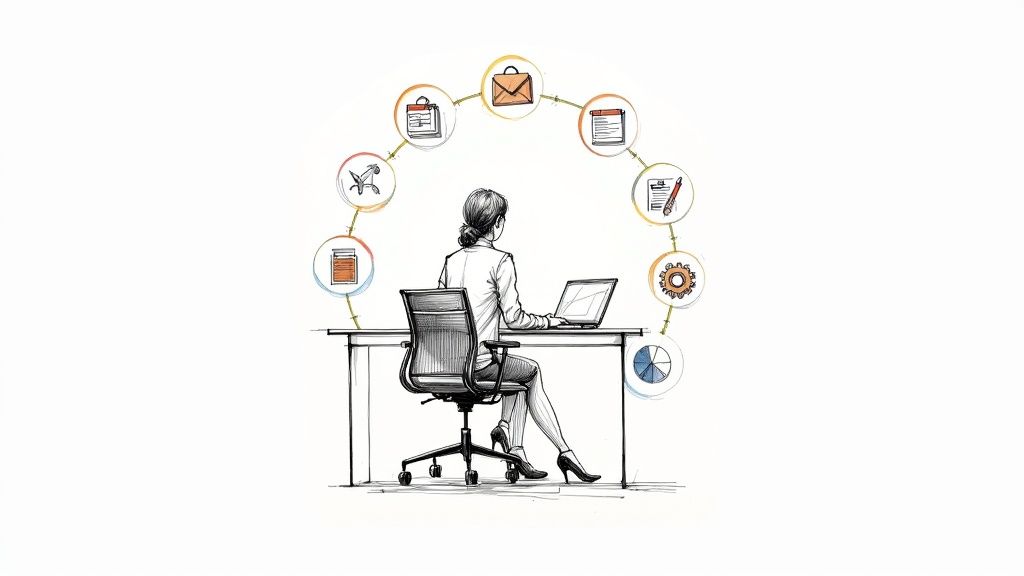
Hiring an Executive Assistant is the single highest-leverage decision a founder can make. It's not about offloading administrative chores; it's about reclaiming your most finite resource: time. Ask any high-performing CEO or investor, from Tim Ferriss to the titans of Silicon Valley, and they'll tell you their secret weapon isn't a new productivity app. It's a force multiplier in human form, a partner who systematically de-risks their time and amplifies their focus. This isn't just about delegation; it's about total system optimization.
We're going to deconstruct the tasks of an executive assistant from first principles. Forget the outdated job description. Instead, we'll view each function not as a task to be done, but as a critical system to be designed, managed, and continuously improved. The top 1% of EAs don't just manage your calendar; they engineer your workflow, automate inefficiencies, and create the strategic whitespace for you to do what only you can do: think, create, and lead. This is the core philosophy I've built my company on.
This guide provides a prioritized, comprehensive framework for exactly what those systems are and how to implement them. We'll break down the 10 core functions a world-class EA should own, complete with actionable templates, real-world examples, and delegation notes. Think of this as the operating manual for installing a human co-processor into your life, designed to free up your bandwidth so you can focus on building your empire. Let's dive in.
1. Calendar and Schedule Management
At its core, calendar management isn't about filling empty slots; it's about manufacturing time for what truly matters. This is one of the most leveraged tasks of an executive assistant because an executive's time is the company's most finite and valuable resource. A world-class EA acts as a strategic gatekeeper, not just an appointment setter, engineering the executive's day, week, and quarter with a first-principles approach to productivity. They move beyond reactive scheduling to proactively architecting a calendar that aligns with the founder's highest-priority objectives.
The goal is to create a schedule that maximizes deep work, minimizes context switching, and protects the executive's energy. This involves ruthlessly auditing incoming requests, batching similar tasks, and building in non-negotiable blocks for strategic thinking and personal recovery. For founders, this deliberate time allocation is the difference between constantly fighting fires and steering the ship.
Implementation and Best Practices
To make calendar management a strategic advantage, your EA should:
Establish a "Scheduling Manifesto": Work together to create a simple document outlining your ideal work rhythms, meeting preferences (e.g., no meetings before 10 AM, "no-meeting Fridays"), and rules for engagement. This empowers the EA to decline or reschedule requests with confidence.
Time Block for Priorities: Proactively block 2-3 hour chunks for "deep work" on the CEO's most critical tasks before the week even begins. These blocks should be treated as unbreakable appointments.
Implement Buffers and Travel Time: Automatically add 15-minute buffers between meetings to allow for notes, mental resets, or travel between locations. This prevents the all-too-common back-to-back meeting fatigue.
Manage Time Zones Masterfully: When scheduling with global teams, the EA should use tools like a world clock or time zone converter to propose several options that respect everyone's working hours, clearly stating the times in each participant's local zone.
Pro Tip: Your calendar should reflect your priorities, not your inbox. If you let incoming requests dictate your schedule, you are operating on someone else's agenda. For more advanced strategies on this, explore these principles for executive time management.
2. Email and Communication Management
An executive's inbox is a battlefield of external agendas. Effective email management isn't about achieving "inbox zero," a vanity metric that often distracts from real work. It's about signal extraction: identifying the 1% of communications that move the needle and ruthlessly ignoring or delegating the 99% that don't. A top-tier executive assistant acts as an intelligence officer for your digital communication, ensuring you only engage with messages that align with your highest priorities.
This task of an executive assistant is crucial because a reactive inbox is a CEO's worst enemy, creating constant context switching that kills deep work. By filtering the noise, drafting routine replies, and escalating only mission-critical items, the EA gives the founder back hours of focused time each day. They transform the inbox from a source of stress into a streamlined command center for strategic decisions.
Implementation and Best Practices
To turn inbox chaos into strategic clarity, your EA should:
Develop a "Triage Protocol": Create a clear set of rules for categorizing emails. For example: "Urgent/Action Required by CEO," "FYI/Review Later," "Delegate to [Team Member]," and "Archive/Unsubscribe." This empowers the EA to process 90% of your inbox without your input.
Master Your Voice and Tone: The EA must learn to draft responses that are indistinguishable from your own. Provide them with a "swipe file" of your past emails to study your phrasing, tone, and common responses. Start with low-stakes emails and provide feedback to calibrate.
Implement an "End-of-Day Digest": Instead of constant pings, have your EA prepare a single daily email summarizing key actions taken, items needing your direct response, and a list of FYI messages. This batches communication and protects your focus.
Create Canned Response Templates: For recurring inquiries (e.g., sales pitches, partnership requests, interview follow-ups), build a library of pre-approved templates. This allows the EA to handle common communications with speed and consistency.
Pro Tip: Treat your inbox like a physical mailbox. You wouldn't stand by your mailbox all day opening junk mail. Have your EA collect the "mail," throw out the junk, and hand you only the important letters. For a deeper dive, explore these advanced email management best practices.
3. Meeting Preparation and Coordination
An unprepared meeting is a colossal waste of everyone's most valuable asset: cognitive bandwidth. An elite executive assistant understands that their role isn't just to get people into a room (virtual or physical), but to engineer an environment where a decision can be made or a goal can be achieved with maximum efficiency. They treat every meeting like a product launch, where the pre-mortem and preparation dictate 90% of the outcome. This is a critical task for an executive assistant, transforming expensive gatherings from time sinks into high-leverage outcomes.
The goal is to eliminate ambiguity and ensure the executive walks in with complete context and a clear objective. This involves preparing concise briefing documents, circulating agendas that force clarity, and coordinating all logistical and technical aspects flawlessly. For a founder, walking into a high-stakes board meeting or a key client negotiation fully briefed, with all materials at their fingertips, is an almost unfair advantage.
Implementation and Best Practices
To turn meeting coordination into a strategic function, your EA should:
Create Executive Briefings: For every significant meeting, the EA should prepare a one-page briefing doc. This includes attendee bios with LinkedIn links, the primary meeting objective ("What is the one thing we must decide?"), key discussion points, and a summary of relevant prior communications.
Systematize Material Collection: Establish a firm deadline for all participants to submit their materials or talking points (e.g., 48 hours before the meeting). The EA is responsible for chasing these down, compiling them, and circulating a single, unified packet.
Master the "Pre-Flight Check": For all virtual meetings, the EA should test links, confirm A/V equipment, and ensure any presentation materials are pre-loaded 15 minutes before start time. For in-person meetings, this includes booking the room, arranging catering, and setting up the physical space.
Assign and Track Action Items: During or immediately after the meeting, the EA should capture all action items, assign a clear owner, and set a deadline for each. These should be logged in a project management tool (like Asana or Notion) for accountability.
Pro Tip: The quality of a meeting is determined before it ever begins. A well-structured agenda is the single most important tool for ensuring focus and productivity. For a deeper dive, explore these guidelines on how to prepare an agenda.
4. Travel Arrangements and Logistics
Seamless executive travel isn’t about luxury; it's about preserving an executive's energy, focus, and time for the highest-value activities at their destination. This core task of an executive assistant transforms travel from a logistical nightmare into a strategic advantage. A world-class EA approaches travel not as a booking agent, but as a mission director, orchestrating every detail to eliminate friction and decision fatigue. They ensure the executive can step off a plane and walk directly into a high-stakes meeting, fully prepared and mentally sharp.
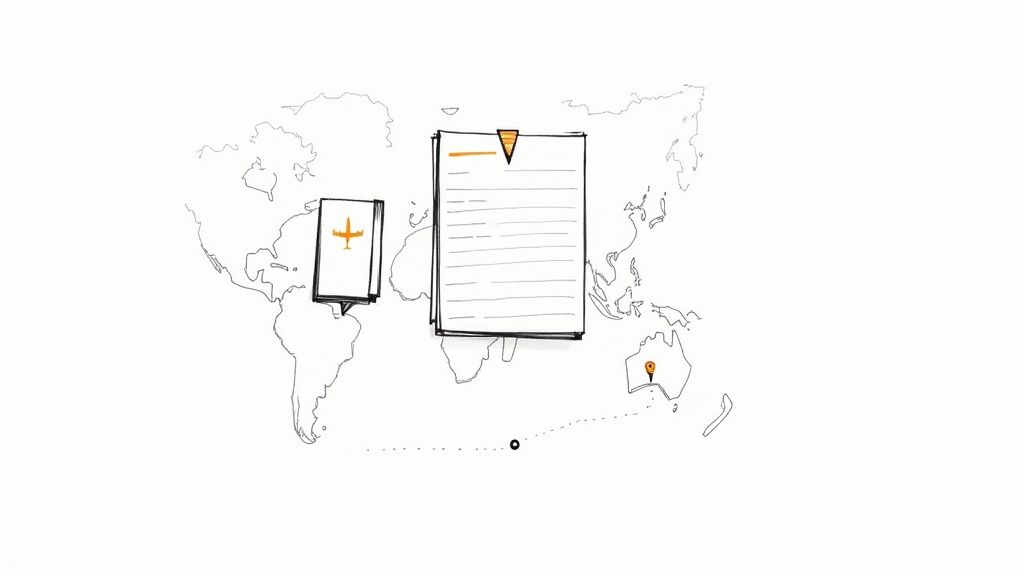
The objective is to create a "travel bubble" where every foreseeable variable is controlled. This includes everything from visa applications and currency exchange to pre-booked ground transport and dinner reservations near the hotel. For a founder on a multi-city fundraising roadshow, this meticulous planning is the difference between closing a round and burning out before the final pitch.
Implementation and Best Practices
To turn travel logistics into a seamless operational system, your EA should:
Create a Detailed Traveler Profile: Build a master document with passport details, loyalty numbers, seat preferences (aisle vs. window), dietary restrictions, and hotel requirements (e.g., high floor, away from the elevator). This eliminates repetitive questions and ensures consistency.
Develop a "Contingency Playbook": For every trip, have a plan for common failures. This includes backup flight options for cancellations, alternative ground transport contacts, and copies of all important documents stored securely in the cloud.
Master the Itinerary Brief: Prepare a single, consolidated document for each trip containing all confirmation numbers, addresses, contact details, and a minute-by-minute schedule. It should be accessible offline on the executive's phone.
Build Vendor Relationships: Establish direct relationships with specific travel agents, car services, and hotel concierges. These connections are invaluable for securing last-minute changes, upgrades, and insider access.
Pro Tip: Your EA should book travel arrangements as if the executive will have zero internet access or phone battery upon landing. Everything they need, from the driver's contact info to the hotel address in the local language, should be pre-loaded and accessible offline.
5. Project and Task Management
An executive assistant isn't just managing your schedule; they are managing your outcomes. Effective project and task management by an EA transforms abstract strategic goals into a series of executed deliverables. They act as the central nervous system for your key initiatives, ensuring nothing falls through the cracks as you operate at a high level. This is a critical function among the tasks of an executive assistant, as it directly translates vision into progress. They don't just track tasks; they own the operational follow-through that makes ambitious plans a reality.
The objective is to create a seamless system of accountability and momentum. An elite EA manages the executive's to-do list, monitors deadlines for the entire leadership team, and ensures that action items from meetings are captured, assigned, and completed. For a founder juggling fundraising, product development, and hiring, this system is the difference between organized execution and chaotic reactivity. It frees up the executive’s mental RAM to focus on the next big move, not the status of the last one.
Implementation and Best Practices
To turn task management into a high-leverage operational advantage, your EA should:
Create a Centralized "Source of Truth": Use a dedicated project management tool like Asana, Monday.com, or Trello to serve as the single repository for all key initiatives, tasks, and deadlines. This eliminates confusion from scattered notes and emails.
Establish a Weekly Project Sync: Dedicate 30 minutes each week for a rapid-fire review with your EA. The agenda is simple: review progress against milestones for the top 3-5 priorities, flag any risks, and confirm next steps. This keeps you informed without pulling you into the weeds.
Develop Executive Dashboards: Your EA can build a simple, high-level dashboard (even in a Google Doc) that provides a one-glance status update on your most important projects. This should highlight what's on track, what's at risk, and where your attention is needed most.
Define Clear Action Items: Ensure every meeting concludes with the EA capturing and articulating action items with a clear owner and a specific due date. This simple discipline closes the loop between discussion and action.
Pro Tip: Your EA should be empowered to follow up relentlessly. Give them the explicit permission to chase down updates from anyone in the company, regardless of title, to ensure your projects stay on schedule. This removes you as the bottleneck for accountability.
6. Expense Management and Financial Processing
Financial processing is not about mindless data entry; it’s about safeguarding the company’s lifeblood: capital. An elite EA treats the executive's budget and expenses with the same rigor a CFO applies to the company's balance sheet. They serve as the first line of defense against waste, ensuring every dollar spent is intentional, compliant, and meticulously documented. This is one of the most critical, trust-based tasks of an executive assistant, directly impacting financial integrity and operational efficiency.
The goal is to create a frictionless system for financial administration that saves the executive time while providing crystal-clear visibility into spending. For a founder moving at breakneck speed, a disorganized expense process isn't just an annoyance; it's a liability that can lead to compliance issues, inaccurate forecasting, and wasted resources. A top-tier EA transforms this potential chaos into a streamlined, audit-proof operation.
Implementation and Best Practices
To turn expense management into a strategic function, your EA should:
Implement a Digital-First System: Immediately adopt an expense management tool (like Expensify or Ramp) to eliminate manual receipt tracking. The EA should configure the system, set up approval workflows, and train the executive on how to simply snap a photo of a receipt and be done.
Establish a "Financial Cadence": Create a recurring weekly or bi-weekly block on the calendar dedicated solely to processing invoices, reconciling credit card statements, and submitting expense reports. This prevents month-end scrambles and ensures timely reimbursements.
Develop an Expense Policy One-Pager: The EA can draft a simple, clear document outlining company expense policies, spending limits, and submission deadlines. This empowers them to enforce compliance and answer questions without constantly involving the executive.
Maintain an Impeccable Digital Trail: Ensure every transaction has a corresponding digital receipt, a clear business purpose noted, and is categorized correctly. A core duty involves detailed financial processing and expense tracking, and a comprehensive guide to business travel expense management can provide invaluable strategies for optimizing these systems.
Pro Tip: Your expense reports should tell a story of strategic capital allocation, not a mystery novel. If you can't understand a charge from six months ago in five seconds, your system is broken. The aim is zero ambiguity and 100% compliance.
7. Stakeholder and Relationship Management
An executive's network is one of their most powerful assets, but it requires constant, deliberate cultivation. This is where a strategic EA transcends administrative support and becomes a force multiplier for social capital. Stakeholder management isn't about just keeping a contact list updated; it's about engineering serendipity and ensuring every key relationship receives the right level of attention, at the right time. Your EA acts as the central node, managing the flow of communication and goodwill between you and your most important stakeholders: board members, investors, key clients, and partners.
This task is crucial because relationships are built on consistent, personalized touchpoints, which founders rarely have the bandwidth to manage alone. An elite EA ensures that no important connection goes cold. They are the guardians of your professional network, operating with the nuance and foresight to strengthen alliances that directly impact your company's trajectory. This is one of the tasks of an executive assistant that directly builds long-term value beyond daily productivity.
Implementation and Best Practices
To turn relationship management into a strategic function, your EA should:
Build a "Relationship CRM": Create and maintain a simple but detailed database (a spreadsheet or dedicated tool) of key stakeholders. It should include contact information, the context of the relationship, personal details (family, hobbies), last contact date, and next planned follow-up.
Develop Access Tiers: Work with your EA to define clear criteria for who gets direct access to you. This empowers them to handle requests from different stakeholders appropriately, protecting your time while ensuring VIPs feel valued.
Systematize Personal Touchpoints: Your EA can manage a system for sending personalized notes, relevant articles, or small gifts for birthdays and major milestones. These thoughtful gestures are high-leverage activities that deepen loyalty.
Coordinate Pre- and Post-Meeting Briefs: For any significant meeting, the EA should prepare a concise brief on the attendees, their history with the company, and desired outcomes. Afterward, they should ensure thank-you notes are sent and action items are captured and tracked.
Pro Tip: Think of your key stakeholders like a portfolio that needs to be actively managed and diversified. Your EA is your "portfolio manager," ensuring you are making the right "investments" of your time and attention to yield the highest returns in trust and support.
8. Information Research and Analysis
In the age of information overload, a founder's most critical advantage isn't access to data; it's the ability to extract signal from noise. This is where an executive assistant transitions from a support role to a strategic intelligence partner. They act as a human search engine and synthesizer, arming the executive with the precise insights needed to make high-stakes decisions with clarity and confidence. This is one of the most impactful tasks of an executive assistant, directly influencing strategy, M&A, and competitive positioning.
The objective is to pre-digest complex information so the executive can absorb the core takeaways in minutes, not hours. Whether it's dissecting a competitor's quarterly report, compiling a dossier on a potential investor, or summarizing new market regulations, the EA delivers distilled intelligence. This frees the founder from the weeds of raw data, allowing them to operate at a higher strategic altitude and connect dots others might miss.
Implementation and Best Practices
To turn research into a strategic weapon, your EA should:
Develop Standardized Briefing Templates: Create one-page templates for common research requests like "Company Profile," "Competitor Analysis," or "Market Trend Summary." This ensures consistency and focuses the research on the most critical data points.
Identify and Vet Primary Sources: Maintain a curated list of trusted industry publications, government databases, analyst reports, and paid research tools. This prevents reliance on unreliable or biased information and speeds up the fact-finding process.
Master the Art of Synthesis: The final output should never be a simple data dump. The EA must learn to synthesize findings into a concise executive summary, highlighting the "so what" for the founder and the business. This is the most crucial skill.
Cite Everything and Show the Work: Every report should include clear source citations. This builds trust in the data and allows the executive to quickly verify information or dig deeper into a specific point if needed.
Pro Tip: Define the "depth" of research required upfront. A quick "back-of-the-napkin" summary for an internal chat is different from a board-level competitive teardown. Create simple labels like "Level 1: Quick Scan" vs. "Level 3: Deep Dive" to clarify expectations and save everyone time.
9. Board and Governance Support
Supporting a board of directors is less about administrative logistics and more about orchestrating high-stakes governance. This is where an executive assistant’s role transcends day-to-day tasks and becomes foundational to the company's strategic oversight and legal integrity. A great EA doesn’t just distribute board packs; they act as a nexus of information, ensuring the founder and board members operate with precision, confidentiality, and complete clarity. This is one of the tasks of an executive assistant where precision and discretion are paramount.
The goal is to create a frictionless governance process that allows the board to focus on high-level strategic decisions, not on chasing down documents or clarifying logistics. For a founder, a well-managed board process builds investor confidence and establishes a rhythm of accountability that permeates the entire organization. It’s about building a system that makes governance a strategic asset, not an administrative burden.
Implementation and Best Practices
To elevate board and governance support from a task to a strategic function, your EA should:
Create a Governance Cadence Calendar: Map out the entire year of board activities, including all committee meetings, reporting deadlines, and required filings. This master calendar should be the single source of truth for all board-related scheduling.
Develop Standardized Board Meeting Templates: Build a repeatable playbook for every board meeting. This includes templated agendas, minutes, and a standardized format for the board pack, ensuring consistency and making information easier for members to digest.
Maintain a Secure Digital Board Portal: Use a secure platform (like Diligent or a secure shared drive) to house all board materials, past minutes, resolutions, and governance documents. This provides a centralized, access-controlled repository and demonstrates a commitment to security.
Track Action Items and Resolutions Rigorously: The EA should own the process of capturing, distributing, and following up on all action items and resolutions from each meeting. This closes the loop and ensures board decisions are translated into operational execution.
Pro Tip: Treat your board meetings like a product launch. Every detail, from the pre-read materials to the post-meeting follow-up, should be meticulously planned and executed. This level of professionalism signals to your board that you run a tight ship.
10. Professional Development and Continuous Learning
An executive's growth is often capped by the capabilities of their support system. A static assistant becomes a bottleneck, while a dynamic, learning assistant becomes a force multiplier. This is why one of the most crucial, yet often overlooked, tasks of an executive assistant is their own continuous learning. A world-class EA doesn't just execute tasks; they evolve their skill set in parallel with the executive and the business, staying ahead of the curve on tools, strategies, and industry trends.
This isn't about collecting certificates for a resume. It's about sharpening the saw to provide ever-increasing leverage. For a founder, an EA who actively seeks professional development is investing in their ability to handle more complex delegations, anticipate future needs, and operate with greater autonomy. This creates a virtuous cycle: as the EA's skills grow, the executive can offload higher-level responsibilities, freeing up their own time for the unique work only they can do.
Implementation and Best Practices
To foster a culture of continuous improvement, your EA should:
Pursue Targeted Certifications: Encourage them to obtain credentials that directly benefit your operations, such as the Certified Administrative Professional (CAP) for foundational excellence or specialized project management certifications if you are launching new products.
Engage with Professional Networks: Active participation in organizations like the International Association of Administrative Professionals (IAAP) provides access to a hive mind of best practices, new technologies, and solutions to common executive support challenges.
Study the Business Itself: The EA should be a student of your industry. This means reading the same books, following the same thought leaders, and understanding the core business principles that drive your decisions. This context transforms them from a task-doer to a strategic partner.
Build a "Personal Tech Stack": Just as you optimize your company's software, the EA should be constantly testing and mastering new productivity tools. This proactive approach ensures your operational infrastructure is always cutting-edge.
Pro Tip: Allocate a dedicated budget and protected time for your EA's professional development. Treat it like R&D for your own productivity. The ROI of an EA who can independently learn and implement a new CRM or automation tool is immeasurable.
Executive Assistant Tasks: 10-Point Comparison
Service | 🔄 Complexity | ⚡ Resource requirements | 📊 Expected outcomes | ⭐ Key advantages | 💡 Ideal use cases |
|---|---|---|---|---|---|
Calendar and Schedule Management | High — ongoing multi‑calendar & time‑zone coordination | Calendar platforms, stakeholder access, constant availability | Maximized executive time; fewer conflicts | Maximizes productivity and strategic focus | Scheduling across time zones; blocking focus time |
Email and Communication Management | Medium — continual triage and prioritization | Email clients, filtering/AI tools, clear priority rules | Reduced inbox burden; faster response rates | Frees executive time; ensures critical messages seen | High‑volume inboxes; client correspondence drafting |
Meeting Preparation and Coordination | Medium‑High — prep, logistics, attendee management | Collaboration tools, templates, participant inputs | Shorter, more focused meetings; clearer decisions | Improves meeting productivity and accountability | Board packets, large virtual meetings, client briefings |
Travel Arrangements and Logistics | High — complex itineraries, contingency planning | TMCs/tools, vendor contacts, travel preference profiles | Smoother travel, comfort optimization, cost control | Minimizes disruption; ensures travel readiness | Multi‑city/international trips; VIP travel planning |
Project and Task Management | Medium — continuous tracking and stakeholder follow‑up | PM platforms, dashboards, regular reviews | On‑time deliverables; improved visibility | Raises project success and executive accountability | Tracking strategic initiatives; product launches |
Expense Management and Financial Processing | Medium‑High — accuracy and compliance required | Expense systems, accounting knowledge, policy docs | Accurate records; timely reimbursements; audit readiness | Improves budget control and compliance | High‑value expenses; SOX/audit‑sensitive reporting |
Stakeholder and Relationship Management | Medium — diplomatic gatekeeping and personalization | CRM, contact databases, event coordination resources | Stronger relationships; protected executive time | Enhances reputation management and access control | VIP visits, client relationship maintenance, networking |
Information Research and Analysis | Medium‑High — requires analysis and synthesis | Research databases, industry sources, analytical skills | Actionable insights; informed strategic decisions | Identifies opportunities and risks for leadership | Competitive intelligence; pre‑meeting briefings |
Board and Governance Support | High — confidential, regulatory and procedural depth | Secure board portals, legal counsel, governance templates | Effective governance; compliance assurance | Reduces legal/regulatory risk; professional board ops | Annual meetings, audit/committee materials, resolutions |
Professional Development and Continuous Learning | Low‑Medium — ongoing time investment | Courses, certifications, professional associations | Improved skills; greater role value and mobility | Keeps practices current; increases credibility | Upskilling, certification pursuit, adopting new tools |
Stop Managing Tasks, Start Building Systems: Your Next Move
We’ve dissected the ten core domains of an elite executive assistant, from managing your calendar with surgical precision to coordinating complex board meetings. But if you walk away from this article with just a glorified to-do list to hand off, you’ve missed the entire point. The goal isn't just delegation; it’s liberation. It's about fundamentally changing your operational paradigm.
The list of tasks of an executive assistant is not a static checklist. It’s a blueprint for building interconnected, self-improving systems that create leverage. A world-class EA doesn’t just do the tasks. They deconstruct them, find the points of friction, and rebuild them as efficient, scalable workflows. They don't just manage your inbox; they engineer a communication system that protects your focus. They don’t just book flights; they build a logistics engine that makes travel a non-event.
The Mental Model Shift: From Doer to Designer
Founders like Sam Altman and entrepreneurs like Tim Ferriss don't get more done by working more hours. They get more done by ruthlessly focusing on their unique points of leverage and delegating everything else to trusted operators who can build and run systems. Your job is not to manage the minutiae of travel arrangements or expense reports. Your job is to make the critical decisions that only you can make.
Viewing your EA as a simple task-doer is a first-order mistake. The real unlock comes when you empower them as a systems architect.
From Reactive to Proactive: Instead of asking, "Can you book this trip?" the mindset becomes, "Can you design a travel protocol that anticipates my needs and minimizes my cognitive load for all future trips?"
From Execution to Optimization: Instead of, "Please prepare the slides for the meeting," it's, "How can we streamline the entire meeting prep process, from agenda creation to follow-up, to make it 20% more efficient?"
This is the transition from hiring a pair of hands to integrating a strategic partner into your operational core. They aren't just taking tasks off your plate; they are installing infrastructure that allows the entire organization to move faster.
Your Actionable Next Steps: Building the Machine
To truly capitalize on this potential, you need to transition from an "asker" to an "enabler." Arm your EA with the tools and autonomy to build. A critical component of this is automating the repetitive, manual work that bogs down even the best systems. To genuinely transition from managing tasks to building robust systems, exploring document workflow automation is a critical next step. When you automate how information flows through your company, you free up your EA to focus on higher-leverage strategic initiatives rather than just pushing paper.
Embracing this systems-first approach is what separates the founders who are constantly drowning in operational debt from those who scale gracefully. You can't build a billion-dollar company on a foundation of ad-hoc requests and manual processes. The initial investment in defining these systems with your EA pays dividends in reclaimed time, reduced stress, and increased organizational velocity. It’s the ultimate force multiplier for your leadership.
Ready to install this operational excellence into your own life? At Hyperon, we don’t just find you an assistant; we match you with a strategic operator trained in the art of systems-building. Stop searching and start scaling by visiting Hyperon to find the co-pilot your mission deserves.